

1. Defining the Treaty
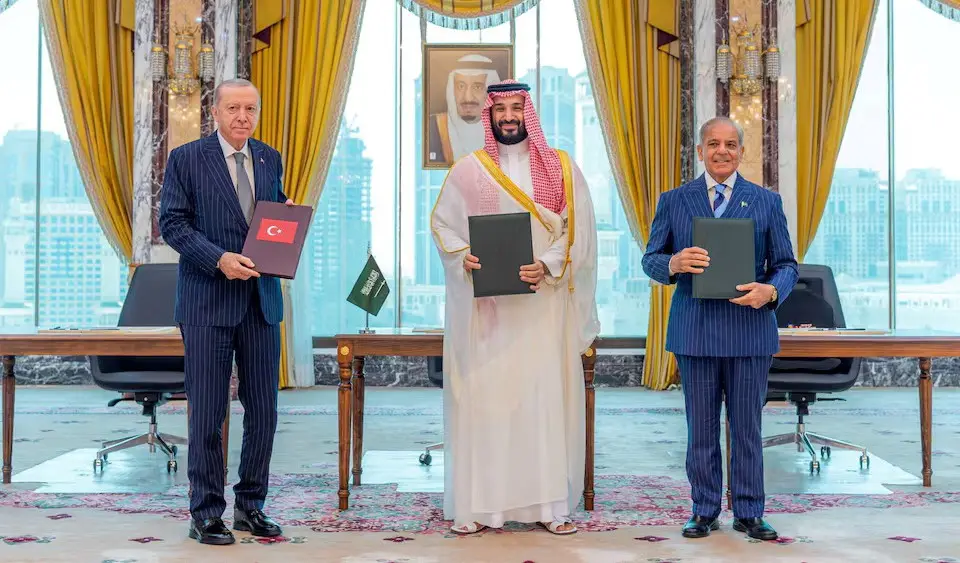
On the 7th of August, three regionally powerful nations of the Muslim world-Saudi Arabia, Türkiye and Pakistan came together and signed a defence pact, the Mecca Joint Defence Agreement (MJDA). The pact was signed in Mecca by Saudi Crown Prince Mohammed bin Salman, Turkish President Tayyip Erdogan and Pakistani Prime Minister Shehbaz Sharif.
The MJDA did not emerge out of nowhere. It built up upon the the earlier Strategic Mutual Defence Agreement (SMDA) between Pakistan and Saudi Arabia, signed on 17th of September 2025 in Riyadh, which committed both states to collective defence and formalized a military relationship. Pakistani forces had already been training Saudi troops for decades before the SMDA was signed. And Türkiye’s entry builds upon a tie that has already existed.
In other words, Mecca Agreement did not invent a new alliance but merged two bilateral relationships that were already intact.
According to the joint statement issued in Mecca, “Any armed attack against any one of the three states shall be regarded as an attack against them all.”
1.2 Why the Need for Mecca Agreement?
To understand the origins of the treaty, we have to look at the environment in the Middle East, a region that has suffered deep instability for years. Conflict, proxy wars and power struggles that have caused the collapse of national or regional security architectures.
Since the end of WW2, many Middle Eastern states relied on Western powers, importantly US for armament, intelligence and balancing against regional threats. Yet this raises dozens of questions and risks, an ally’s interests are not always constant and their priorities do not necessarily align with one’s own. While an Arab state views a conflict as an existential threat, Washington may perceive it merely as a crisis to be solved (Middle East Council on Global Affairs, 2026).
However these relationships with US’s allies made it easier for Washington to pursue its interests in the region, flowing oil, ensuring Israeli security and blocking any nation from challenging the American supremacy in the region. And generally speaking, US was successful achieving its goals despite some setbacks like 1973 Arab oil embargo or 1979 Iranian Revolution. And Washington’s regional allies were vital in maintaining these goals and Middle East security.(Cook, 2026).
Heightened military aggression from both Israel and revolutionary Shi’ite Iran remains a shared concern for the three nations, especially as Washington, their traditional ally struggles to contain the regional instability that has caused a global energy crisis.
2.Strategic Timing and Context
The timing of the agreement was also not incidental. Since April, amid the war involving US Israel and Iran, Saudi Arabia has endured repeated missile and drone strikes, directly from Tehran and its regional proxies- the Houthis and allied militias in Iraq. And Iran’s blockade and domination over the Strait of Hormuz has added another layer of damage to region. None of this, however broken the bond between Washington and Riyadh but it has convinced Riyadh that the bilateral relationship is no longer sufficient. (Al Jazeera, 2026)
Türkiye and Pakistan have avoided the direct attacks from either sides, and both are keen to calm the conflicts threatening their own security or economies. As for Saudi Arabia, since 2023 three years of Middle East conflicts have affected its oil exports and their ambitious development 2030 plans and the big question came over, Is US and their providing security umbrella, really that reliable?
Saudi Arabia, is now looking for other options- such as the Mecca Agreement. It is irrrelevant that Türkiye and Pakistan are unable to bring the kind of military power that US possesses. Saudi Arabia’s strategic point is about autonomy, not replacing one superpower with another. What is important is that Saudi Arabia and their new security partners are seeking a new order that allows them, not US to shape the Arab Peninsula.
When major powers step back, the question of who defines the regional order becomes unavoidable. The central issue is not merely the military leverage of Iran or Israel but the changing structure of Arab Peninsula’s security order. Therefore in that context, The Mecca Treaty should be viewed not as a declaration of war but rather an investment to avert future conflicts.
2.1 Where does the actual credibility start? A Muslim NATO?
The Mecca is intended to strengthen collective ‘’deterrence’’ against any act of aggression and stipulates that an armed attack against any of the three country shall be regarded as an attack on all, as made clear in the statement with a language modelled on NATO’s Article 5.
So the media jumped over the NATO comparison as understandable, pointing out this clause and Article 5. However NATO’s Article 5 is a seventy-five-year-old integrated command structures, standing forces and codified planning, the MJDA does not specify this. (New Arab 2026, Middle East Political and Economic Institute, 2026)
Moreover, since these different countries have diverse threat perceptions, the Iran threat may be viewed as ‘’managable’’ for Türkiye and Pakistan, whereas it is seen as more ‘’direct or aggressive’’ for Saudi Arabia. If the pact acts as a broad cooperation rather than a NATO-style collective defence, its actual enforcement would be limited. Does this agreement truly force Riyadh and Ankara to join Pakistan’s defence in a South Asian War, or if Pakistani and Saudi forces would back Ankara in a potential conflict with Israel in Syria? Given the different threat perceptions, obligatory collective security remains unlikely. Therefore we can describe the MJDA more as a cooperation framework rather than a NATO-like alliance.
The highlighting word would be deterrence as Turkish Vice President Yılmaz stated that the agreement is not aimed at any specific country. And as Türkiye, being tied with the NATO’s priorities, another Turkish offical added that it was purely defensive and did not abrogate any existing agreements the countries had with other states. The joint statement issued by the Saudi Press Agency and Pakistan’s Foreign Ministry describes the agreement’s purpose as strengthening collective deterrence too.(Al Jazeera 2026)
The nuclear question sharpens this. Analyst also noted that it would be unlikely to extend the deterrent source of Pakistan’s nuclear weapons to cover for Türkiye or Saudi Arabia, as Pakistani government made it clear in the past that they reserved these capabilities for solely for Pakistan’s own security interests.
However the statement did not specify the commitment each nation would be willing to give any particular military action in each other’s defence. Türkiye’s Foreign Minister Hakan Fidan has said a state under attack would first have to request assistance and specify what kind of help it wants- whether intelligence, logistics or troops. (Al Jazeera 2026)
These commitments of the Agreement were tested only 2 days after the signing, when Houthis fired on a Saudi Aramco oil refinery in Jazan. Although Saudi Arabia has been under fire from Houthis since July 13, Saudi leaders did not call on their new partners for help. Maybe because they believed Houthi threat isn’t much of a concern or maybe despite the new security agreement Saudi leaders did not believe that Türkiye and Pakistan were eager to join the existing conflict. (Cook, 2026)
However this does not mean that the Agreement is holding any less importance. The significance of the Mecca does not lie solely in its security guarantees, but rather in how it reflects a change in the traditional Middle Eastern regional order.
3. Why Saudi Arabia, Türkiye and Pakistan?
Türkiye has the second-largest military in NATO with its strategic geographical position while Pakistan is the only nuclear-armed Muslim country while maintaining its relationships with the West and China. and Saudi Arabia is home to Islam’s holiest sites and one of the world’s top oil exporters, making these three countries unique contributors to the agreement. Furthermore all three are members of the Organisation of Islamic Cooperation.
Moreover, the geographic reach gives the agreement more significance that’s extending beyond national borders, connecting the Eastern Mediterranean, the Gulf and Indian Ocean. (Middle East Eye, 2026)
Pakistan has provided training to Saudi forces as mentioned in the beginning while Turkey and Pakistan have exchanged warships and training aircraft. And Saudi Arabia is a major purchaser of drones from Turkey. Also, both Pakistan and Turkey voiced support for the Saudi Arabia’s maritime defence coalition to protect regional shipping and energy routes.
For Pakistan, after the recent tensions with India, Pakistan views these alliances to secure vital multi-front military. (Altuwaijri, 2026)
The Mecca Agreement will enable Saudi to finance and fund the projects, while Türkiye provides deep tech equipment and Pakistan provides manpower in the frontline. (“What to Make,” 2026)
The Saudis and Turks have also gone further with proposing a redirection of the rail link that is a part of IMEC. This way, goods would bypass Israel and continue from Saudi Arabia through Jordan, North Syria and finally Türkiye before transshiped to Europe.
4. International Responses
Official Israeli channels remained silent, but Israeli news sources view the pact as an influential ”Sunni Bloc” that threatens Israeli operational flexibility, advising stronger ties with Greece, Cyprus and India.
New Delhi responded cautiously, a spokesperson from the Indian Ministry of External Affairs said India is ”closely following this development”.
Tehran was skeptical yet conditionally positive, regarding the lesser US involvement in the region. Foreign Ministry spokesperson Esmaeil Baghaei stressed that Iran’s final response is dependent on whether the alliance adopts an anti-Iranian stance or not.
As for United States, president Donald Trump made it clear in the past that he did not mind the Middle East finding ways to defend itself. He endorsed the agreement via Truth Social “Very happy to see that Saudi Arabia, Turkey, and Pakistan have recently, and finally, signed the MJDA. It shows that the Middle East is coming together and how countries will finally be able to defend themselves in a more meaningful way.” he wrote. Washington has accused allies of not spending enough on their own defence, framing the deal as a step toward regional self-reliance and US burden-sharing.
5. What Could This Become in the Future?
The MJDA, represents a transformation regarding a decision from a US-guaranteed Middle east order to a self-relied security framework. Signing the pact in Mecca carries another dimension, the alliance coming together in the qibla, the place towards which Muslims turn their hearts, a symbol of unity.
This transformation signals a strategic hedging. Nowadays states refuse to choose exclusively between Washington, Beijing or Moscow. Instead they want to deal with all of them.
Another common ground between signatories is the access to critical maritime spaces. Recent disruptions around the Strait of Hormuz and Bab-el-Mandeb proved that securing the energy routes is vital for countries. Consequently, it is expected that collaboration will include operational capabilities such as joint maritime surveillance, naval intelligence and counter-drone technologies. (Altuwaijri, 2026)
As for the question ‘’Can Mecca really replace the US?’’. Previously, regional rivalries were contained because leaders prioritized their individual relationships with Washington as the central binding tie. Today, the new emerging Middle East can be defined by two frameworks. Firstly, The Abraham Accords bloc, U.S.-centered defence coordination with Israel. Secondly, The Mecca pact which could contribute to a more autonomous regional security framework. Despite the different calculations on Iran, India, Israel and US, the signatories demonstrated a core rule of international relations. The rule that states do not need to fully agree on every issue or conflict, they only need a sufficient enough common ground where joint actions serves their intersts better than acting alone.
The durability and operational reflexes of the agreement will be tested in future crises. It is also dependent on whether Washington will tighten its bonds with Gulf allies after the war with Iran coming to end, or treating the agreement as ‘’Regional powers have more than enough to defend themselves’’(Mohee, 2026). Ultimately, even though some questions remain unanswered the MJDA is the result of strong political will among these nations.
References
Al-Jazeera. (2026, August 18). Trump hails Mecca pact: Can it replace the region’s US security umbrella?https://www.aljazeera.com/news/2026/8/17/trump-hails-mecca-pact-can-it-replace-the-regions-us-security-umbrella
Breaking Defense. (2026, August 7). Saudi Arabia, Turkey, Pakistan ink ‘joint defense’ agreement.https://breakingdefense.com/2026/08/saudi-arabia-turkey-pakistan-ink-joint-defense-agreement/
Cook, S. A. (2026, August 13). The U.S.-led Middle East order is over. The Mecca agreement proves it. Council on Foreign Relations. https://www.cfr.org/articles/the-u-s-led-middle-east-order-is-over-the-mecca-agreement-proves-it
Middle East Political and Economic Institute. (2026, August 8). The Mecca Joint Defense Agreement and the limits of Gulf strategic autonomy. https://mepei.com/the-mecca-joint-defense-agreement-and-the-limits-of-gulf-strategic-autonomy/
Middle East Research and Information Council. (2026, August 12). The Mecca agreement: From imported security to regional joint security. Middle East Council. https://mecouncil.org/blog_posts/the-mecca-agreement-from-imported-security-to-regional-joint-security/
Middle East Eye. (2026, August). Mecca Agreement: Why Saudi Arabia, Turkey and Pakistan teamed up in historical moment. https://www.middleeasteye.net
What to make of a new Saudi-led defence pact. (2026, August 19). The Economist. https://www.economist.com/
Wikipedia. (n.d.). Mecca Joint Defence Agreement. Retrieved August 28, 2026, from https://en.wikipedia.org/wiki/Mecca_Joint_Defence_Agreement