


Economic Coercion and Russia’s Hybrid Influence in Armenia’s 2026 Elections
Introduction
In recent years, democratic elections have increasingly become targets of disinformation campaigns, cyber-enabled influence operations, and other forms of hybrid interference (Hollis and Ohlin 2021). Rather than relying on disinformation alone, actors combine information operations with economic, political, and cyber tools to influence public opinion and shape electoral outcomes (Mazur 2025). These interconnected forms of pressure reinforce one another, making modern influence campaigns more persuasive and more difficult to detect. Economic pressure, for example, can make foreign narratives more believable by creating conditions that appear to confirm them (Wheatley 2020).
The Armenian parliamentary elections of 7 June 2026 illustrate this evolving pattern. Held in the aftermath of Armenia’s gradual geopolitical reorientation towards the European Union (EU) and the deterioration of its traditionally close relationship with Russia, the elections became more than a domestic political contest. They represented a test of competing geopolitical visions for Armenia’s future.
This brief argues that Russia sought to influence the 2026 Armenian parliamentary elections not only through disinformation but also through economic coercion to shape the political environment. By examining how these instruments were used together, it shows that modern election interference increasingly relies on coordinated hybrid strategies rather than on disinformation alone.
Armenia’s Geopolitical Realignment: Between East and West
Historically, Russia has viewed Armenia as an important security partner and a key part of its influence in the South Caucasus region. Following the incorporation of the region into the Russian Empire in the nineteenth century, Moscow developed deep political, economic, and cultural ties with Armenia and continues to view it as a significant strategic ally within its sphere of influence (de Waal 2019). Armenia’s membership in the Collective Security Treaty Organisation (CSTO) and the Eurasian Economic Union (EAEU), together with the presence of Russian military forces, has created a strong dependence on Russia for security and economic cooperation. For Moscow, Armenia’s geopolitical importance extends beyond geography; it serves as a buffer against Turkish and Western influence and enables Russia to project power across the South Caucasus and key regional transport corridors (de Waal 2019).
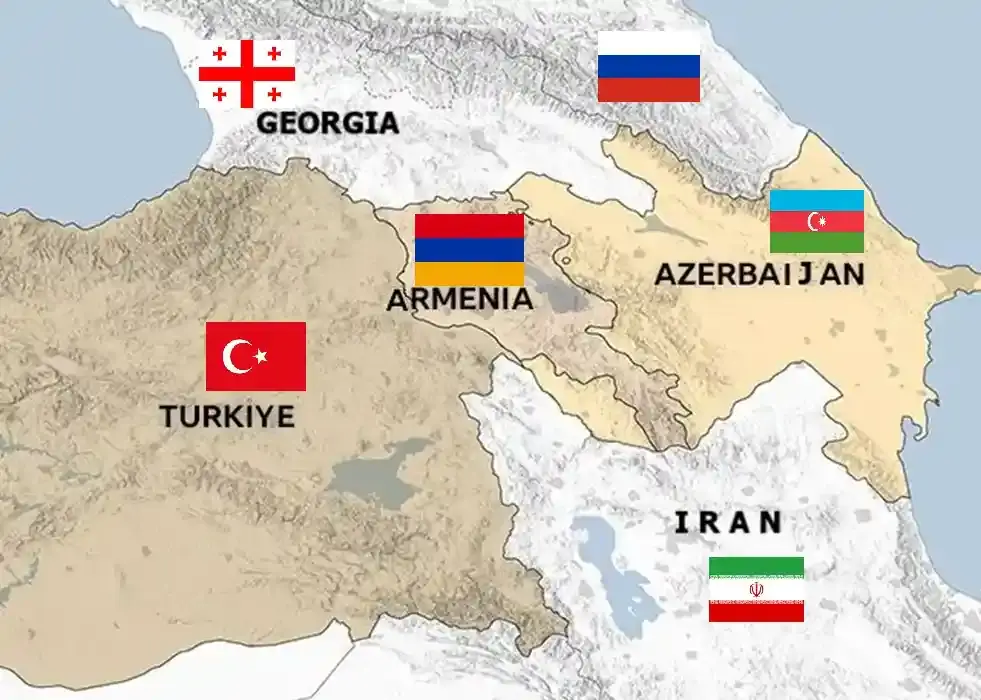
However, this relationship has deteriorated considerably in recent years. Following the 2018 Velvet Revolution, Armenia gradually shifted towards closer ties with the EU, while Russia was increasingly viewed as an unreliable security partner (Sukiasyan, Narek et al. 2026). Moscow was widely criticised in Armenia for failing to provide meaningful support during the 2020 Second Nagorno-Karabakh War, for not intervening during Azerbaijani incursions into Armenian territory in 2022 despite Armenia’s CSTO membership, and for failing to prevent the Azerbaijani takeover and forced displacement of Armenians from Nagorno-Karabakh in 2023 (Caprile 2026). These events significantly eroded public trust in Russia and intensified debates over Armenia’s democratic transformation and geopolitical orientation. Although Russia remains Armenia’s principal trading partner and a crucial energy supplier, Armenia’s growing cooperation with the EU increasingly challenges Russia’s traditional dominance in the region. Consequently, the June 2026 parliamentary elections represented not merely a domestic political contest but a critical test of whether Moscow could preserve its long-standing influence over one of its closest post-Soviet allies.
From a geopolitical perspective, Armenia’s importance to the EU derives from four interconnected factors: (1) its role as a democratic partner in the Eastern Partnership; (2) its contribution to regional stability in the South Caucasus; (3) its position within the EU’s efforts to counter foreign information manipulation and hybrid threats; (4) and its growing significance in emerging connectivity corridors linking Europe and Asia. These factors explain why the EU invested considerable resources in supporting electoral integrity and combating disinformation during the 2026 Armenian parliamentary elections.
Economic Coercion as an Instrument of Information Warfare
Russian attempts to influence Armenia’s 2026 parliamentary elections extended far beyond election-period disinformation. In the months leading up to the vote, Moscow sought to discourage Armenia’s growing alignment with the West by combining economic pressure with information and political influence. These measures reinforced one another, reflecting the logic of hybrid warfare, in which multiple instruments are coordinated to influence a state’s strategic decisions without direct military force (Iskandarov and Gawliczek 2022; Mazur 2025).
Economic coercion became the foundation of this broader influence strategy. As Iskandarov and Gawliczek (2024) argue, asymmetric economic relationships create opportunities for political manipulation by allowing powerful states to impose costs on weaker partners who pursue unwanted policies. Armenia remains particularly vulnerable.
According to the Institute for Human Sciences and Rights, Russian influence operations sought to weaken trust in Armenia’s democratic institutions by exploiting genuine political and economic anxieties rather than relying exclusively on fabricated stories (Shikaryan 2026). This distinction is important: the campaign was persuasive precisely because it was built around real events.
This dynamic became particularly evident in the months leading up to the June 2026 parliamentary elections. As Prime Minister Nikol Pashinyan accelerated Armenia’s rapprochement with the EU and expanded cooperation with Western partners, Moscow responded with a series of coercive economic measures. Russia warned that Armenia could lose preferential gas prices should it continue distancing itself from Moscow. As Russian Foreign Ministry spokesperson Maria Zakharova stated, “The Russian Embassy has officially forwarded a letter… stating that if the process of accession to the EU continues, the Russian side will suspend or unilaterally terminate the Agreement on Cooperation in the Supply of Natural Gas, Petroleum Products and Rough Diamonds.” (Osborn et al. 2026). Russia simultaneously introduced restrictions on Armenian agricultural exports, including fruit, vegetables, flowers, and alcoholic beverages. Although Russian authorities justified these measures on technical grounds, Armenian officials and many observers viewed them as politically motivated attempts to increase the costs of Armenia’s westward orientation (Antonov and Papachristou 2026).
The significance of these measures extended well beyond their immediate economic impact. They also strengthened Russia’s information campaign. Economic coercion alone rarely changes public opinion, but visible economic hardship can make political narratives appear credible. As trade restrictions disrupted exports and uncertainty grew over energy supplies, Russian-linked messaging increasingly portrayed Armenia’s cooperation with the European Union as the source of the country’s economic difficulties.
The narrative was effective because it reversed cause and effect. Russia first imposed economic pressure through trade restrictions and energy threats, then presented the resulting economic costs as evidence that Armenia’s pro-European course was failing. Rather than acknowledging that Moscow itself had created these pressures, Russian-linked messaging portrayed the deteriorating economic situation as proof that closer cooperation with the European Union was harming Armenia’s economy. This framing was echoed by senior Russian officials, who repeatedly warned that closer integration with the EU would bring severe economic consequences. For example, Russian Security Council Deputy Secretary Alexey Shevtsov claimed that EU accession “could cost Armenia as much as 23% of its GDP, trigger inflation, shrink domestic consumption, and significantly reduce living standards” (ARKA 2026). Presented alongside Russia’s trade restrictions and energy threats, such warnings reinforced the impression that Armenia’s economic difficulties were the inevitable result of its pro-European course rather than the product of Moscow’s own coercive measures.
The same logic shaped discussions surrounding Armenia’s membership in the EAEU. Russian officials argued that pursuing closer ties with the EU would inevitably lead to the loss of the economic benefits associated with the EAEU. Russian Deputy Prime Minister Alexei Overchuk echoed this narrative, arguing that if Armenia were “moving toward the EU, it must decide and make a choice about where it should be,” as the two paths may be incompatible (Armenpress 2026).
Economic pressure formed only one component of a broader influence operation. Evidence suggests that Russian-linked actors simultaneously established fake Armenian news websites, coordinated bot networks, supported pro-Russian political actors, and even discussed transporting Russian-Armenian citizens to participate in the elections (Reuters, 2026). Rather than relying on official Russian messaging, the Kremlin-linked Social Design Agency sought to launder pro-Russian narratives through seemingly independent sources. One planning document proposed creating a fake media outlet, Yerevan1, targeting the Armenian diaspora in Russia. Its objective was to undermine Prime Minister Pashinyan while promoting the central message that “Armenia can only prosper in a close alliance with Russia and under its protection” (Balmforth et al. 2026). Simultaneously, another Kremlin-linked influence operation, known as Storm-1516, amplified these broader narratives through fabricated news websites, impersonated media outlets and journalists, and a network of coordinated X(Twitter) accounts and influencers. More than 1,600 posts from around 1,000 X accounts, including 36 accounts with over 100,000 followers, shared Storm-1516 content targeting Armenia, generating millions of views and creating the appearance of independent reporting and widespread public support. The network also increasingly used accounts posing as local Armenian users and fake marketing bots, making pro-Russian messaging appear organic rather than state-directed (Bodnar and N 2026; Schumann and Paternoster 2026).
Taken together, these activities demonstrate that Russia’s election interference extended well beyond the spread of disinformation. Economic coercion, coordinated online manipulation, political mobilisation, and strategic messaging operated as mutually reinforcing components of a broader hybrid influence campaign. Rather than promoting a single political candidate, the overarching objective appears to have been to weaken confidence in Prime Minister Pashinyan’s government and erode public support for Armenia’s westward orientation (Balmforth et al. 2026). Although Moscow denied these allegations, the reported activities illustrate how economic pressure and information warfare can be integrated into a single strategy of political influence.
Outcomes of Russia’s Hybrid Influence Campaign
As the preceding analysis demonstrates, Armenian elections were noted by direct foreign pressure in the form of escalating trade restrictions and security threats during the campaign, while investigations also pointed to coordinated disinformation networks and attempts to mobilise pro-Russian political support.
Despite the breadth of these efforts, the campaign appears to have achieved only limited political success. PM Nikol Pashinyan’s Civil Contract party won almost 50% of the vote, retaining a parliamentary majority and securing another mandate for its policy of diversifying Armenia’s foreign relations and deepening cooperation with the EU and the US (Gallo 2026). Several analysts have argued that Russia’s overt pressure may even have been counterproductive, reinforcing public perceptions that Moscow was attempting to dictate Armenia’s political future (Ålander et al. 2026; Hosaka 2026).
Nevertheless, the results should not be interpreted as evidence that Russian influence was insignificant. Pro-Russian parties still secured roughly one-third of parliamentary seats, ensuring that Moscow retains important political interlocutors within Armenia (Zolyan 2026). Moreover, the elections demonstrated that economic coercion and information operations can shape the campaign environment even when they fail to alter the final electoral outcome.
Armenia’s experience mirrors recent Russian influence operations in Moldova, where Moscow similarly combined disinformation, economic coercion, and support for pro-Russian political actors to shape electoral outcomes and undermine pro-European governments. Unlike Moldova, however, Armenia’s greater dependence on Russian energy and trade gave economic coercion a more prominent role within the broader hybrid campaign, illustrating how Moscow adapts its influence toolkit to the vulnerabilities of individual target states (Cenusa 2026). While Moldova’s vulnerability historically centred on energy dependence and trade restrictions, Armenia’s exposure has been reinforced by its reliance on Russian gas supplies, access to Russian markets, and participation in Russia-led economic frameworks. These dependencies allowed Moscow to frame closer ties with the European Union as economically risky, amplifying narratives that Western integration would bring higher prices, trade losses, and instability (Dubois-Harounyan 2026). Thus, the Armenian case demonstrates how Russia adapts its influence toolkit to the specific vulnerabilities of target states, using economic interdependence not only as a coercive instrument but also as a foundation for information operations to shape public perceptions of geopolitical change.
Conclusion
The Armenian case demonstrates that contemporary election interference extends beyond attempts to manipulate information online. Instead, foreign actors increasingly combine economic, political, and informational tools to shape the environment in which voters make political decisions. By creating real-world economic pressures and then framing them as evidence of the costs of Armenia’s westward orientation, Russia blurred the distinction between coercion and information manipulation. As these instruments reinforce one another, foreign influence campaigns become more persuasive and considerably more difficult to detect and counter. Strengthening electoral resilience, therefore, requires responses that address not only disinformation itself but also the broader hybrid strategies that give such narratives credibility.