



Recognizing this cyclical logic does not mean resigning ourselves to fatalism.
The “global disorder cycle”
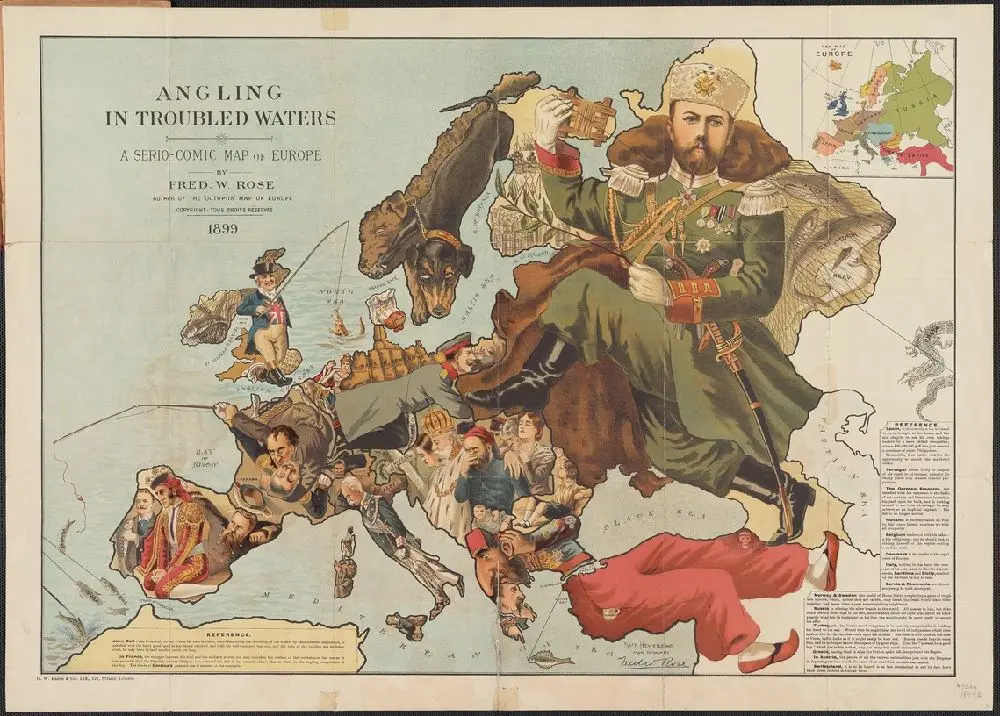
Figure 1 : A comic map of political situations in Europe in 1899 depicting several, made by Fred W. Rose. Yale University Library, source : https://collections.library.yale.edu/catalog/15259160
- Introduction
Since the end of the Seven Years War (1756-1763), observers of international relations have repeatedly been struck by a strange déjà-vu: every violent war that claims to be ‘the last’, ephemeral peace settlements that promise durable stability, and new legal institutions that assert they have finally overcome the violence of the past. Yet, decade after decade, crises return, rights recede, and global disorder resurfaces in different forms but with a familiar logic. This recurrence is too cyclical to be accidental. As Paul Kennedy observed, “the rise and fall of the great powers” (Kennedy, 1987) follows a pattern where economic overstretch systematically precedes political decline, revealing the cyclical — rather than linear — nature of international order It reflects a structural dynamic that brings global history closer to the logic of a market economy than to a linear march toward progress. Just as economies oscillate between growth and recession, the international legal and political landscape alternates between phases of expansion of rights and phases of contraction, where security, sovereignty, or ideology justify such restrictions, or worse, denial.
This cyclical reading can be applied not only to war and peace but also to the development of international law, rights, and liberties. When a major systemic shock occurs – whether an important war, the collapse of an empire, the beginning of an era of peace, or a global pandemic – it is often interpreted as an unprecedented rupture demanding unprecedented responses At each turn, international law is simultaneously invoked as a tool of stabilisation and revealed as fragile, selective, or subordinated to power politics.
The core thesis of this article is not to interpret history through an esoteric approach. The understanding of today’s world, in particular with the rise of uncertainty towards the trajectory of international law, necessarily passes through a factual understanding of history. Periods of apparent stability, legal innovation, and universalist discourse are followed by phases of tension, erosion of rights, and outright collapse. The central interrogation that will follow us is to know if those moments of global disorder are exceptional shocks or predictable phases within a recurring structural cycle.
In the first part, this article will examine how, from the Seven Years War to the dawn of the 20th century, a specifically Western form of cyclical global governance emerged, combining legal expansion and deep structural inequality (I). This article will then show how the interwar period illustrates a typical phase of ‘legal optimism’ without enforcement, where rights progress in theory but regress in practice, preparing the ground for systemic collapse (II). In a third part, this article analyses the Cold War and the immediate post–Cold War era as a moment of controlled expansion and ‘managed disorder’, where law is universalised but applied selectively (III). Finally, this article argues that the post-Covid era should not be seen as an entirely new crisis, but rather as the latest phase of a recurrent recession of rights within this long historical cycle (IV).
From the Seven Years War to the Dawn of the 20th Century: The Emergence of Cyclical Global Governance in the West
Post–Seven Years War Reordering (1763–late 18th century)
The Seven Years’ War (1756–1763) is often considered the first ‘world war’, (Canadian Encyclopedia, 2006) involving major European powers and their colonial possessions. Indeed, the revolution of armament permitted a lot of States to reinforce their influence, such as the Duchy of Prussia and the British Empire. Its outcome, formalised notably in the Treaty of Paris of 1763, profoundly restructured the global balance of power, especially by consolidating British dominance in North America and India (cession of the New France territory to Great Britain). This reordering represents a typical post-crisis phase of systemic stabilisation: after a generalised conflict, the victorious powers attempt to impose a new equilibrium presented as durable and rational.
At the same time, the post–Seven Years War period saw a significant expansion of international trade and early forms of globalisation. Battles of Pondichéry and Abraham Plains, in 1759, testify to the rivalry between France and Britain, not only on the European theater but also about their worldwide claims. Colonial empires extended their reach, maritime commerce intensified, and networks of financial and commercial interdependence deepened between Europe and the rest of the world (French General Trade Chart, 1938). To sustain these flows, imperial powers developed increasingly sophisticated legal frameworks, governing trade and navigation, such as the Ordonnance Royale des Eaux et Forêts (1681), before the war. However, this legal ordering was highly asymmetric: it was designed to secure the interests of metropolitan elites and merchants, not to recognise equal rights for all subjects of the empire, with the example of the maintenance of slavery in the colonies.
Alongside the progression of Europe on the international scene, arts and philosophy started to catch up on the delay taken during the Middle Ages over the Muslim world. Indeed, many thinkers, including Voltaire, Montesquieu, Kant, and Schopenhauer, contributed to the expansion of the Lumières philosophy (a philosophical and intellectual movement defending liberalism, opposed to political and religious oppression during the seventeenth century). Thus, the separation of property and power, in public or private domains, was defined and incorporated, especially during the French Revolution, into legal frameworks, such as Constitutions and laws. This led to, despite some short-lived eras of recession (the Terror, 1793-1794), a brutal dictatorship led by the Public Salute Committee ; despite this episode, a constant progression within the States that was later diffused through French conquests over the continent.
Here we see the first fundamental tension that will characterise later cycles: economic expansion goes hand in hand with an evolution of the legal framework, sometimes selective and uneven recognition of rights. In Europe and North America, debates on natural rights, sovereignty of peoples, and constitutional limitations on power intensified, especially in the wake of the American and French Revolutions.
2.2. The 19th Century: Legal Expansion and Structural Inequality
The 19th century is often read as the century of constitutionalism, liberal thought, and the codification of rights in Europe and North America. Through the Napoleonic Code, the diffusion of constitutional charters, and the generalisation of parliamentary institutions are usually presented as milestones in the progress of the rule of law: the most durable legal revolution of the modern era ( Carbonnier, 2002). The Napoleonic Empire (1804-1815) and various forms of enlightened despotism, in Prussia, Russia and Sardinia, combined, in different proportions, modernisation of state structures, rationalisation of law, and recognition—at least for certain categories—of civil and political rights. The vassalisation of Europe under the rule of the French Empire led to the establishment of property protection and commercial frameworks (such as the Code du Commerce, 1807). After this era of wars, the stabilisation of borders in mainland Europe and the expansion of the United States westwards led to a significant era of development.
Yet, this expansion was accompanied by deep structural inequalities. While some European states gradually abolished serfdom and recognised broader civil rights, they simultaneously maintained or expanded systems of colonial domination. The abolition of slavery, in particular, was often tardy and ambiguous: France reinstated slavery, although it was abolished in 1794 (Victor Hugues’ Declaration, 1794). In Eastern Europe, Russian imperialism weighed heavily on territories like Poland, Courland and Finland, subject to partitions, repression, and denial of national self-determination, often resorting to serfdom. During the conquest of the American West, the United States chased amerindian lands, in order to expand, deporting them, while developing its own cities on the East Coast.
On the international level, law was less a universal normative system than a tool of stability for dominant powers.. The Holy Alliance, bringing together Russia, Austria, and Prussia, sought to preserve the monarchical order and contain revolutionary movements under the guise of preserving European peace: the balance of power, despite national revendications in Italy, modern-day Germany, led to a relative stability in order to maintain peace on the continent. Interventions and non-interventions were justified not by the protection of self-determination, but by the defense of an order favorable to great powers.
3. The Interwar Period: Legal Optimism and Structural Regression
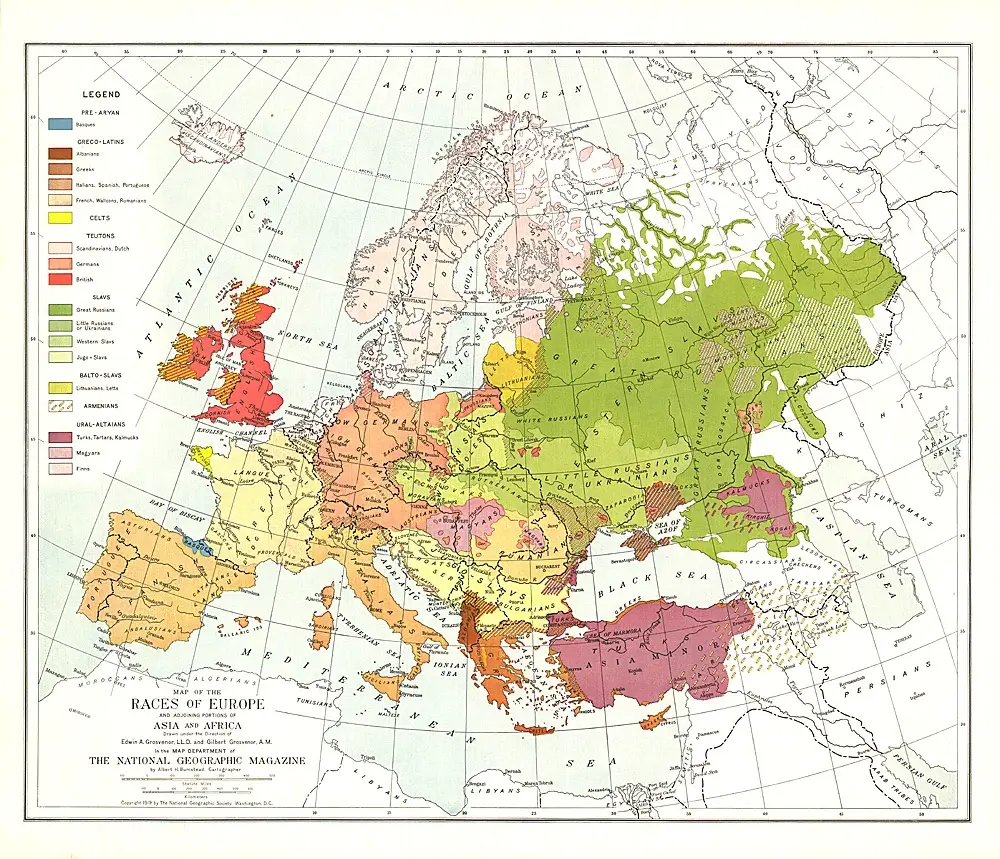
Figure 2 : Map of the Races of Europe at the end of World War I, as the Treaty of Versailles is defining new borderlines. National Library of Australia, source: https://nla.gov.au/nla.obj-280523200/view
3.1. Post–World War I Reconstruction without Enforcement
The end of the First World War inaugurated a new phase of legal optimism. In response to the unprecedented devastation of 1914–1918, the victors sought to build an international order based on collective security and law, rather than on a mere balance of power. The creation of the League of Nations and the development of new legal norms were intended to prevent the return of such a conflict. The famous Lotus case of 1927 (often dated 1923 in abbreviated references) symbolised a moment when international law, and particularly the Permanent Court of International Justice, appeared capable of settling disputes through legal reasoning rather than violence.
However, this reconstruction suffered from a decisive flaw: the lack of binding and effective enforcement mechanisms. While states proclaimed their attachment to collective security, they remained reluctant to accept strong constraints on their sovereignty. The reluctance to intervene during crises such as the occupation of Sankt Veit an der Flaum (1918), or the Russian Civil War (1917-1923), illustrates this dilemma: the fear of provoking a new large-scale conflict led to a policy of minimal to non-intervention, even when violations of norms were obvious. Sanctions, when they existed, were limited and inconsistent: embargos remained rare and often ineffective, and no serious measures were taken against Japan or Italy when they engaged in acts of aggression.
Concrete cases reveal this structural weakness. The Memel dispute (Freistaat Preußen v. Lietuva, 1920), and the Volhynia question exacerbated the tension between the new States. Linked to the League of Nations’ mandates, such as Cameroon, Palau Islands, and Japan (1919), or the Sykes–Picot Agreement of 1916, showed how the new order largely preserved the interests of former colonial powers.
3.2. Rights Expansion in Theory, Retraction in Practice
At the normative level, the interwar period also saw significant advances in the recognition of minority rights and the principle of self-determination. The creation of new states such as Czechoslovakia and Yugoslavia, the system of minority treaties, and the rhetoric of national self-determination seemed to mark a decisive break with the imperial logics of the 19th century. On paper, more groups than ever before were recognised as subjects entitled to protection and representation. Women, in some states, were even granted the right to vote, in Hungary, Poland, or the United Kingdom, all in 1918.
Nevertheless, these advances were undermined by economic instability and social unrest. The Great Depression, mass unemployment, and social conflicts eroded confidence in liberal institutions. The Spartacist uprising in Germany revealed the fragility of the young Weimar democracy and the radicalisation of political struggles, which was also intensified by the evolution of authoritarianism, such as Austria, Hungary, Romania, or, more notably, Poland, with the Constitution of the 3rd of April 1935. In many states, emergency powers—initially presented as temporary—gradually became normalised, leading to a considerable recession of rights, even in democracies. In France, for instance, the administration was given a lot of power through law-decrees, especially with the political violence resulting from the end of the war (law of the 24th March 1924).
In this sense, the interwar period is a textbook example of a cycle where rights expand in theory but retract in practice. This gap between normative ambitions and political reality is precisely what Eric Hobsbawm characterised as the “Age of Catastrophe” (Hobsbawn, 1994) – a period where the institutions of liberal democracy proved structurally incapable of resisting the combined pressures of economic crisis and nationalist extremism. The apparition of fascism was the ultimate nail to the coffin of the global peace hopes.
3.3 The Interwar Years as a Failed Stabilisation Phase
Far from consolidating a new stable order, the interwar years can be interpreted as a failed stabilisation phase within the historical cycle. International law proved largely incapable of absorbing economic and political shocks. Institutions such as the League of Nations lacked both legitimacy in the eyes of some major powers and the instruments necessary to constrain others. Each new breach – Japanese expansion in Asia (since 1932), Italian aggression in Ethiopia (1936), Germany’s rise of power in Europe – eroded a little more the credibility of the system.
At the same time, civil liberties were progressively eroded in several states before the outbreak of overt conflict: the Reichstagsbrandverordnung zum Schütz von Volk und Staat (Reichstag’s Fire Decree, for People’s and State’s protection), of the 28th February 1933, prohibited communist journals and limited liberty of movement, expression, and the press Bundestag, 2006). This example shows how legislation was used, after the blaze of the Reichstag, probably caused by the nails themselves, in order to constrain the population. The violent rupture of the 1939–1945 war was therefore not an unexpected accident, but the culmination of a contraction phase already well advanced by the remilitarisation of the Rhineland (7 March 1936), the annexation of the Sudetenland (30 September. 1938), and the claim of Memel (20 March 1939). Totalitarianism appears as the extreme expression of this logic: a regime in which law is absorbed by ideology, and where rights are sacrificed in the name of security, nationalism, or racial myths.
The interwar period thus confirms the cyclical hypothesis: after a war that was supposed to end all wars and a legal re-foundation presented as a guarantee of peace, structural forces of regression reasserted themselves. The failure of this stabilisation phase paves the way for a new systemic collapse, which will, in turn, give birth to a new phase of legal reconstruction after 1945.
4. The Cold War Era and the Post–Cold War Moment: Controlled Expansion and Managed Disorder
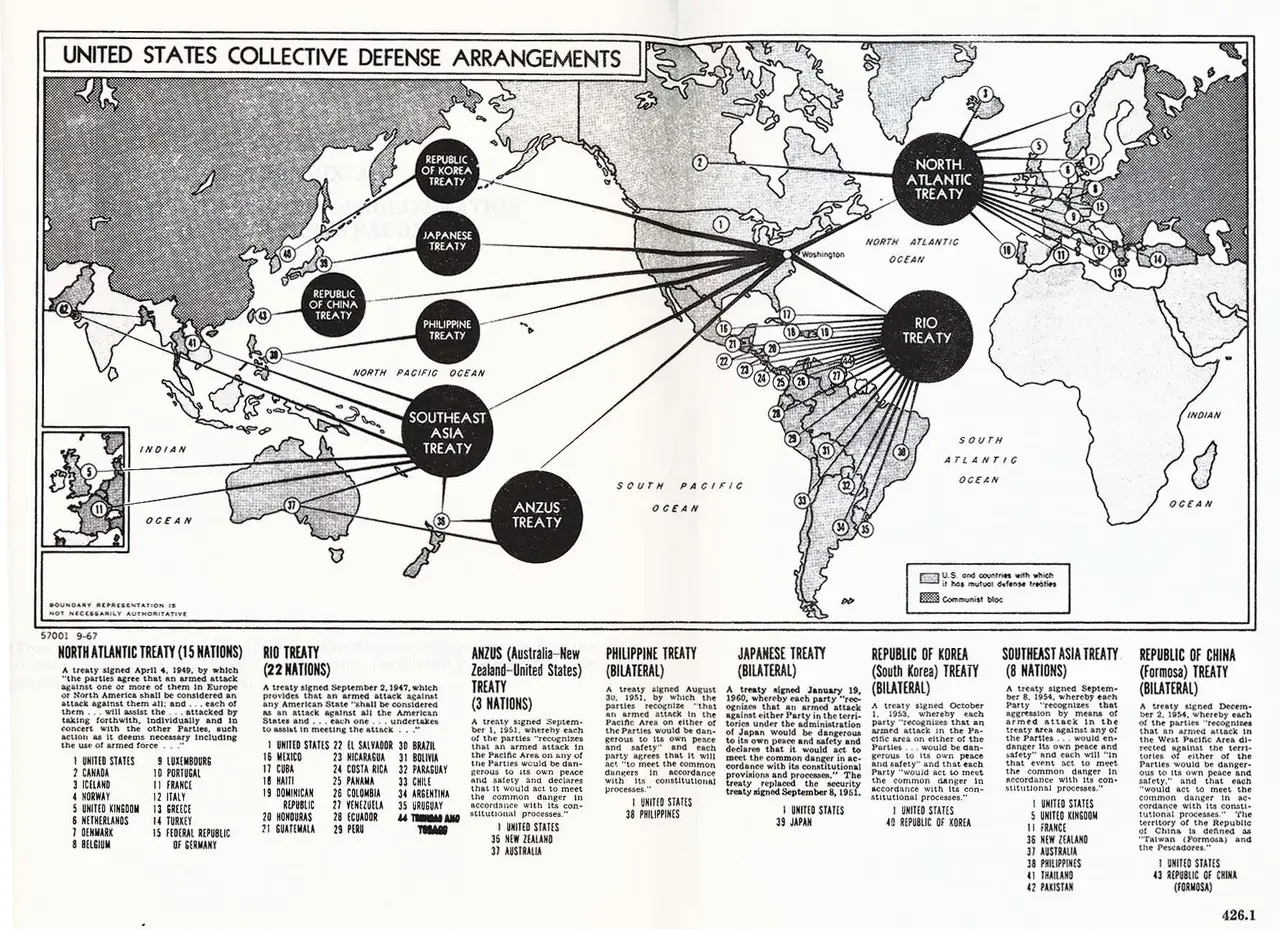
Figure 3 : Map from the US department of State, 1967, deputizing the different defense agreements throughout the ‘Western Bloc”, Library of Congress, source : https://www.loc.gov/resource/g3201f.ct004057/?r=-0.12,-0.024,1.25,0.739,0
During the Cold War, global order was characterised by a paradoxical combination of relative stability between superpowers and intense, often violent, conflicts in the so-called ‘Third World’. Rights protection was frequently subordinated to ideological alignment. Western powers and the Soviet bloc both supported regimes that committed serious human rights violations, as long as they remained strategically loyal. In Asia, the case of the Khmer Rouge and Pol Pot is emblematic: despite atrocities and genocide, political and diplomatic considerations long impeded a coherent international response, such as the China and the USSR massively helping the dictatorship with material and trade, in order to maintain the repression.
International law was applied inconsistently, depending on strategic interests. The case Military Activities in Nicaragua (International Court of Justice, 1987) show very much this logic : the United States of America did not respect international law, in order to act against the left-wing regime that was elected in the country ; and this happened while the Western Bloc was condemning the repression and occupation of Czechoslovakia in 1968, after the Prague’s Spring, a peaceful revolution against the communist authoritarian regime.
Meanwhile, in formally democratic states such as France, post-war restrictions on certain liberties—linked to colonial wars or internal security concerns—were regularly contested, notably during the events of May 1968. This led to the end of the emergency powers’ application in France, as the Général De Gaulle exercised them for almost ten years.
From the perspective of the cycle, the Cold War appears as a phase of controlled expansion and ‘managed disorder’. Legal frameworks proliferated, and institutions multiplied, but their application remained highly selective. Global stability between superpowers, based on deterrence and spheres of influence, masked localised legal regressions and recurrent conflicts. Law functioned as both an instrument of legitimation and a terrain of ideological competition.
4.3 The Post–Cold War Expansion (1990s–early 2000s)
The end of the Cold War was widely interpreted as the opening of a new era of peace and legal progress. The collapse of the Soviet bloc, alongside the spread of electoral democracies, and the strengthening of international institutions fed a discourse of “end of history,” famously theorised by Francis Fukuyama: “what we may be witnessing is not just the end of the Cold War, but the end of history as such” (Fukuyama, 1992). International criminal law experienced an unprecedented boom with the creation of ad hoc tribunals and the International Criminal Court.
This era led to the European Charter of Fundamental Rights in 2000, the Treaty of Lisbon (2009), which included themselves in the dynamic of recognition of human rights, as the Cairo Declaration (1990) was following the European example.This period reached a peak of legal optimism. Rights and liberties seemed destined to progress irreversibly, while neoliberal economic globalisation extended its norms until the 2007–2008 financial crisis.
5. The Covid and Post-Covid era: A Contemporary Recession of Rights
5.1. The Pandemic as a Catalyst, Not a Cause
The Covid-19 pandemic is often presented as an unprecedented event that suddenly disrupted global governance and domestic legal orders. Yet, in a cyclical perspective, it appears more as a catalyst than a true cause. The crisis accelerated pre-existing trends rather than creating them ex nihilo: distrust toward institutions, rise of populism, growing tensions between security and rights, and fragmentation of multilateralism were already visible well before 2020. Measures initially presented as temporary—lockdowns, curfews, suspension of certain freedoms—tended, in many countries, to be extended, renewed, or transformed into ordinary instruments of governance. Giorgio Agamben, in the Stato di Eccezione (State of Exception), 2005, said that “the state of exception tends increasingly to appear as the dominant paradigm of government in contemporary politics”. Executives saw their authority expand at the expense of parliamentary oversight and judicial review. In some cases, emergency rhetoric served to justify restrictions that went well beyond strictly sanitary necessities, targeting political opposition or disfavored minorities.
5.2. Long-Term Consequences for Rights and Liberties
The long-term consequences of this phase for rights and liberties are considerable. Restrictions on freedom of movement, assembly, and privacy risk becoming semi-permanent in the name of public security, health, or the fight against new threats. Many events are now completely protected, allowing trespass of property, in order to avoid new islamist attacks, such as Christmas Markets or Technological surveillance – via contact-tracing applications, biometric data collection, or algorithmic monitoring – has been justified as a rational and neutral response to crisis management. However, once these tools are in place, it is often difficult to roll them back, especially when they serve other political or administrative objectives. The French état d’urgence sanitaire (sanitary emergency state) allowed a total quarantine of the population, which even the justice confirmed (Conseil d’État, 2020).
At the international level, trust in norms and institutions has eroded. Disputes over vaccine distribution, border closures, and divergent national strategies have fueled the perception that multilateralism is unable to provide fair and effective responses. Some states have openly challenged the authority of international organisations, while others have used the crisis to reinforce discourses of sovereignty and control. This dynamic contributes to a broader questioning of the universality of rights, increasingly presented as relative or negotiable depending on circumstances.
5.3 Signs of a Broader Cyclical Contraction since the Covid era
Following the investiture of Trump to the White House, in the context of an international rise of tension, especially with the Russian war against Ukraine (since the 24th February 2022), the sign of a broader contraction appeared as evidence.
International law, already weakened by different interventions, is nowadays living a hard time since 2026. Following the different conflicts happening during the several months of the year, from the invasion of Venezuela on 3rd January 2026, by the Operation Absolute Resolve (Ourbak, 2026), the war between Pakistan and Afghanistan (since the 21st February 2026), and the open war since the American strikes on the Islamic Republic of Iran (since the 27th February 2026).
This boiling international context may remind us of the interwar times, especially the 1930s. Indeed, even in internal affairs, States tend to limit rights and to follow a sort of laissez-faire. In Europe, since the islamist wave of terrorist attacks, many states have opted for emergency power, and still use them: in France, emergency powers are still used by the Government (Défenseur des Droits, 2024), and the Défenseur des Droits, a constitutional and independent authority, altered on the recession of such rights. This contraction is also visible in other States, outside Europe: in Iran, where many young protesters were killed by the Police and Army.
6. Conclusion
In conclusion, it can be argued with relatively little risk that history, like the economy, advances through oscillations rather than in a straight line. It moves backward and forward, alternating phases of expansion and phases of contraction. Although societies evolve and norms are reformulated, they tend to repeat the same patterns and mistakes, resulting in a cycle of recession and progression in rights, especially in international relations. Recognizing this cyclical logic does not mean resigning ourselves to fatalism, but it does invite us to approach each episode of ‘global disorder’ not as an unprecedented accident, but as a moment that reveals, once again, the persistent structural tensions at the heart of global governance: still, citizens of States are also a part of the process, influencing the conduct of politics and the possible shrinking, or expansion, of their rights.
Reference List
Agamben, G. (2005). State of Exception.
Canadian Encyclopedia. (2006). Canada and the Seven Year’s War.
Carbonnier, J. (2002). Droit civil — Introduction, PUF, collection Thémis, 2002.
Conseil d’État. (2020). Syndicat Jeunes Médecins decision. https://www.legifrance.gouv.fr/ceta/id/CETATEXT000041782274/
Défenseure des Droits. (2024). Annual Activity Report. https://www.defenseurdesdroits.fr/rapport-annuel-dactivite-2024-communique-de-presse-836
Deutsche Bundestag. (2006). The Enabling Act of 23 March 1933. https://www.bundestag.de/resource/blob/189778/enabling_act.pdf
French Ministry of Economy. (1938). General Trade Chart.
Fukuyama, F. (1992). The End of History and the Last Man.
Hobsbawm, E. (1994). The Age of Extremes: The Short Twentieth Century, 1914–1991.
International Court of Justice. (1987). Military Activities in Nicaragua case.
Kennedy, P. (1987). The Rise and Fall of the Great Powers: Economic Change and Military Conflict from 1500 to 2000.
Moyn S. (2010). The Last Utopia: Human Rights in History.
Ourbak, B. (2026). Operation Absolute Resolve : the ordering of the American order, https://www.frstrategie.org/publications/notes/absolute-resolve-mise-ordre-bloc-americain-2026


