


Because of this dual approach, Italy resolves the traditional tension between national autonomy and allied dependency, ensuring at the same time integration with European members and national autonomy
The Italian Blueprint for Space Security: Deterrence, Awareness, and European Integration
In 2019, NATO announced a groundbreaking strategic shift, recognising space as an operational domain. This meant that the securitisation of space was no longer a future theory but became a current operational reality. However, while superpowers can afford to invest huge resources in this new competitive frontier, European nations do not have the same economic availability, risking being caught in the middle and squeezed out. The situation requires a European approach that strategically uses its limited resources to remain on the cutting edge.
To present a possible solution, this article utilises Italy as a case study to show which pathway can be undertaken in the future by European neighbours. Italy has indeed updated its strategic posture with the establishment of the Space Operations Command (COS) in 2020, shifting towards a framework that relies on resilience rather than offensive capabilities. This analysis breaks down the Italian approach into three core pillars. First, it examines Deterrence by Denial, the main concept behind the Italian strategy that focuses on making the space architecture extremely resilient to deflate any hostile attacks as structurally ineffective. Second, it addresses the absolute priority to achieve Space Domain Awareness (SDA) to enable threat attribution. Lastly, it moves away from the operational aspect to understand how the Italian approach is committed to finding a balance between maintaining sovereign capabilities and pursuing an integration within NATO and EU architectures. These elements lead to the conclusion that the Italian strategy should not be interpreted as a localized defence project, but rather as an operationalization of the 2023 EU Space Strategy for Security and Defence, showcasing a practical blueprint for other European countries
Released in 2023, the EU Space Strategy for Security and Defence asked European countries to develop better capabilities to enhance the resilience of their space infrastructures. Borrowing the exact words from the document, the EU, rather than focusing exclusively on the development of offensive capabilities, demands to “harden” and develop dual-use systems to address hybrid threats, such as spoofing and jamming, as well as kinetic attacks (European Commission, 2023). In line with this need, requested by Brussels and given the lack of real anti-satellite capabilities and the economic resources to develop them, Italy has adopted the Strategy of Deterrence by Denial as the only viable option. Hence, since deterrence based on the threat of a retaliatory attack would not be taken seriously, the aim of this strategy is to dissuade the adversary from attacking in the first place. The logic behind it is to build the whole architecture with enough absorption capability to bear attacks while still ensuring operability, thus eliminating the so-called “single point of failure”. This means that no single target exists; for an attack to be successful, an adversary would have to undertake multiple simultaneous strikes.
Italy operationalises this denial strategy through two main technological vectors: architectural redundancy and signal hardening. Regarding redundancy, Italy does not rely on a single, highly vulnerable satellite. Instead, it leverages distributed architectures such as the radar-based COSMO-SkyMed constellation and the newly launched IRIDE program (Agenzia Spaziale Italiana [ASI], 2020; ASI, 2024). The former was conceived to satisfy both civil purposes, like environmental and emergency issues, and the military needs of the Ministry of Defence. The IRIDE program, instead, is conceived as a “constellation of constellations” in Low Earth Orbit with over 70 operational satellites. Moreover, IRIDE has been designed to be Italy’s first “End to End” space system, meaning that Italy controls the entire value chain, from the Upstream segment, satellites in orbit, to the Downstream and Service segments, where data are analysed and distributed (Mastracci & Geraldini, 2023). Italy has achieved this technological sovereignty using funds provided by the EU, showing a direct usage of European resources in line with Brussels' security mandate (Dipartimento per la trasformazione digitale, 2022; Mastracci & Geraldini, 2023).
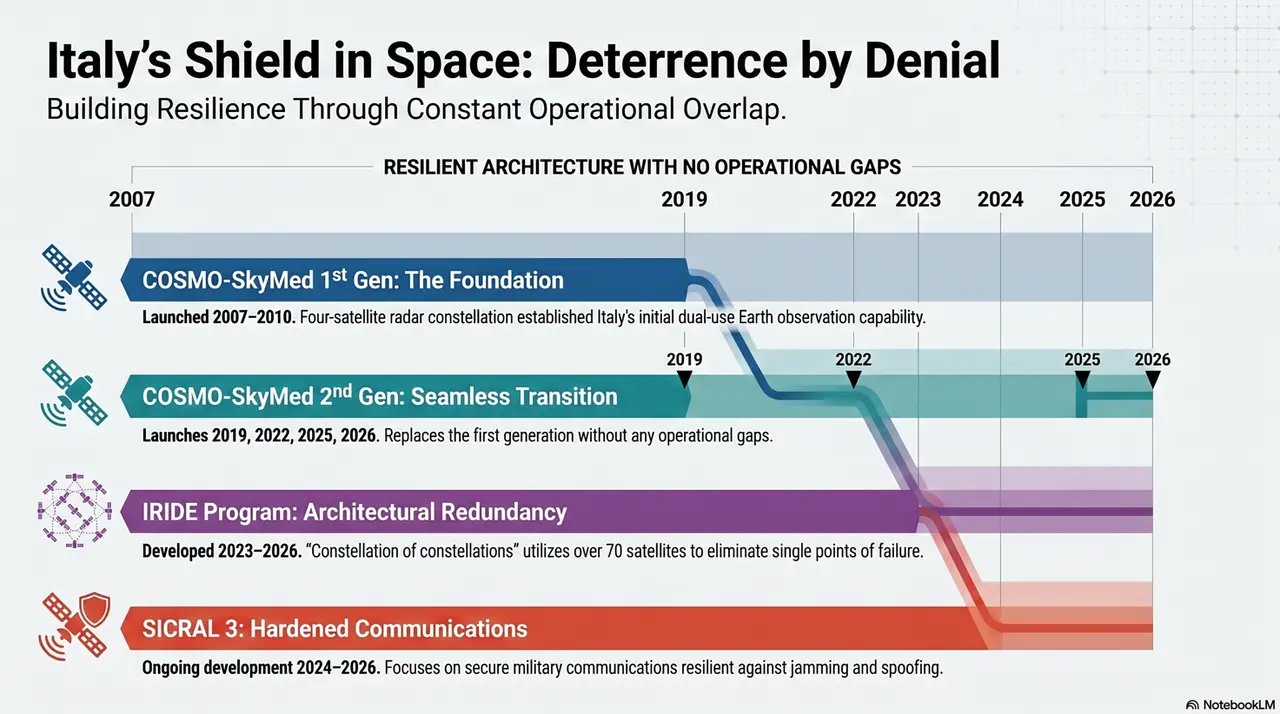


In the field of signals, to address the EU’s demand for safeguards against interference, Italy applies technological hardening through its military satellite SICRAL family (ASI, 2024). Designed to secure military and institutional communications, this system utilises protected frequency bands that make a possible disruption much more complicated. Once again, the core point of the strategy unfolds here: if signal disruption or spoofing becomes complex and highly costly, adversaries will be dissuaded from attempting electronic warfare. As well as with IRIDE, the upcoming generation of SICRAL is also being developed using European funds allocated under the PNRR, highlighting a direct commitment to Europe’s requests.
To quote once again the EU Space Strategy for Security and Defence, Brussels, acknowledging a deficit in the awareness of what happens in orbit, demands member states to increase a “shared understanding” and a better “Threat Response”. For a mid-sized power pursuing the Deterrence by Denial strategy, the strict precondition is having the ability to attribute with certainty the threat's origins. Moving toward these directions, the newly published Italian Documento Strategico di Politica Spaziale Nazionale places as a priority the strategic leap from Space Situational Awareness (SSA) to Space Domain Awareness (SDA) (Rossi, 2026). The first one is limited to mere data gathering of space hazards and is unfolded into three main components: Space Surveillance and Tracking (SST) for space debris, Near-Earth Objects (NEO), and space weather. SSA identifies what is in space, but it is only through SDA that the understanding becomes more complex, involving the intentions of the actors operating in orbit. The establishment of the Comando delle Operazioni Spaziali (COS) is in line with this new priority of enhancing Italian ability and comprehension of outer space, a context in which security is no longer guaranteed, both due to the high presence of space debris and the competitiveness the domain is witnessing. To achieve this awareness, the COS relies on a network of sensors, including advanced optical telescopes and radars that are jointly operated by the Italian Space Agency (ASI), the Ministry of Defence, and the National Institute for Astrophysics (INAF), showcasing the strict link between civil and military purposes.
This Italian national triad operates within the European Union consortium EU-SST (European Space Surveillance and Tracking), established to share information between member states about the risk of space debris. Italy has been appointed with the exclusive leadership and responsibility for continental re-entry, calculating the trajectory of “dead” satellites, and in-orbit fragmentation services, tracking and analysing the consequences of orbital collisions. The operational core of this architecture is the ISOC (Italian SST Operation Centre), located at the Pratica di Mare military base and managed by the Italian Air Force, which works in strict synergy with the C-SSA (Space Situational Awareness Centre) in Poggio Renatico (ASI, 2020; ASI, 2024). This joint military and civil effort is fed by sovereign sensors of absolute excellence, including the Sardinia Radio Telescope and the Croce del Nord radio interferometer. Furthermore, Italy is significantly enhancing its discovery capabilities through the deployment of the innovative "Flyeye" telescope. Developed in collaboration with ESA and the National Institute for Astrophysics (INAF), this asset features a unique optical design that positions Italy at the forefront of rapid space object tracking. By relying on these advanced physical assets, Italy transforms raw observational data into actionable intelligence for Europe. (ASI, 2020; ASI, 2024).
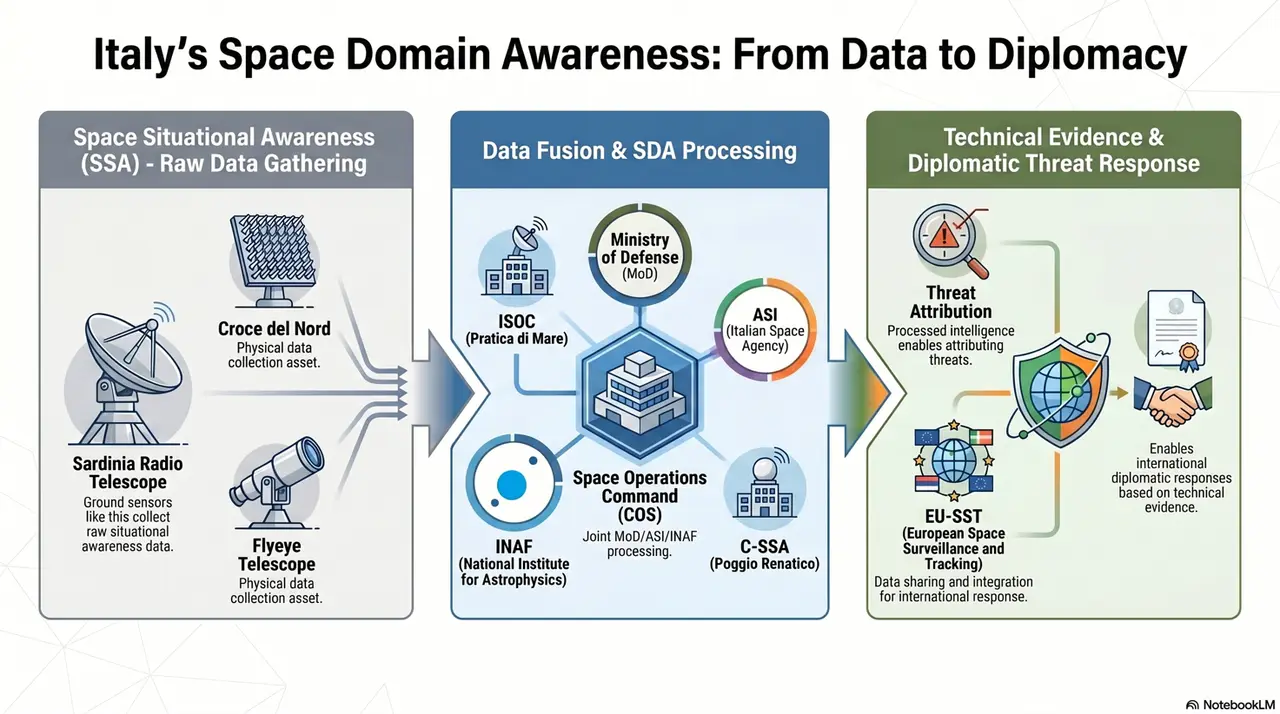
From a policy perspective, this integration represents a paradigm shift. By systematically sharing the intelligence gathered by its sovereign sensors and processed by the joint efforts of the Space Operations Command (COS) and the Italian Space Agency (ASI), Italy transcends its national defence mandate to act as a definitive “net security provider” for Brussels. This posture directly bridges the critical capability gap lamented by the 2023 EU Space Strategy for Security and Defence, which identified Europe’s fragmented intelligence as a primary vulnerability. It provides European institutions with the technical evidence required to attribute threats and trigger diplomatic sanctions.
The last criticality that any mid-sized space power must face is to balance the need to secure sovereign capabilities with being integrated in a broader defence architecture. In our case, this friction is exacerbated by the rise of commercial actors, mostly non-European, that are increasingly playing a prominent role. The risk is to not find any other alternatives than relying on these external and private providers for strategic assets, leaving exposed vulnerabilities. To prevent this eventuality, Italy has introduced a “Space Bill” that established a “reserve of national satellite transmission capacity”, mandating that critical institutional communications must be operated exclusively by European Union or NATO entities. This legal measure serves to keep any external actor outside of Italian strategic networks. (Rossi, 2026; SkyTG24, 2026)
Moreover, this legislative boundary goes hand in hand with the broader Italian context, that can be defined as “Deterrence by Entanglement”. Indeed, Italian space architecture is intimately linked with allied networks: the broadband system Athena-Fidus is operated jointly with France (Arrigo, 2021; ASI, 2024), while the Space Operations Command (COS) channels critical data directly into the NATO Space Centre. Consequently, an adversary attempting to blind Italian space assets would inevitably disrupt allied operations. This tripwire effect drastically raises the geopolitical stakes, carrying the implicit risk of triggering NATO’s Article 5 collective defence clause.
Furthermore, after the announcement by the European Union to launch the GOVSATCOM program and Secure Connectivity, better known as IRIS² (ASI, 2024)., conceived to secure communications, Italy has shown a dual approach. On one side, supporting the integration by finalizing the Ital-GovSatCom, funded by the national Space Economy Plan (ASI, 2024), respecting the European GOVSATCOM requirements. On the other side, in the meantime that the European architecture is implemented, Italy is hardening its national military communications with the development of SICRAL 3, once again thanks to EU funds.
Because of this dual approach, Italy resolves the traditional tension between national autonomy and allied dependency, ensuring at the same time integration with European members and national autonomy. Beyond the European and NATO frameworks, this balancing act extends globally through a proactive "Space Diplomacy". A prime example is Italy's strategic partnership with the United States regarding the Artemis program. In October 2020, Italy became one of the original eight founding signatories of the US-led Artemis Accords (ASI, 2020b; National Aeronautics and Space Administration [NASA], 2020). Notably, Rome took this decisive step amidst the initial political silence of other major European players like France and Germany, thereby securing a leadership role in the future of lunar exploration (Arrigo, 2021; Piccin, 2024). This proactive posture demonstrates that Italy does not limit itself to regional defense; it acts as a privileged diplomatic hinge, bridging European strategic autonomy with the broader transatlantic vision for the peaceful and sustainable use of outer space.
Conclusion
The analysis of Italy’s strategic and operational framework reveals that securing the extra-atmospheric environment does not necessarily require the deployment of offensive capabilities or the triggering of an unsustainable arms race. By combining the resilience of dual-use systems and achieving Space Domain Awareness, the Italian posture perfectly meets the demands outlined in the 2023 EU Space Strategy for Security and Defence. Moreover, Italy is showing an increased commitment towards space, allocating more financial resources and establishing a national legal framework. The Italian model proves that European strategic autonomy does not mean isolation. By transforming sovereign technological capabilities into a cohesive, interoperable defensive shield, Italy offers a highly practical and scalable blueprint for other European nations to secure the continent’s critical extra-atmospheric infrastructure.
References
Agenzia Spaziale Italiana [ASI]. (2020a). Documento di visione strategica per lo spazio 2020-2029. Retrieved from ASI Official Documents.
Agenzia Spaziale Italiana [ASI]. (2020b, October 13). ARTEMIS, siglato il primo accordo multilaterale di cooperazione internazionale. ASI Press Release.
Agenzia Spaziale Italiana [ASI]. (2024). Piano triennale delle attività 2024-2026. Retrieved from ASI Official Documents.
Arrigo, G. (2021, November 30). L’Agenzia Spaziale Italiana e la cooperazione internazionale. Direzione Affari Internazionali, Agenzia Spaziale Italiana.
Dipartimento per la trasformazione digitale. (2022). Spazio: siglate le Convenzioni PNRR con ESA e ASI. Governo Italiano.
European Commission. (2023). EU Space Strategy for Security and Defence. European External Action Service.
Mastracci, F., & Geraldini, S. (2023). IRIDE: dai servizi definiti dall'utente alle costellazioni di satelliti, il primo sistema italiano end-to-end di osservazione della Terra da satellite. mediaGEO.
National Aeronautics and Space Administration [NASA]. (2020). The Artemis Accords: Principles for a safe, peaceful, and prosperous future in space.
Piccin, S. (2024, February 21). Cosa sono e perché sono importanti gli Accordi Artemis? Intervista ad Antonino Salmeri. AstroSpace.it.
Rossi, C. (2026, May 15). Cosa prevede il nuovo Documento strategico di politica spaziale nazionale. Startmag.
SkyTG24. (2026). Meloni al Comint, approvato il Documento strategico di politica spaziale nazionale. Sky Italia.

