




An Analysis of the Strategic, Industrial, and Political Implications of Domestic Interceptor Manufacturing
Washington is facing a severe munitions shortage whose consequences are strategic. After six months of campaign, the United States (US) Operation Epic Fury against Iran has exhausted the stocks of these munitions.
Advanced interceptors such as Terminal High Altitude Area Defense (THAAD) and Patriot Advanced Capability-3 (PAC-3), alongside long-range strike systems including the Army Tactical Missile System (ATACMS) missiles, Precision Strike Missile (PrSM), and Tomahawk missiles, are produced too slowly, at high cost, and in limited numbers.
Time constraint for refurnishing the stockpiles and shared production lines mean that reconstitutions of the inventories will take years. Washington has to prioritize between restocking its own forces or honouring allied orders, while rivals might exploit the window of opportunity. Thus, how far is the US shortage of interceptors and long-range strike missiles? And, what does the reconstitution gap mean strategically for the US? What follows examines the weapons at issues, the structural origins of the munitions gap, the Iran war as a trigger point, and the shift of US’s strategic posture.
A Catalogue of Advanced Interceptors and Long-Range Strike Missiles
The US munitions shortage has to be understood as an issue with precise strategic consequences. Advanced missile-defense interceptors and long-range strike missiles are the two main categories concerned. The prior used for protecting military materiel and personnel. The latter employed for targeting distant objectives. These weapons are sophisticated and subject to low production rate. In other words, their production takes time and cannot be easily replaced because of their composition, cost, and current manufacturing scheme. Therefore, understanding the strategic consequences of such munitions shortage means knowing their role, integration, and the way they are used.
The interceptor category comprises missiles that detect, track, calculate, and collide with other missiles. Part of a command-and-control network, satellites equipped with infrared sensors detect intense heat generated by a missile launched before ground-based or sea-based radars track it. The command-and-control network then gathers information and calculates the trajectory, selects the suitable interceptor, and determines the optimal moment to launch it before collision (Interesting Engineering, 2026).
According to Fabian R. Hoffmann, the long-range strike category consists of conventional weapon systems with advanced technologies. These can be cruise and ballistic missiles but also precision-guided long-range rocket artillery. Long-range strike missiles are used to engage strategic and high-value assets in-depth of a given territory (Hoffmann, 2024).
The munitions shortage currently faced by the US includes THAAD missiles and PAC-3 missiles, that fall within the interceptor category. The THAAD system serves as a defense against short, medium, and intermediate-range ballistic missile threats that could intercept targets outside and inside the atmosphere (Lockheed Martin, n.a.). It is estimated that 40% of its missiles have been fired since the start of Operation Epic Fury (Lindsay, 2026). The PAC-3 missiles use direct body-to-body contact for a wide range of threats (Lockheed Martin, n.a.). It is considered that more than 1,500 interceptors have been fired with only 830 missiles remaining in stock (Lindsay, 2026).
The munitions crisis also affects the long-range strike category with missiles such as the ATACMS, the PrSM, and the Tomahawk. The ATACMS is a guided missile that has a 300km maximum range (Lockheed Martin, n.a.). The PrSM is a surface-to-surface missile with a potential success range from 60km to more than 500km (Lockheed Martin, n.a.). Both see their stocks almost completely exhausted by the Operation in Iran (Lindsay, 2026). The Tomahawk can be launched from ships, submarines, and ground launchers, and can strike till approximately 1,600km (Raytheon, 2026). The US would have fired approximately 1,000 units, with a current stock that would have fallen at 2,000 units (Lindsay, 2026).
Post-Cold War Industrial Decisions and the Current Munitions Gap
Munitions consistently lose out to platforms, such as aircraft, ships, and armoured vehicles, that remain visible and in service for decades and therefore contribute more obviously to deterrence. Political debate has largely treated the ongoing war with Iran, Operation Epic Fury, as the source of the US munitions shortage. Defence analysts at CSIS take a more precise view, stating that the war is a major driver of the crisis, but it exposed a vulnerability rather than creating one from nothing (Cancian & Park, 2026). The United States’ difficulty in rapidly restocking short munitions is linked to decisions made three decades ago, not simply in the demands of current operations. When the Cold War ended, the Department of Defence recognised that the smaller budgets of the 1990s could not sustain the industrial base built to counter the Soviet Union. The number of aerospace and defence prime contractors fell from 51 to just five.
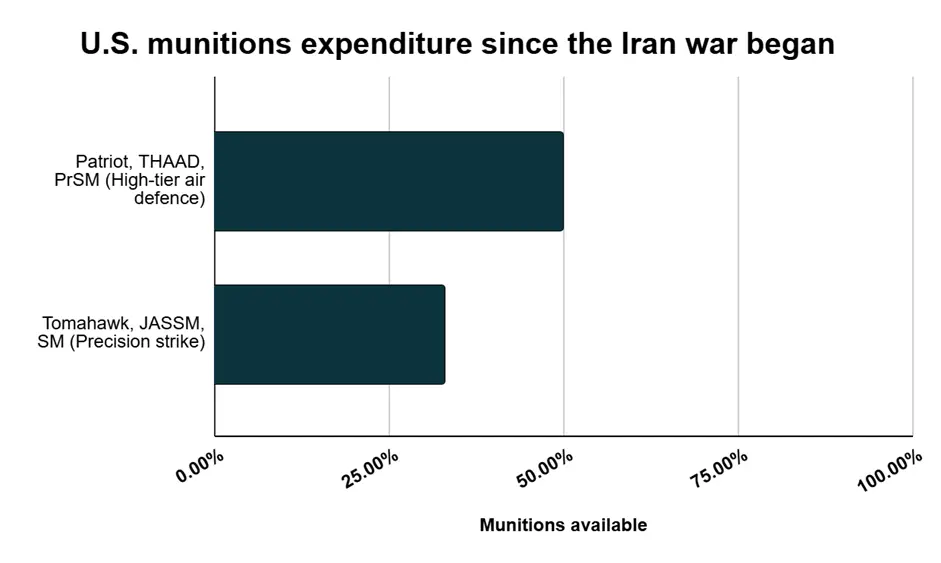
The United States has used roughly half of its pre-war inventory of Patriot, THAAD, and the Precision Strike Missile, and around a third of its Tomahawk, JASSM, and Standard Missile stocks. During the Twelve Day War phase of the conflict, US forces reportedly fired around 150 THAAD interceptors and 24 Tomahawks in a matter of days. Broader Middle East operations under both the Biden and Trump administrations, used hundreds more (Cancian & Park, 2026).
Therefore, it is worth noticing that the main problem is not, as expected, to come from Iran. According to Mark F. Cancian and Chris H. Park, enough remains for any possible scenario in the war against Iran. The risk comes from potential future wars, especially with China, but possibly also with North Korea or Russia. Before the current war, many analyses pointed to a need for larger munition inventories. And Operation Epic Fury has simply accelerated problems with munitions. (CSIS)
Evaluating Kyiv’s Actual Impact on the U.S. Interceptor Deficit
One CSIS finding is worth mentioning directly, since it complicates the popular political narrative. Aid to Ukraine is, with one partial exception, a comparatively limited factor in the US shortage, though exact drawdown figures remain undisclosed. Out of the more than 100 categories of equipment supplied to Kyiv, only four relate to the munitions used against Iran . The source of interceptors given to Ukraine, much of the approximately five to six hundred Patriot interceptors were a mix of newly manufactured missiles, European supply, and some direct stockpile drawdown from US inventories.
Consequently, industrial realities are that the actual state of things is not consistent with some administration officials explanations with Ukraine being responsible for the shortfall; the CSIS data suggests that framing significantly overstates Kyiv’s role (Cancian & Park, 2026).
The Introduction of the PAC-3 ACE and the Challenge of Cheap Drone Threats
Facing this data, US industry has begun pivoting towards cheaper interceptors rather than simply producing more expensive ones. On 20 July 2026, at the Farnborough International Airshow, Lockheed Martin unveiled the Patriot Advanced Capability-3 Adapted Capability Effector, or PAC-3 ACE, priced at under half the cost of the premium PAC-3 Missile Segment Enhancement (MSE) variant, which the US Army’s FY2027 budget request prices at roughly $5.3 million per round, putting the ACE at under $2.65 million (Lockheed Martin, 2026; Army Recognition, 2026a).
Even so, a roughly $2.65 million interceptor still represents a poor economic trade against a $20,000 to $50,000 Iranian Shahed drone. The PAC-3 ACE narrows the cost-exchange problem without resolving it.
Paradoxically, the strategic insights of the four-year long war in Ukraine appear to be underestimated in contemporary defence planning. A prominent example of concern is the ongoing expenditure of high-value munitions by major defence power to neutralize cheap drone threats. For a country possessing the world’s highest military budgets, this failure to adapt in advance to asymmetric cost warfare raises important questions regarding strategic planning.
The Hidden Reliance on Allied Tactical Innovation for Regional Defense
Set against these supply delays, the diplomatic relationship has also run in the opposite direction. Since March 2026, Ukraine has deployed more than 200 counter-drone specialists to five Middle Eastern states: the UAE, Saudi Arabia, Qatar, Kuwait, and Jordan. In order to help US and allied forces intercept Iranian Shahed drones using battle-tested, low-cost Ukrainian technology (Defense News, 2026).
Notably, President Trump publicly downplayed the significance of this assistance in March 2026, telling that Washington did not need Kyiv’s help with drone defence, even as expert support has been separately requested for personnel in the region (Aerotime, 2026). Ukraine, for its part, has treated the arrangement as joint rather than charitable, seeking additional high-end air defence missiles from its Gulf partners and the United States in return for its expertise, and signing long-term security cooperation agreements with Saudi Arabia and Qatar as part of the exchange (Associated Press/Fortune, 2026).
Taken together, the pattern is one of a superpower publicly minimizing its reliance on a smaller ally’s technology while quietly depending on it. Which is a contradiction that mirrors the broader gap between political support and material reality through the whole munitions debate.
The Prioritization Dilemma and the Shifting U.S. Global Posture
Strategic implications run deep under the US munitions shortage. The low missile’s production rate implies a time constraint. Therefore, instead of a mere production issue, Washington faces a prioritization dilemma. A choice between restocking itself, fulfilling its commitment/obligation toward purchasing allied countries, and being ready to face rival states exploiting the reconstitution gap, is necessary.
Reshaping the manufacturing of these missiles in the short to medium term is unrealistic. Time is, here, the binding constraint. For instance, the annual production capacity for Tomahawk missiles is projected to be currently at a maximum rate of 600 units with an estimated return to prewar inventory in late 2030-early 2031 (Cancian & Park, 2026). In addition, assembly lines are shared for different types of missiles and the same goes for solid rocket motors creating industrial bottlenecks (Rumbaugh & Karako, 2026).
Therefore, a large assessment on capabilities has to be made from the production line to the unit delivery on time constraint, supply chains, and resources.
The munitions shortage forces the US to redirect its stocks, delaying already purchased orders from allies in Europe and Asia. For example, Estonia and Lithuania have been notified of delays in arms procurement because of the war in Iran (Breaking Defense, 2026). Japan has been warned that there could be delays in the delivery of 400 Tomahawk missiles (Financial Times, 2026). Taiwan has also been notified by the US in the halting of weapon deliveries because of Operation Epic Fury (Breaking Defense, 2026). In the long-run, Washington is taking the risk to erode its credibility.
Low production rate, time and resource constraints, the reshuffling of munitions stockpiles, and delays in allies’ procurement create a window of opportunity for Washington’s rivals. In the US 2025 National Security Strategy, Asia ranked second after the Western Hemisphere in terms of priority (The White House, 2026). However, with US military assets now concentrated near Iran and difficult to stretch across multiple regions, the Indo-Pacific theatre appears insufficiently covered (The Diplomat, 2026). Consequently, the US is no longer capable of deterring China (Doshi et al., 2026). Backing Taiwan in face of the People’s Liberation Army will require Washington to engage into deep reforms in terms of missile production. As US’s rivals are likely to use such opportunities, the China-Russia-Iran-North-Korea axis of strategic cooperation must, therefore, be closely monitored.

The aforementioned elements imply two structural shifts in US strategic posture. First, by revising its operational posture and assessing its missile shortage, Washington is forced to sequence its response to threats. NATO and other US’s allies must be prepared to face delays in munitions deliveries and, consequently, be ready to defend themselves with less US support (Breaking Defense, 2026). Second, because THAAD, Tomahawk, ATACMS and PrSM cannot be rebuilt at wartime rates, the US has to change the formula. Investments and innovations become critical in such moments. The opening of four premier stateside military test ranges for innovative weapons indicates that Washington is fully aware of the weakness it faces (US Army, 2026).
The US munitions shortage exposed by Operation Epic Fury is not merely an operational barrier, but a profound strategic vulnerability laying deeply in the institutional arrangements.With storages of critical systems and long-range strike missiles severely depleted, Washington is caught in a prioritization dilemma.
In the long run, this shortfall dictates a structural shift in the US global stance. Washington is now forced to accept the limits of its arsenal, its responses to global threats, and rapidly innovate its defence industrial base to ensure readiness in an increasingly multipolar world.
Bibliography
Cancian, M. F., & Park, C. H., CSIS, May 2026, Rebuilding U.S. missile inventory: A multiyear project. https://www.csis.org/analysis/rebuilding-us-missile-inventory-multiyear-project
Council on Foreign Relations, August 2026, Out of ammo: A two-year sprint to rebuild the American arsenal and deter China. https://www.cfr.org/reports/out-of-ammo-a-two-year-sprint-to-rebuild-the-american-arsenal-and-deter-china
Hoffmann, F. R. (2024). The strategic-level effects of long-range strike weapons: A framework for analysis. Journal of Strategic Studies, 47(6-7), 964–1000. https://doi.org/10.1080/01402390.2024.2351500
Lindsay, J. M., Council on Foreign Relations, August 2026, The U.S. munitions crisis. Council on Foreign Relations. https://www.cfr.org/articles/the-u-s-munitions-crisis
Lockheed Martin, ATACMS advanced military rocket and missile technology. https://www.lockheedmartin.com/en-us/products/army-tactical-missile-system.html
Lockheed Martin, Long range precision strike missile (PrSM). https://www.lockheedmartin.com/en-us/products/precision-strike-missile.html
Lockheed Martin, PAC-3 advanced air defense missile technology. https://www.lockheedmartin.com/en-us/products/pac-3-advanced-air-defense-missile.html
Lockheed Martin, Terminal High Altitude Area Defense (THAAD): Missile interceptor and defense system. https://www.lockheedmartin.com/en-us/products/thaad.html
Raytheon, Tomahawk Cruise Missile. RTX. https://www.rtx.com/raytheon/what-we-do/sea/tomahawk-cruise-missile
Ashley Roque, Breaking Defense Europe, June 2023, The US is delaying weapon sales to allies. Will there be long-term impact? https://breakingdefense.com/2026/06/the-us-is-delaying-weapon-sales-to-allies-will-there-be-long-term-impact/
Rumbaugh, W., & Karako, T., CSIS, June 2026, Solid rocket motors for missile defense: Challenges and opportunities for expanding the industrial base. https://www.csis.org/analysis/solid-rocket-motors-missile-defense-challenges-and-opportunities-expanding-industrial-base
Shaikh, K., Interesting Engineering, July 2026, How interceptor missiles work: The technology behind stopping missiles in mid-air. https://interestingengineering.com/military/how-interceptor-missiles-work
Sevastopulo, D., Financial Times, May 2026, US warns Japan of severe delays in Tomahawk deliveries due to Iran war. https://www.ft.com/content/406bc3bb-068b-4f4c-b064-23082e8a9f70
The White House, November 2025, National security strategy of the United States of America. /api/wp-media/2025/12/2025-National-Security-Strategy.pdf
Tsuruoka, M., The Diplomat, March 2026, Why the US won’t be making a pivot to Asia anytime soon. https://thediplomat.com/2026/03/why-the-us-wont-be-making-a-pivot-to-asia-anytime-soon/
U.S. Army Public Affairs, August 2026, Army opens premier test ranges to private industry for rapid innovation. https://www.army.mil/article/294470/army_opens_premier_test_ranges_to_private_industry_for_rapid_innovation
Clement Charpentreau, Aerotime, April 2026, Zelenskyy: Ukraine trading drone defense for fuel, interceptors from Gulf states. https://www.aerotime.aero/articles/zelenskyy-ukraine-drone-defense-oil-diesel-gulf
Army Recognition. (2026). Farnborough 2026: Lockheed Martin unveils PAC-3 ACE low-cost interceptor.
https://www.armyrecognition.com/news/army-news/2026/lockheed-martin-pac-3-ace-patriot-interceptor
Defense News Army, July 2026, Lockheed Martin unveils PAC-3 ACE interceptor to cut Patriot missile cost in half amid global shortages.
Stephen Bryen, Asia Times, July 2026, US, Ukraine strike PAC-3 missile production deal — with a catch. https://asiatimes.com/2026/07/us-ukraine-strike-pac-3-missile-production-deal-with-a-catch/
Volodymyr Yurchuk and the Associated Press, Fortune, March 2026, Ukraine looks to leverage its help to Arab Gulf states fighting off Iranian drones in exchange for interceptors against Russian missiles.
Chirtina Harward, Critical Threats, July 2026, Russian Offensive Campaign Assessment, July 6, 2026. https://www.criticalthreats.org/analysis/russian-offensive-campaign-assessment-july-6-2026
Defence Ukraine, August 2026, Ukraine’s Patriot licence: Announced, then reversed.
https://www.defenceukraine.com/en/insights/ukraine-patriot-coproduction-2026
Defense Express, April 2026, What is known about Ukraine’s Sky Map system being rapidly deployed by the U.S. at its bases to counter Shahed drones.
Max Hunder and Yuliia Dysa, Defense News, March 2026, Ukraine deploys units to 5 Middle East countries to intercept drones.
Haye Kesteloo, DroneXL, March 2026, Ukraine’s interceptor elite: Meet the 5 drones reshaping global air defense.
https://dronexl.co/2026/03/22/ukraines-interceptor-5-drones-air-defense
Joseph Hunt, HNGN, August 2026, Zelensky locks in monthly Patriot deal but license remains elusive as winter gap widens.
Dmytro Basmat, Polina Moroziuk, Tania Myronyshewa, Asami Terajima, Yuliia Taradiuk, Kyiv Independent, July 2026, For second time in 4 days, Russia targets Kyiv with mass missile attack, killing at least 26.
https://kyivindependent.com/russian-attack-july-6
Scott McCain, TechTimes, July 2026, Ukraine locks in both Patriot makers: Licenses signed, interceptors still years away.
UN News, August 2026, Russian missiles kill 17 more in Ukraine as Guterres calls for ceasefire.