



Securing critical supplies necessary for the economy aligns with the economic imperialism school of thought and reflects Trump’s attempts to exert international influence through economic means.
Introduction
The United States of America is, undoubtedly, one of the most important geopolitical actors in the world. With a GDP of almost $29 trillion (World Bank Group, 2024) and a defense budget of $1 trillion, expected to rise to $1.5 trillion in 2027 (Chia, 2026), the country’s hard power cannot be questioned.
This year’s events have put the spotlight once more on the USA, both internally and externally. On 3rd of January 2026, the USA conducted a military intervention in Venezuela, which resulted in the removal of the sitting Venezuelan President, Nicolas Maduro (Center for Preventive Action, 2026). Furthermore, Trump expressed interest in acquiring Greenland, a self-governing territory of Denmark. At the beginning of 2026, Trump ramped up efforts to acquire the island, at one point even threatening military intervention if his demands weren’t met, but eventually backing off on these claims (Blake, 2026). These recent developments have brought more disorder to an already disorderly geopolitical landscape and could mark a critical juncture for both the USA and the world’s international affairs. Some world leaders have already acknowledged this, with Canadian Prime Minister Mark Carney saying that the rules-based international order, as we know it, is coming to an end (World Economic Forum, 2026).
While Trump’s diplomatic tactics have been controversial, even in his first presidential term in 2016, the recent events are a clear escalation compared to the first term. Based on the above-mentioned developments, the goal of this research is to explore the two events mentioned and determine if they can be characterized as imperialism, using Stephen Kettel and Alex Suttons’ characteristics of imperialism as a baseline for the paper, alongside other academically important papers on modern imperialism.
As such, the research question for this paper will be the following: To what extent do Trump’s recent military intervention in Venezuela and territorial ambitions in Greenland conform to, or depart from, standard scholarly definitions of imperialism?
The paper will not seek to provide conclusive explanations for both events or to fill a literature gap. Rather, its purpose is to explore whether President Trump’s recent decisions fit a scholarly definition of imperialism or any international relations model, thereby offering a potential explanation of the recent events.
Definitions of imperialism
Imperialism as a concept has various definitions, but little consensus on a standardized one (Johnson, 2026). What is certain is the origin of the word, which was used to describe the new phenomenon that was manifesting in the British Empire at the turn of the 20th century. One of the important researchers who wrote about early imperialism is John Hobson, who made significant contributions to economics and sociology with his work on British Imperialism. Hobson wrote about the economic factors that drive imperialism, focusing on how financial elites controlled the surplus of goods produced (Wood, 1983). Hobson’s work on economic imperialism laid the groundwork for Marxist theories, with prominent Marxists such as Lenin, also influenced by Karl Marx’s writings about capitalism’s global expansion, expanding imperialism definitions (Cain, 2007). Classical Marxists focused on the necessity for new emerging markets and the exploitation of the colonies that opened those markets (Ratcliffe, 1983).
There has been a revival in the literature about the study of the United States as an empire, but little consensus regarding an answer (MacDonald, 2009). Contemporary schools of thought have various approaches to modern imperialism. Works such as John Smith’s book ‘Imperialism in the 21st Century” focus on the economic factors that motivate global powers to pursue economic imperialism (Smith, 2015). Antony Anghie looks at the War on Terror that the United States pursued after the events of 9/11 (2012). A problem with the current stream of research on new imperialism is the lack of consensus on its characteristics and how to distinguish it from classical branches (Kettell & Sutton, 2013). In general, new schools of thought place new imperialism into 2 categories: economic and geopolitical. The economic perspectives argue that modern imperialism is driven by global capitalism, and the powerful states in this economy continue to expand their power, but, unlike classical imperialism, this is done through the control of global markets. Geopolitical perspectives argue that modern imperialism is driven by social factors, with military force being justified from a humanitarian and moral perspective. Scholars argue that new indirect mechanisms such as diplomacy, finance, and trade, as well as nations of equality, democracy, and self-determination are used to exert influence across the globe (Kettell & Sutton, 2013).
For this paper, imperialism will be defined according to Johnson (2026), who states that it is “the systematic inter-play of capitalist development and geopolitical conflict in the construction and reproduction of international hierarchy” (p.3). While the definition is broad, the nature of modern imperialism, compared to older versions, makes it difficult to concentrate on a specific definition, as modern geopolitics is constantly shifting. Johnson’s definition encapsulates both economic and geopolitical perspectives and, considering the nature of Trump’s diplomacy, will help with deducing if the cases of Venezuela and Greenland could be considered imperialism.
USA: A history of Imperialism
The United States, at the turn of the 20th century, expanded its influence across the world. One of the events looked at by historians as the starting point of US global influence is the Spanish-American War. In 1898, the U.S. fought against Spain after the destruction of the USS Maine battleship. The U.S won the war, taking control of former Spanish colonies in the Caribbean and the Pacific (Britannica, n.d.). A key characteristic of this American expansion is the use of gunboat diplomacy, a type of diplomacy where the use of military (in this case, naval) power was used to undermine foreign powers and gain concessions. This is considered a key characteristic of the “Age of Imperialism” in the 19th and 20th century (Bodovitz, 2025), as the United States was pursuing territorial gains to raise its influence in the Western Hemisphere.
A more recent example of a U.S. intervention that caused academic debates on its justification is the Iraq invasion. The United States invaded Iraq in 2003, after the Bush administration claimed Saddam Hussein possessed weapons of mass destruction and had ties to terrorism, framing the war as a defensive move to protect global security and “liberate” the Iraqi people (Council on Foreign Relations, 2026). Scholars such as Johnson (2026) and Anghie (2012) have explored the imperialist characteristics of the Iraq invasion, and have argued that the War on Terror, alongside the use of pre-emptive defensive strikes, have Imperialistic characteristics. The United States’ justification for protecting global security and liberating the Iraqi people can be described as a form of geopolitical imperialism. This is extended by the numerous works that have analysed the Iraq invasion as a case of US Imperialism (O’Meara, 2006).
This section aimed to show that the United States, throughout its history, has exhibited behavior that some schools of thought would describe as imperialism. With this precedent in mind, we will examine Donald Trump’s behavior as the current president of the United States.
Trump’s foreign policy influence
President Trump’s second term in office has been characterized by uncertainty on the international stage; the Venezuela and Greenland situations exemplify this. That being said, while this behavior from Trump has become expected, it is less clear as to the underlying reasons for it. The following section will look at some factors that potentially contributed to the above-mentioned events.
One of Trump’s most trusted advisors is Stephen Miller. Miller is a conservative “firebrand” who is in Trump’s close inner circles and considered one of the big influencers behind Trump’s recent policies (Zurcher, 2026). His position at the White House is deputy chief of staff for policy and homeland security adviser, but his influence can also be seen in foreign affairs, as, after the capture of Maduro, he was seen behind Trump during the announcement (Zurcher, 2026). During the Greenland situation, Miller has appeared on television talking about the U.S.’s position as the dominant world power of the Western Hemisphere. He even declared that “Nobody is going to fight the United States militarily over the future of Greenland” (Miller 2026, cited from Zurcher, 2026).
Trump has also been influenced by former US presidents. He has not shied away from using the ‘big stick’, a characteristic of US diplomacy during the Presidency of Theodore Roosevelt (Cohen, 2026), a man Trump has declared several times to be one of his favorite Presidents (Thorndike, 2025). But Roosevelt is not the only President that Trump is taking inspiration from. The Monroe Doctrine is a document from 1823, where President James Monroe claimed:
“Any attempt by a European power to oppress or control any nation in the Western Hemisphere would be viewed as a hostile act against the United States”, resulting in the western hemisphere being directly under U.S. influence only” (Britannica, 2026).
The ‘Donroe Doctrine’, in a nod to James Monroe, is a term used by observers to describe Trump’s recent endeavors in the western hemisphere; interventions in Venezuela, claiming Greenland for the U.S., conducting a “war on drugs” coming from Mexico, and even renaming the Gulf of Mexico into the Gulf of America.
The case of Greenland
Trump first exhibited interest in acquiring Greenland in 2018 because of its strategic position in the North Atlantic amid rising Russian submarine activity. During his first term, he framed control of Greenland as essential for Arctic security, in the context of Russian and Chinese advancements in the area. This never materialized during the first term, but now, in the second term, Trump has threatened Denmark with sanctions, even mentioning the use of military force to seize the island (Cortellessa, 2026).
This came as a surprise, as the U.S. already has a military presence on the island. Indeed, in total, it has the largest number of military bases around the world, with 742 permanent bases (IBON Foundation, 2024).
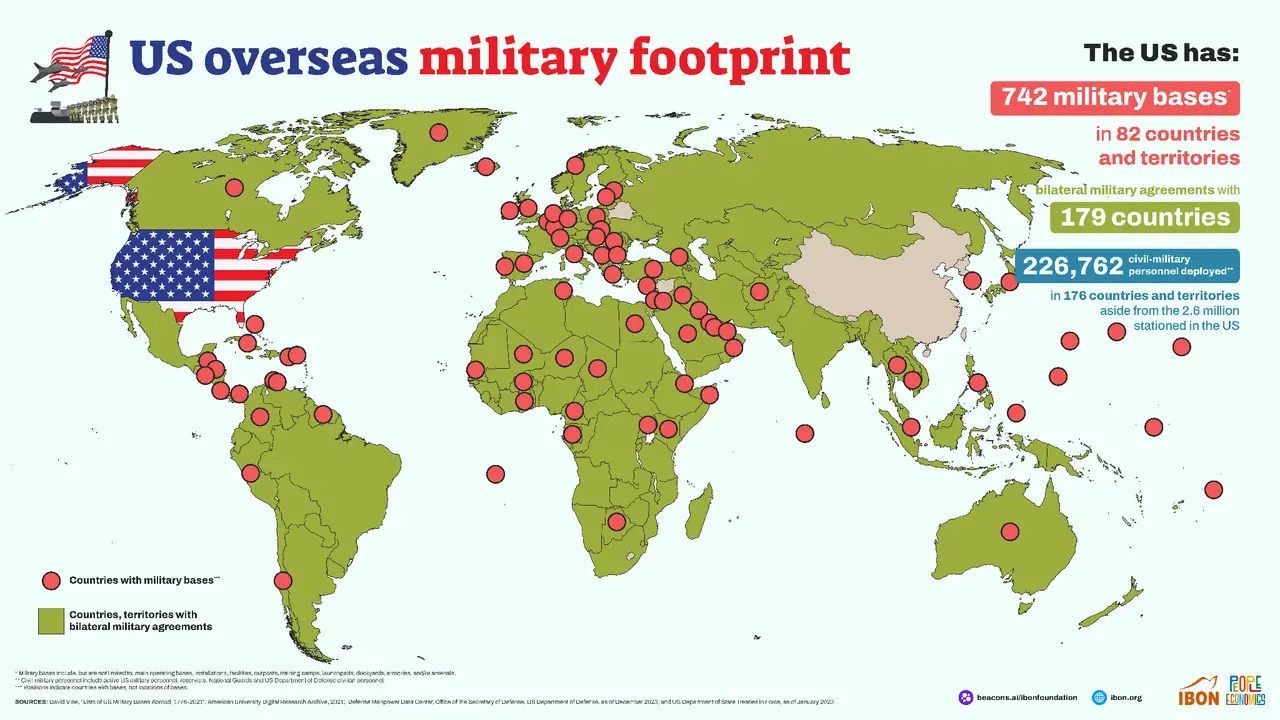
Figure 1: US Overseas Military Footprint, Source: https://www.ibon.org/us-russia-china-military-footprint/
What would be the reason for Trump’s acceleration for the pursuit of Greenland? Perhaps answers could be obtained by looking at what other benefits acquiring Greenland would give. Trump has wanted to implement a system called the Golden Dome, meant to act as a line of defense against hypersonic and ballistic missiles (Cortellessa, 2026). The project was announced last year, with the goal of full implementation by 2028. The Golden Dome has been described as a “herculean effort” to be implemented in such a short time-frame, with the project seeing multiple delays currently (Decker, 2026). Another important factor would be the cooperation of American allies, such as Canada and, importantly for our case, Greenland. They are needed as help for tracking the missiles that would be launched over the Arctic, and without them, the implementation of the Golden Dome would be difficult. This can help explain Trump’s recent efforts to acquire Greenland through various means, including military intervention.
Can we characterize Trump’s behavior regarding Greenland as imperialist? If we look at the new imperialism schools of thought, specifically at economic and geopolitical, we see that the Greenland situation could fit into both. Firstly, Trump has said that he wants Greenland due to “international security” (Verger, 2025) and to “free the people of Greenland” (Aikman, 2025). These claims fit into the geopolitical imperialism school of thought, as Trump is using moral and democratic claims to justify the takeover of Greenland.
Furthermore, the threat of military intervention is a characteristic of classical imperialistic schools of thought. Trump has threatened to intervene militarily if Denmark does not cooperate (Aikman, 2025). Military intervention from the United States has been described as a means to increase the country’s international position when it feels weakened, and scholars such as Harvey have described American military intervention as the “tip of the imperialistic iceberg”, highlighting its importance (Kettell & Sutton, 2013).
In addition, Trump has announced a framework for a potential deal with Greenland regarding its vast deposits of rare minerals. The island has a vast resource of rare minerals, ranking 8th in the world. Trump has been interested in these resources on the background of securing rare supplies in the competition with China (Cohen, 2026). Securing critical supplies necessary for the economy aligns with the economic imperialism school of thought and reflects Trump’s attempts to exert international influence through economic means, rather than solely through military force.
The case of Venezuela
Trump’s actions in Venezuela also present an interesting picture. As mentioned in the introduction, Trump captured Nicolas Maduro and his wife after US military intervention in Caracas, in a move that shocked the world. The pretext was different compared to Greenland. The Trump administration has repeatedly claimed that drugs were coming from Venezuela into the country, using the war on drugs as a justification for military intervention (Adriaensen, 2026). Further accusations were about hundreds of thousands of illegal immigrants and gang members allegedly sent by Venezuela to the USA. In contrast with the Greenland situation, Trump did send military troops, initially with strikes on Venezuelan boats, then on the Venezuelan capital, and finally sending special troops to capture Maduro (Buschschlüter, 2026).
Nicolas Maduro has claimed that Trump wanted to depose him to access Venezuela’s vast oil reserves (Buschschlüter, 2026). At first look, this would make sense. Venezuela has the largest crude oil reserves in the world, alongside the 9th highest natural gas reserves. The country further has untapped reserves of gold and rare minerals (Duggal & Ali, 2026), prospects that would certainly attract a hegemonic intervention, like the one that occurred.
While this would fit the definitions of imperialism used in this paper, there are other factors to consider. Firstly, while the reserves of Venezuela are impressive, the oil is very heavy and sour, which means that it is dense and viscous, even described as tar-like. This makes the oil very difficult to refine and process. Furthermore, while certain US refineries are equipped to deal with such crude oil, US companies are unlikely to be interested in the Venezuelan market due to the leadership instability and previous investment problems within the country while Chavez was president (Power, 2026).
Rather, there is an alternative explanation for the US intervention that would still fit into imperialism definitions. China purchased the largest amount of Venezuelan, at a volume of 81.7% (Duggal & Ali, 2026). In this case, the intervention could have been a result of Trump wanting to impede one of the United States’ biggest rivals internationally. The race for resources or, in this case, impeding a rival from resources, could certainly be considered a form of economic imperialism, as the US has gained an upper hand in the control of South America. This could also reflect the “Donroe Doctrine” ambition, which aims to recreate US hegemony over the western hemisphere. The US State Department seems to reflect this assumption as they posted on X, formerly Twitter, after the capture of Nicolas Maduro, that “This is OUR hemisphere”, alongside a picture of Trump (US State Department, 2026 cited from Borger, 2026).
The military intervention by itself seems to be rooted in geopolitical imperialism. The United States’ defense budget is the highest in the world, dwarfing its nearest competitors by spending more than the next 4 ranked countries combined (GFP, 2026).
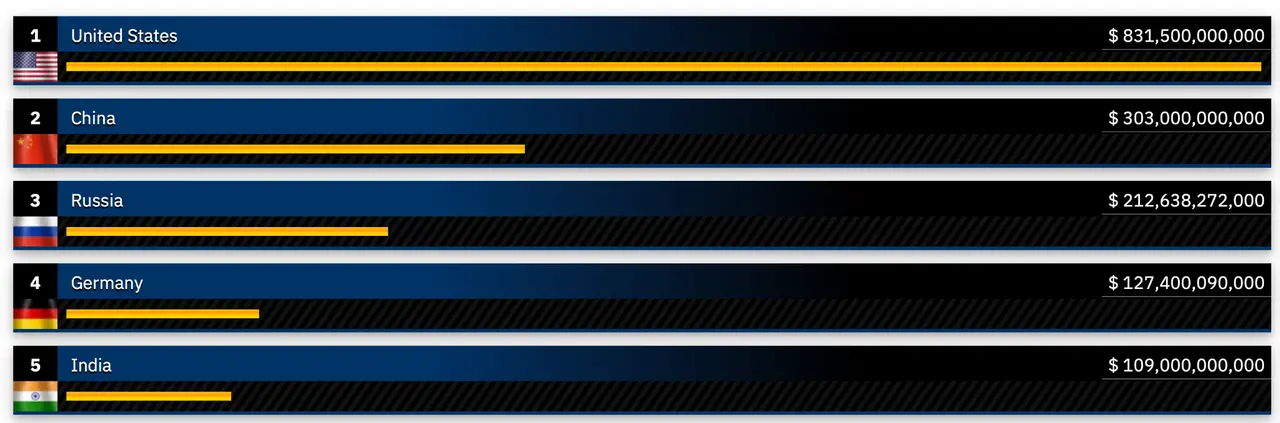
Figure 2: Defense Budget by Country 2026, Source: https://www.globalfirepower.com/defense-spending-budget.php
There have been precedents set, for example, with the Iraq War, but a military intervention from the US has not occurred in several years, certainly not to the magnitude of removing a sitting president.
The military intervention in Venezuela was impressive from a military perspective: there were no US casualties, the operation was swift and successful in its goal (Evans, 2026). The resounding success can be interpreted as sending a message to the United States’s rivals: the US still has the most powerful military in the world and is not afraid of using it. This would be in line with academia regarding the US military as the tip of the imperialistic iceberg.
Conclusion
In conclusion, some characteristics define Trump’s foreign policy for Venezuela and Greenland as imperialistic. According to Johnson’s definition, both situations could be classified as forms of economic and/or geopolitical imperialism. That being said, academia also struggles with a common definition of imperialism, and new perspectives are brought up frequently. Furthermore, the cases of Greenland and Venezuela are still ongoing in one form or another. As such, it would make it complicated to classify both situations with certainty as imperialist. Nonetheless, both case studies are interesting analyses and could showcase how applying the lens of current new imperialism could be used.
What is more observable is the influence other factors have on Trump’s recent behavior internationally, be it a form of imperialism or extreme nationalism, as in the case of Stephen Miller, or historical institutionalism in play, such as the ‘Donroe Doctrine’.
Reference List
Adriaensen, B. (2026, March 24). Venezuela two months after Trump’s intervention. Radboud University. https://www.ru.nl/en/research/research-news/this-is-what-venezuela-looks-like-two-months-after-trumps-intervention
Aikman, I. (2025, January 26). Donald Trump says he believes the US will “get Greenland”. https://www.bbc.com/news/articles/crkezj07rzro
Anghie, A. (2012). Imperialism, Sovereignty and the Making of International Law. Cambridge University Press. https://doi.org/10.1017/CBO9780511614262
Blake, A. (2026, January 21). Trump just backed off on using military force to take Greenland. What does it mean?.CNN Politics. CNN. https://www.cnn.com/2026/01/21/politics/military-force-us-greenland-trump
Bodovitz, P. (2025, May 20). Gunboat Diplomacy: How Military Power Reshaped Global Politics. The Collector. https://www.thecollector.com/gunboat-diplomacy-military-power/
Borger, J. (2026, January 10). Trump’s territorial ambition: New imperialism or a case of the emperor’s new clothes?. The Guardian. https://www.theguardian.com/news/ng-interactive/2026/jan/10/trump-territorial-ambition-imperialism
Britannica. (n.d.). Spanish-American War Summary, History, Dates, Causes, Facts, Battles, & Results.Britannica. https://www.britannica.com/event/Spanish-American-War
Britannica. (2026, February 18). Monroe Doctrine History, Summary, & Significance.Britannica. https://www.britannica.com/event/Monroe-Doctrine
Buschschlüter, V. (2026, January 3). Why has Donald Trump attacked Venezuela and taken Maduro?. https://www.bbc.com/news/articles/c93n4nx5yqro
Cain, P. J. (2007). Capitalism, Aristocracy and Empire: Some ‘Classical’ Theories of Imperialism Revisited. The Journal of Imperial and Commonwealth History, 35(1), 25–47. https://doi.org/10.1080/03086530601143388
Center for Preventive Action. (2026, February 18). U.S. Confrontation With Venezuela. Global Conflict Tracker. https://www.cfr.org/global-conflict-tracker/conflict/instability-venezuela
Chia, O. (2026, January 8). Trump calls for US military spending to rise more than 50% to $1.5tn. https://www.bbc.com/news/articles/cy59kxl2xwzo
Cohen, A. (2026). Trump’s Greenland Minerals Ambitions: What’s Beneath The Ice. Forbes. https://www.forbes.com/sites/arielcohen/2026/02/20/trumps-greenland-minerals-ambitions-whats-beneath-the-ice/
Cohen, R. S. (2026, March 2). America Under Trump Is the Realists’ Grand Experiment. Foreign Policy. https://foreignpolicy.com/2025/04/08/trump-realists-realism-international-relations-theory-power-politics-self-interest/
Cortellessa, E. (2026, February 5). The Origins of Trump’s Greenland Obsession. TIME. https://time.com/7368798/trump-greenland-pursuit/
Council on Foreign Relations. (2026, January 13). The Invasion of Iraq—The 10 Best 10 Worst U.S. Foreign Policy Decisions. https://www.cfr.org/ten-best-ten-worst-us-foreign-policy-decisions/the-iraq-war/
Decker, A. (2026, February 3). Trump’s Golden Dome, a year in, is struggling to take shape. POLITICO. https://www.politico.com/news/2026/02/02/trump-golden-dome-missile-defense-00759943
Duggal, H., & Ali, M. (2026). What resources does Venezuela have —Apart from the world’s most oil?. Al Jazeera. https://www.aljazeera.com/news/2026/1/8/what-resources-does-venezuela-have-apart-from-the-worlds-most
Evans, G. (2026, January 4). Spies, drones and blowtorches: How the US captured Maduro.BBC. https://www.bbc.com/news/articles/cdred61epg4o
GFP. (2026). Defense Budget by Country (2026). https://www.globalfirepower.com/defense-spending-budget.php
IBON Foundation. (2024, May 27). Overseas military footprint of US, Russia, and China. IBON Foundation. https://www.ibon.org/us-russia-china-military-footprint/
Johnson, D. (2026). Reconstructing imperialism: From the new imperialism to the new geopolitics. Review of International Studies, 1–18. https://doi.org/10.1017/S0260210526101806
Kettell, S., & Sutton, A. (2013). New Imperialism: Toward a Holistic Approach. International Studies Review, 15(2), 243–258. https://www.jstor.org/stable/24032950
MacDonald, P. K. (2009). Those Who Forget Historiography Are Doomed to Republish It: Empire, Imperialism and Contemporary Debates about American Power. Review of International Studies, 35(1), 45–67. 10.1017/S0260210509008328
Nicas, J. (2025, November 17). The ‘Donroe Doctrine’: Trump’s Bid to Control the Western Hemisphere. The New York Times. https://www.nytimes.com/2025/11/17/world/americas/trump-latin-america-monroe-doctrine.html
O’Meara, D. (2006). “American Empire” and “US Imperialism” after the war in Iraq?: The American state in the contemporary global order. Labour, Capital and Society / Travail, Capital et Société, 39(1), 4–33. http://www.jstor.org/stable/43158259
Power, J. (2026). Why access to Venezuela’s ‘heavy’ oil is ‘tremendous’ news for US refiners. Al Jazeera. https://www.aljazeera.com/news/2026/1/16/why-access-to-venezuelas-heavy-oil-is-tremendous-news-for-us-refiners
Ratcliffe, B. M. (1983). Review of Review of Marxist Theories of Imperialism: A Critical Survey, by A. Brewer. The International History Review, 5(4), 620–623. https://www.jstor.org/stable/40105341
Smith, J. (2015). Imperialism in the Twenty-First Century. Monthly Review, 67(3), 82. https://doi.org/10.14452/MR-067-03-2015-07_6
Thorndike, J. (2025). Trump Keeps Praising FDR, But What About His War On Wealth?. Forbes. https://www.forbes.com/sites/taxnotes/2025/12/08/trump-keeps-praising-fdr-but-what-about-his-war-on-wealth/
Verger, C. (2025). Trump and the purchase of Greenland: Bluff?. Institut Jacques Delors. https://institutdelors.eu/en/publications/trump-and-the-purchase-of-greenland-bluff/
Wood, J. C. (1983). J. A. Hobson and British Imperialism. The American Journal of Economics and Sociology, 42(4), 483–500. https://www.jstor.org/stable/3486245
World Bank Group. (2024). World Bank Open Data. https://data.worldbank.org
World Economic Forum. (2026, January 20). Davos 2026: Special address by Mark Carney, PM of Canada [Speech]. https://www.weforum.org/stories/2026/01/davos-2026-special-address-by-mark-carney-prime-minister-of-canada/
Zurcher, A. (2026, February 9). Stephen Miller: The aide driving Donald Trump’s most controversial policies. BBC. https://www.bbc.com/news/articles/ce8rl71n4r3o


