
In 2026, African countries are starting to trade electricity regularly through regional power pools (World Bank, 2026). A mini-grid is a small, stand-alone electricity system, usually solar-powered, that supplies a village; a community-owned mini-grid belongs to the people it serves, usually through a cooperative. This brief asks on what terms such mini-grids must connect to national grids and regional markets so that their value stays local. It sets aside power sources and climate arguments because, in Africa’s situation, access to electricity comes first for its power to alleviate poverty. The answer is that three terms must change: payment for village power, fees for the national lines, and the right to keep selling once the grid reaches the village. Drawing on regulations, contract reviews and studies of mini-grid business models (Oemmelen et al., 2025), the brief follows the money, then the three terms: ownership, reach and rules.
Rents at the Top, Costs at the Bottom
The top refers to large power plants and the national companies that buy from them; the bottom refers to villages far from the main power lines. Under take-or-pay contracts, money flows from consumers and taxpayers, through loss-making state power companies, to plant owners, who are paid for capacity whether or not it is used. A rent is income beyond what is needed to provide a service. A capacity payment that only covers the cost of staying available is not a rent, but one for unneeded capacity, or above what open competition would cost, is. In 2019, Ghana’s finance minister said the country paid over half a billion US dollars a year for capacity it did not need (Starr FM, 2019). In Kenya, private plants were paid far more than their share of supply (Figure 1). Government guarantees can lower the cost of building needed plants, but they leave the public carrying the risk while a few owners keep a guaranteed return.
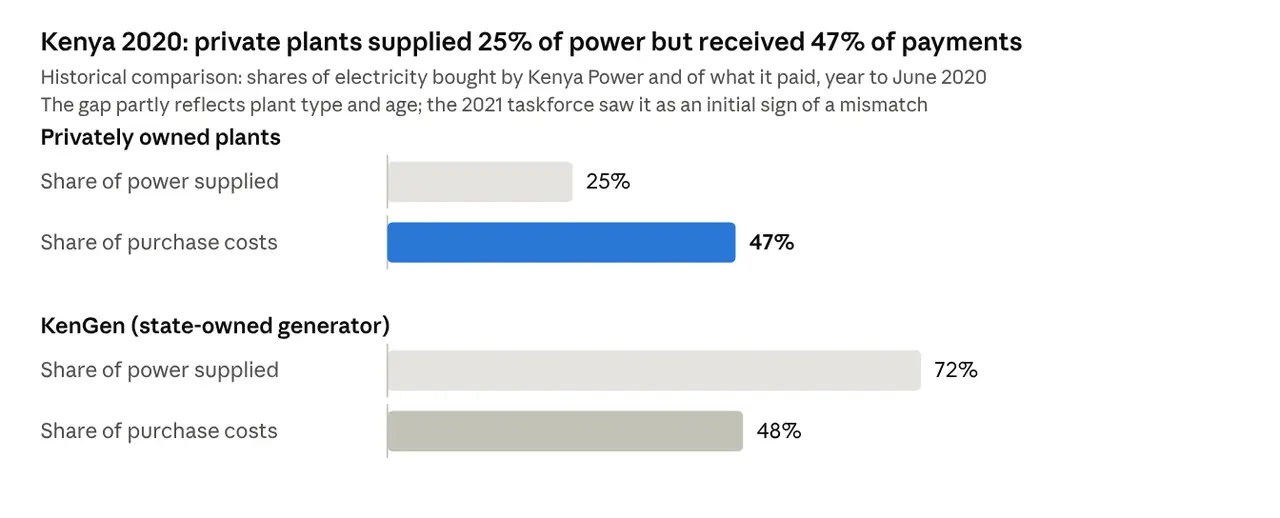
Figure 1. Source: Presidential Taskforce on the Review of Power Purchase Agreements (2021).
At the bottom, the poorest pay the most. Most African countries keep a single national electricity price below the cost of supply, while mini-grids must charge their full cost (African Union, n.d.). In Sierra Leone, mini-grid customers paid 0.74 to 0.87 US dollars per kilowatt-hour, compared with about 0.20 US dollars per kilowatt-hour on the national grid (International Monetary Fund, 2024). Small systems cost more to run, but the subsidy goes to grid customers, who are usually better off, while remote villages pay in full.
Three Terms at the Point of Connection
Three terms decide who keeps the value of a connected community mini-grid’s power: what it is paid for its electricity, what it pays to use the national lines, and what its owners keep when the grid reaches their village. On the first, small producers are usually paid only the power company’s avoided cost, meaning the savings it incurs by not producing that electricity itself. They sell per unit on standard contracts, as in Tanzania (Africa Minigrid Developers Association, 2025), while large plants are paid for capacity whether it is used or not.
Nigeria shows how the second term can shift costs onto villages. Since December 2025, a connected mini-grid has paid the local distribution company, the private firm running the area’s power lines, a fixed rental fee “regardless of energy flow” plus an energy charge (Nigerian Electricity Regulatory Commission, 2025). The rules contain concessions: the rental fee includes only half the company’s usual return, and the energy charge only a third of its running costs. Yet the energy charge also passes on a quarter of the losses the regulator allows the company, including electricity it fails to bill or collect, and up to 10% of what indebted customers pay goes to its old debts. Fixed payments once flowed only to large plants; now they also flow from villages to companies that lost 1.334 trillion naira in 2025 on unbilled or unpaid power (ThisDay, 2026).
The third term applies when the national grid reaches a mini-grid’s area. In Nigeria, since April 2026, the two sides negotiate after 12 months’ notice on whether the mini-grid continues to sell through the grid, hands over its equipment, or closes; the regulator decides if they cannot agree, and compensation excludes expected future profits (Udo Udoma & Belo-Osagie, 2026). A sale therefore turns the surplus a village would have kept every year into a one-off payment. None of these rules treats community owners differently from private developers, so a village must negotiate its future with a much larger company.
Ownership: Who Keeps the Surplus
Ownership decides who receives the surplus left after costs are paid. In an investor-owned mini-grid, it goes to investors. In a cooperative, it goes to members who are also customers, through lower prices, reinvestment or new connections. LUMAMA, a community enterprise in Tanzania’s Ludewa District, serves around 20,000 people, who pay their bills in full and cover its operating costs (WAME2030, n.d.).
The strongest objection is that private operators perform better: most sustainable mini-grids in Sub-Saharan Africa are not community-owned, and for-profit ones score better on economic and technical sustainability (Oemmelen et al., 2025). Yet ownership and management can be separated. Members elect a board, and the board hires a professional manager or a specialist firm that is paid for results, such as hours of supply and fees collected. Uganda’s Kyegegwa Rural Electricity Cooperative Society operates as follows: a general manager oversees daily operations (Kelly, 2023).
Reach as Growth
Local ownership matters most where investors do not go. In Sub-Saharan Africa, the number of people without electricity barely changed between 2010 and 2024, falling only from 565 to 563 million (allAfrica, 2026). Private developers avoid sites the national grid may soon reach and, among remote sites, choose only those where customers can pay full-cost prices, leaving the poorest villages unserved (International Renewable Energy Agency, 2016). Community owners can accept lower returns and invest their own savings and grants to serve sites that investors reject. Reach, not efficiency, is therefore the main strength of local ownership.
Reach becomes growth when supply is affordable and reliable. In South Africa, rural electrification increased women’s employment because women spent less time collecting firewood and started small businesses (Dinkelman, 2011), though a later replication study urges caution (Bensch et al., 2020). A model that looks inefficient on an operator’s balance sheet can therefore be efficient for society, because returns such as women’s paid work, shops open after dark, and lit classrooms and clinics never appear in its revenue. A community owner can price for these social returns, whereas an investor must price for revenue.
Rules for Fair Integration from Below
Regulators can make the three terms fair with three rules. First, one valuation rule for all producers: the power company pays for village power according to what it saves, including electricity otherwise lost in long lines, and must buy from community mini-grids that meet technical standards. Second, fair fees: fees cover only the costs a mini-grid causes on an efficiently run network, not the company’s billing failures or old debts. Third, the right to keep selling: when the national grid reaches the village, a community mini-grid that meets technical standards stays connected as a seller unless its members choose to sell. Paying for what village power saves costs the power company no more than producing that power itself, so these rules need not raise costs elsewhere. To stop private developers from posing as communities, regulators can adopt the European Union’s test: open membership, local control, and member benefit before profit (Directive 2018/2001, 2018).
Regional bodies must also open a route into regional markets, which barely exists for small producers. Cross-border trade is low and uneven: about 8% of electricity in West Africa (World Bank, 2026) and 0.4% of generation in the East African Community (Rubanda et al., 2025). In Southern Africa, 68% to 90% of cross-border trade in 2023 and 2024 was conducted through long-term deals between two national power companies, rather than the open daily market (Zhuwakinyu, 2025). Integration from above is therefore closed to small producers: a village mini-grid, poorly paid at home, has no second buyer, because the regional buyers are national power companies, too.
The route can work through an aggregator, a joint selling agent that pools many small producers and trades on their behalf. In Zambia, the privately owned 32-megawatt Ilute solar plant sells its power to GreenCo, an independent trader in the Southern African Power Pool, and gives 1% of its annual revenue to a trust for nearby villages (FMO, 2026). Under community ownership, the villages would keep the whole surplus. The power pools’ February 2026 agreement to harmonise their trading rules (Africa Sustainability Matters, 2026) is the right moment to pilot a federation of community mini-grids trading via a single aggregator.
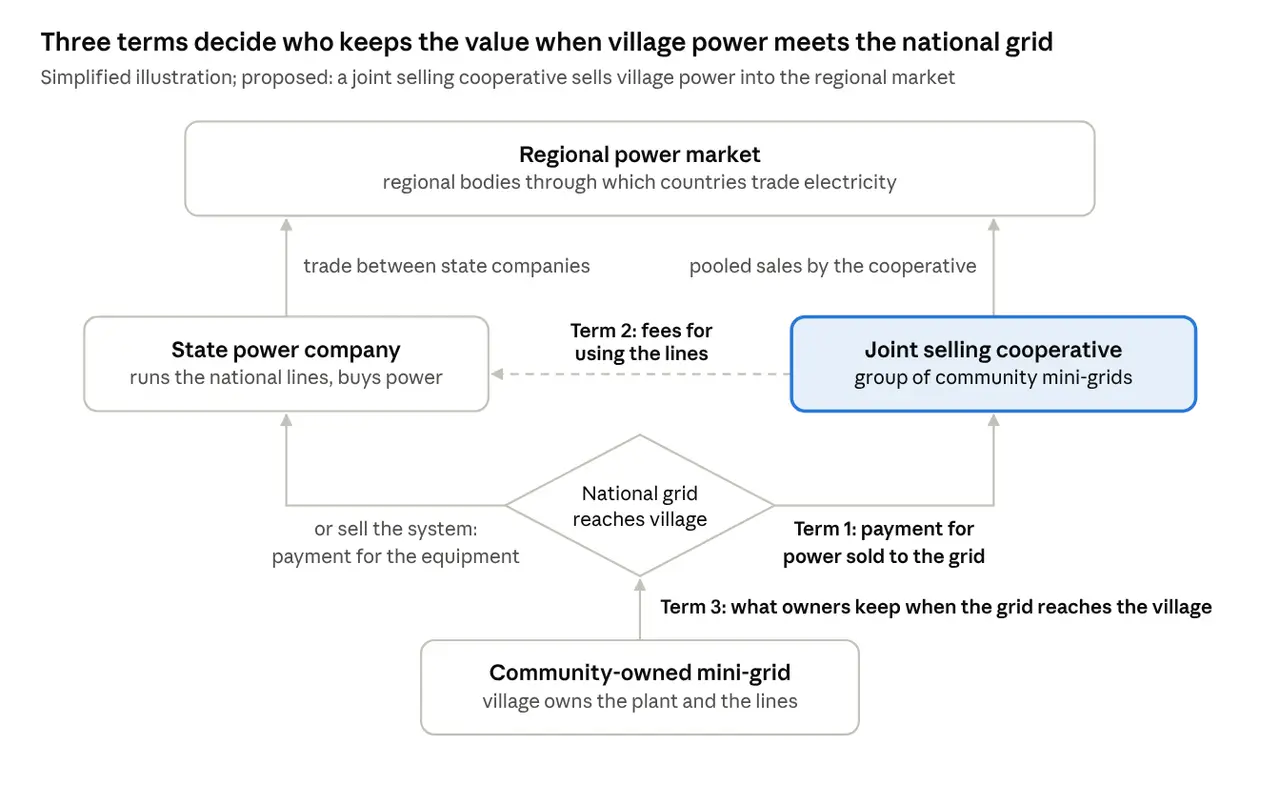
Figure 2. Own simplified illustration.
Conclusion
African power systems pay the top and charge the bottom. Community ownership can reverse part of this flow, because members who are also customers keep the surplus, but only if the three terms of connection change. This brief has not examined the social conditions that community ownership needs, such as leadership, technical skills and trust, or the risk that local elites capture cooperatives. Future research should measure how these terms affect community mini-grids once they are connected.
References
Africa Minigrid Developers Association. (2025). Minigrid policy and business landscape: An in-depth analysis. Tanzania report. /api/wp-media/2025/07/Tanzania-Country-Report.pdf
Africa Sustainability Matters. (2026). Grid gap in focus as Southern African utility leaders join AEW Power Africa Today. https://africasustainabilitymatters.com/?p=25942
African Union. (n.d.). Green mini-grid (GMG) Africa strategy (Specialised Technical Committee Technical Paper No. 6). https://au.int/sites/default/files/documents/32183-doc-green_mini-grid_gmg_africa_strategy-e.pdf
allAfrica. (2026, June 29). Africa: Sub-Saharan Africa accounts for 86% of global electricity access gap. https://allafrica.com/stories/202606290024.html
Bensch, G., Gotz, G., & Peters, J. (2020). Effects of rural electrification on employment: A comment on Dinkelman (2011) (Ruhr Economic Papers No. 840). RWI – Leibniz-Institut für Wirtschaftsforschung. https://doi.org/10.4419/86788973
Dinkelman, T. (2011). The effects of rural electrification on employment: New evidence from South Africa. American Economic Review, 101(7), 3078–3108. https://doi.org/10.1257/aer.101.7.3078
Directive (EU) 2018/2001. (2018). Official Journal of the European Union, L 328, 82–209. https://eur-lex.europa.eu/eli/dir/2018/2001/oj
FMO. (2026, January 6). Ilute solar project reaches financial close. https://www.fmo.nl/news-detail/97f40f71-d39a-4060-acaa-c80a10a9313a/ilute-solar-project-reaches-financial-close
International Monetary Fund. (2024). Sierra Leone: Technical assistance report—Climate policy diagnostic. https://www.imf.org/-/media/Files/Publications/TAR/2024/English/tarea2024105-print-pdf.ashx
International Renewable Energy Agency. (2016). Policies and regulations for private sector renewable energy mini-grids. https://www.irena.org/-/media/Files/IRENA/Agency/Publication/2016/IRENA_Policies_Regulations_minigrids_2016.pdf
Kelly, E. (2023, November). Electric co-ops catching on in Africa. NRECA International. https://www.nrecainternational.coop/electric-co-ops-catching-on-in-africa/
Nigerian Electricity Regulatory Commission. (2025). Guidelines on commercial framework for interconnected mini-grids. /api/wp-media/2025/12/Guidelines-on-Commercial-Framework-for-IMG.pdf
Oemmelen, K., Page, B., & Parikh, P. (2025). Shared power, shared benefits? Reviewing private sector collaborations with community actors in Sub-Saharan Africa’s mini grid sector. Renewable and Sustainable Energy Reviews, 222, Article 115948. https://doi.org/10.1016/j.rser.2025.115948
Presidential Taskforce on the Review of Power Purchase Agreements. (2021). Report of the Presidential Taskforce on the Review of Power Purchase Agreements. Government of Kenya. https://s3-eu-west-1.amazonaws.com/s3.sourceafrica.net/documents/121049/The-Report-of-the-Presidential-Taskforce-on-the.pdf
Rubanda, M. E., Senyonga, L., Ngoma, M., & Adaramola, M. S. (2025). Infrastructure adequacy for electricity trading in East Africa. ORSEA Journal. https://journals.udsm.ac.tz/index.php/orsea/article/view/7486
Starr FM. (2019, August 1). Gov’t yet to communicate to us on “take and pay” – IPPs. https://starrfm.com.gh/govt-yet-to-communicate-to-us-on-take-and-pay-ipps/
ThisDay. (2026, March 23). Nigeria: Electricity woes worsen as DisCos record N2.4trn in financial losses. allAfrica. https://allafrica.com/stories/202603240403.html
Udo Udoma & Belo-Osagie. (2026). Power sector update: April 2026. /api/wp-media/2026/05/Power-Sector-Update-April-2026.pdf
WAME2030. (n.d.). Community involvement in rural electrification in Mawengi – Tanzania. https://www.wame2030.org/project/1122/
World Bank. (2026, May 11). Connecting West Africa through regional power integration and expanded electricity access. https://www.banquemondiale.org/fr/results/2026/05/11/connecting-west-africa-through-regional-power-integration-and-expanded-electricity-access
Zhuwakinyu, M. (2025, March 28). The Southern African Power Pool looks ahead to growth as it marks 30 years. Engineering News. https://www.engineeringnews.co.za/article/the-southern-african-power-pool-looks-ahead-to-growth-as-it-marks-30-years-2025-03-28