
1. Introduction
On October the 8th, the US Defence Secretary announced that the Pentagon planned to livestream the execution of Nidal Hasan, a former US Army major, who killed 13 unarmed military personnel at Fort Hood, a US military base in Texas, in 2009. President Trump has since cancelled the live stream. It will be the first public execution in the US in nine decades. The announcement drew condemnation from governments, human rights organisation and commentators worldwide.
The UN Human Rights Office warned that, which wanted that the planned public execution could breach the absolute prohibition on torture and cruel, inhuman or degrading treatment. The United States retains the death penalty, and capital punishment is not unlawful as such international law. Why, then, should the decision to broadcast an execution make a permitted act into a prohibited one? Is the UN’s designation legally accurate, or part of a human rights advocacy? This article argues that the characterisation of the UN spokesperson was right as the manner of execution is governed by a separate and absolute norm. It will explore the legal parameters of the death penalty under international human rights law, clarifying its exceptional and non-absolute nature. It will then explain why the method of execution matters.
Finally, it will apply this legal framework to the case of public executions, arguing that by converting a judicial act into a spectacle of humiliation, they create an independent violation of international law that cannot be justified by lawfulness of the underlying sentence.
2. The Right to Life
Under International Human Rights law, the right to life is protected under article 6 of the International Covenant on Civil and Political Rights. (ICCPR). Article 6.1 states that everyone has “the inherent rights to life”, that it should be protected by law and that no one shall be deprived of his life arbitrarily.
Article 6.1 does three things.
First, it imposes a negative obligation not to deprive individuals of life arbitrarily. Secondly, in places positive obligation to foster conditions in which life can be sustained.
Thirdly, the significance of this right is showed by the usage of the word “inherent”, a unique statement exclusively used in Article 6. Manfred Nowak (2005), former UN Special Rapporteur on Torture, characterises right to life as the “supreme human right” as all other rights would be devoid of meaning without this protection. This characterisation has also been supported by the Human Rights Committee’s (CCPR), General Comments (GC) No 6 & 36. The rights to life can be described as a jus cogens norm. More precisely, it is the prohibition on arbitrary deprivation that has this protection.
The right to life is not absolute as by requiring the deprivation of life must not be arbitrary it accepts that some form of deprivation of life. Arbitrariness does not necessarily equate to illegality, legally sanctioned killings can still be arbitrary. It must be interpreted according to elements of inappropriateness, injustice, lack of predictability, due process as well as elements of reasonableness, necessity and proportionality (CCPR 2019).
3. Legality of Executions
Article 6.2 provides that capital punishment is not abolished and permits states to use it under strict conditions, pursuant to a final judgment by a competent court and not contrary to any other provisions of the ICCPR. The CCPR has clarified that this is confined to offences of extreme gravity involving intentional killing, meaning that drug offences, economic crimes and political offences fall outside of the scope (CCPR, 2019). Article 6(2)-(6) is best understood as an exception to the right to life, a formulation that showcases the conditional, bounded nature of the permission (Joseph & Castan, 2013)
The death penalty’s continue permissibility under Article 6 does not signal indifference to abolition. Article 6(6) provides that nothing in the article may be invoked to delay or prevent abolition, and the Second Optional Protocol to the ICCPR 1989 aims at total abolition. The CCPR clarified that retentionist states should be on a “irrevocable path” towards eradication of the penalty (CCPR 2019). Until today, approximately 170 states have abolished the death penalty in law or in practice (Secretary-General, 2024). But for retentionist states, Article 6(2) remains the formal legal basis for execution, and it is within this conditional framework that the question of public executions must be assessed.
4. How do Public Executions Transform the Legal Parameters
Article 6(2) is directed at the imposition of the death penalty, not at the manner of its execution. It authorises a judicial killing that satisfies strict conditions, but it says nothing about the method. That is governed by a separate and independent norm: Article 7 ICCPR, which prohibits torture and cruel, inhuman or degrading treatment or punishment (CIDT), and which is non-derogable under Article 4(2).
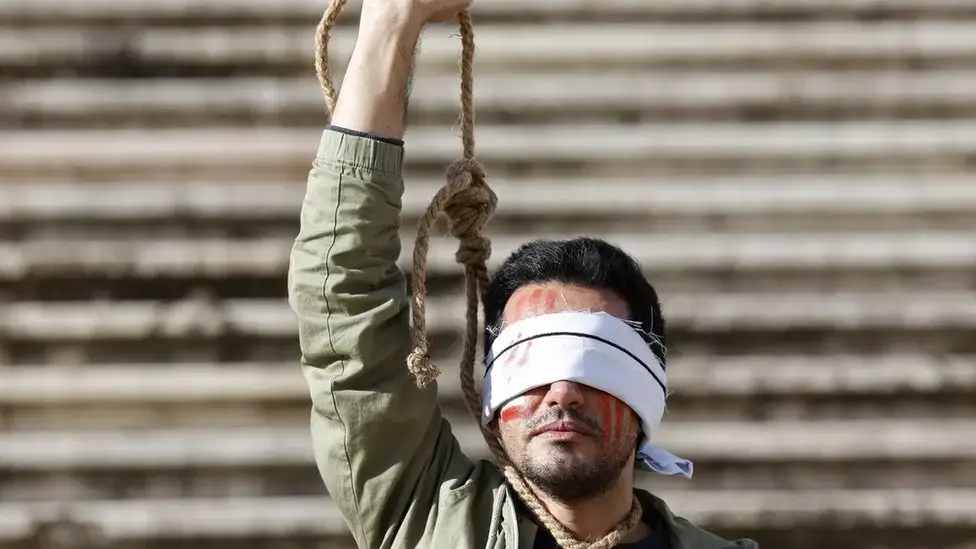
The rationale is not that public executions are more visible but that they inflict a distinctive harm. They contain an element of humiliation which amounts to violation of Article 7 (Nowak 2005). In determining whether an execution breaches Article 7, the CCPR has regard to relevant personal factors affecting the author, the specific conditions of detention on death row, and whether the proposed method of execution is “particularly abhorrent” (Taylor, 2020). Public execution is a paradigm case of a particularly abhorrent method as it converts a judicially sanctioned killing into a spectacle and subjects the condemned person to what the Human Rights Council has called “undignified exposure” (HRC 2015).
Failure to respect Article 7 renders the execution arbitrary in nature and thus also in violation of Article 6 (CCPR,2019) In other words, even if the death sentence itself satisfies Article 6(2) – the most serious crime, final judgement by a competent court – the manner of execution can independently violate Article 6(1) because it makes the deprivation of life arbitrary. The Secretary-General has restated this doctrine, noting that a failure to “respect Article 7 would render the execution arbitrary in nature and thus also violate article 6” (Secretary-General, 2024).
The prohibition is both ways. If public executions breach Article 7 because of their humiliation exposure, secret executions breach it because of the anguish they inflict on the condemned person’s family. In Schedko v Belarus, the CCPR found that the failure to notify a mother of the date of her son’s executions, and the refusal to disclose the location of his grave, amounted to inhuman treatment of the mother in violation of Article 7 (Jospeh & Castan 2013). The implication is that public executions and executions involving practices such as withholding notification or concealing burial information can give rise to distinct violations of Article 7. Such violations may also render the deprivation of life arbitrary under Article 6.e to the condemned person and their family.
5. The Death Penalty is Not a “Package Deal”
A retentionist stage might argue that because Article 6(2) permits the death penalty, it necessarily permits the state to choose the manner of execution, including a public one. This is the “package deal” fallacy, and it collapses under the structure of the covenant.
An execution must pass two separate and cumulative legal tests. Article 6 test asks whether the punishment is for a most serious crime, after a final judgment by a competent court, and whether the deprivation of the death penalty is non-arbitrary. Article 7 test asks whether the method of carrying it out is free from torture and CIDT. A state thus can satisfy the first test but fail on the second one.
But what makes this possible? Article 4(2) ICCPR lists rights from which no derogation may de made in a public emergency, and Article 7 is on that list. Once an Article 7 violation is established, an Article 6 violation follows automatically. A state cannot defend a public execution by pointing to the lawfulness of the underlying sentence.
6. Implications for Policy and Practice
For retentionist states, the minimum obligation is an immediate moratorium on public executions, followed by their legal prohibition and the adoption of execution protocols that ensure the least possible physical and mental suffering and respect for dignity (Special Rapporteur On Torture, 2012). The burden of proof is on the state to demonstrate that its method of execution complies with Article 7. As such, the prohibition on public executions is therefore a binding legal obligation.
For abolitionist states and international institutions, public executions should be treated as a red-line violation, not merely as a regrettable feature of an otherwise tolerated death penalty. Retentionist states must be transparent about their execution methods, yet, public executions persist in Afghanistan and Iran (Secretary-General, 2021). These ongoing practices give abolitionist states and international institutions a concrete basis to raise public execution as a distinct violation, even where they continue to engage in broader debates about abolition.
The deterrence rationale, often invoked to justify public executions, is legally irrelevant and empirically unsupported. There is no conclusive evidence to suggest that death penalty in itself deters crime more effectively than any other punishment. More importantly, even if deterrence could be demonstrated, it would not cure an Article 7 violation as the protection of this article is absolute and no balancing act is permitted (CCPR 2019, CCPR 2001)
The consistent practice of the UN bodies supports the view that the prohibition of public executions is an authoritative interpretation of Articles 6 and 7, and may contribute to the emergence of customary norm, if it has not already done so. Some scholars go further by arguing that capital punishment falls within the existing jus cogens prohibition on torture. (Bessler 2022) Whatever the correct view on the general penalty, the proposition that public executions are contrary to international human rights law is firmly established by the practice of international human rights bodies.
7. Conclusion
The question this article began with was whether the UN Human Rights Office was correct to characterise public executions as a breach of the absolute prohibition on torture and cruel, inhuman or degrading treatment. The answer is yes! The permission to execute under Article 6 is conditional and the prohibition on ill-treatment under Article 7 is a absolute and non-derogable. The two norms operate cumulatively. A state may satisfy the first and still fail the second, and when it does, the CCPR has made clear that the resulting execution is arbitrary under Article 6 as well.
Public executions therefore sit at the intersection of two violations. They breach Article 7 by converting a judicial killing into a spectacle of undignified exposure. Through that breach, they render the execution arbitrary under Article 6, because the manner of deprivation of life is no longer compatible with the Covenant.
References
Bessler, J. D. (2022). The death penalty’s denial of fundamental human rights Cambridge University Press.
European Union. (2008). EU guidelines on the death penalty. https://www.eeas.europa.eu/sites/default/files/08_hr_guidelines_death_penalty_en.pdf
Human Rights Committee. (2001). General comment No. 29: Article 4: Derogations during a state of emergency (CCPR/C/21/Rev.1/Add.11). https://digitallibrary.un.org/record/451555/?v=pdf
Human Rights Committee. (2019). General comment No. 36 (2019) on article 6 on the right to life (CCPR/C/GC/36). https://www.ohchr.org/en/documents/general-comments-and-recommendations/general-comment-no-36-article-6-right-life
Human Rights Council. (2015). Resolution 30/5: The question of the death penalty (A/HRC/RES/30/5). https://digitallibrary.un.org/record/811106?v=pdf
Human Rights Council. (2021). Resolution 48/9: The question of the death penalty (A/HRC/RES/48/9). Question of the death penalty :
Joseph, S., & Castan, M. (2013). The International Covenant on Civil and Political Rights: Cases, materials, and commentary (3rd ed.). OUP
Nowak, M. (2005). U.N. Covenant on Civil and Political Rights: CCPR commentary (2nd ed.). N. P. Engel.
OSCE Office for Democratic Institutions and Human Rights. (2016). The death penalty in the OSCE area: Background paper 2015. https://www.osce.org/odihr/266186
Secretary-General. (2024). Question of the death penalty: Report of the Secretary-General (A/HRC/57/26).https://digitallibrary.un.org/record/4056301
Taylor, P. M. (2020). A commentary on the International Covenant on Civil and Political Rights, CUP
United Nations. (1966). International Covenant on Civil and Political Rights (999 UNTS 171). https://www.ohchr.org/en/instruments-mechanisms/instruments/international-covenant-civil-and-political-rights
United Nations. (1989). Second Optional Protocol to the ICCPR, aiming at the abolition of the death penalty (A/RES/44/128). https://www.ohchr.org/en/instruments-mechanisms/instruments/second-optional-protocol-international-covenant-civil-and
United Nations Commission on Human Rights. (2003). Question of the death penalty (E/CN.4/RES/2003/67). https://www.refworld.org/docid/43f3134a12.html
United Nations Special Rapporteur on Torture (2012). Interim report of the Special Rapporteur on Torture (A/67/279) https://digitallibrary.un.org/record/733853