Introduction
In July 2024, the State Security Service of Georgia (SSSG) interrogated several Georgian volunteers returning from fighting Russia in Ukraine due to concerns that they could act as domestic disruptors (Civil.ge, 2024). This reflects a broader regional trend following Russia’s invasion: a surge in non-Ukrainian nationalist groups motivated by deep-seated grievances combating the Russian military (Rękawek, 2023). Since 2012, Georgia has been governed by the Georgian Dream party, which has pivoted toward Moscow, triggering immense domestic protests (Tavkhelidze, 2026). Given Georgia’s history of conflict, specifically the Russian-backed secessions of South Ossetia and Abkhazia in 1992 and the 2008 invasion, this shift is highly contentious (Vartanyan et al., 2018). Many citizens have rallied around Mamuka Mamulashvili, a veteran of these conflicts who departed to support Ukraine’s Euromaidan.
This framework informs our core research question: how does the political securitisation of returning volunteers reshape Georgia’s alignment and amplify threat narratives? By strictly focusing on the domestic political fallout in Tbilisi rather than battlefield tactics, this brief tracks legal enforcement patterns. It offers crucial policy insights for EU accession teams regarding how states can weaponise domestic legal codes against veterans during regional foreign policy shifts.
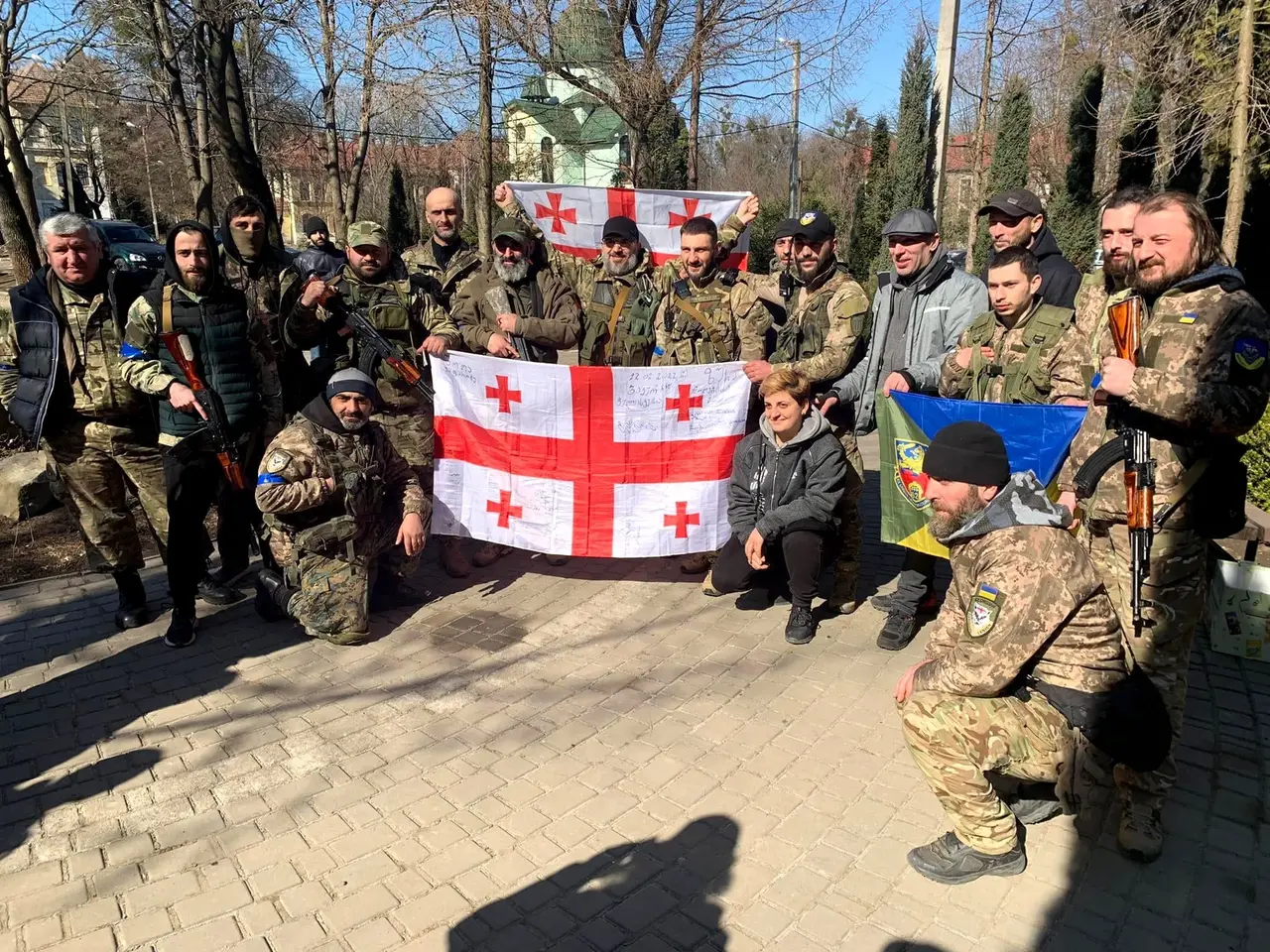
The Legion
Founded in April 2014 by Mamulashvili following Russia’s annexation of Crimea, the Georgian National Legion began as a volunteer unit opposing Russian intervention. It grew into a multinational force, gaining significant visibility after the 2022 invasion (Liklikadze et al., 2022). Its institutional status remains highly contested. While Mamulashvili claimed integration into the Ukrainian Armed Forces since 2016, Ukraine’s Defence Intelligence clarified in February 2025 that the Legion is not part of its structure and that Mamulashvili’s contract ended in April 2023. Consequently, the unit is distinct from Ukraine’s official International Legion and lacks military intelligence accountability (Pohorilov & Kutielieva, 2025). This disavowal strips fighters of formal combatant protections, exposing them to prosecution as illegal mercenaries.
Politically, the Legion polarises Georgia, intensifying domestic debates over foreign policy and ties to Moscow. Russia has designated it a terrorist organisation, alongside uncorroborated allegations of foreign destabilisation (Kvakhadze, 2022). Ultimately, the Legion is a transnational volunteer formation whose military, political, and state relationships must be evaluated independently. To understand its implications for Ukrainian politics, two specific mechanisms must be observed.
First Potential Mechanism of Disruption: Domestic political polarisation and the securitisation of opposition
The Georgian Legion could feed domestic instability mainly because of where it sits: at the meeting point of military volunteering, national identity and the fight over Georgia’s foreign-policy direction. Since it was founded in 2014, the Legion has become known for standing against Russian aggression. That reputation has also been pulled into Georgia’s political divisions, especially the disagreements over how the government deals with Moscow, how it treats Ukraine, and how far the country should go in its European integration ambitions (Lorusso, 2024).
Securitisation is a useful way to look at this. It describes how a political actor presents an issue as an existential security threat, which can then justify exceptional measures. The question here is whether the Legion’s military background and international contacts make it easier to recast political disputes as national-security threats. This became visible in September 2023, when Georgia’s State Security Service alleged that people linked to former Georgian officials and Ukrainian institutions were preparing to destabilise the government. The allegations included claims about Georgians fighting in Ukraine. The authorities presented the supposed plot as a security threat (Askew, 2023), but the reporting available at the time did not independently establish the claims.
What matters about this episode is not whether the plot was real but what such accusations do to domestic political competition. Linking volunteers to a possible coup can damage their public legitimacy, deepen suspicion of political opponents and give the state a reason to look more closely at anyone connected to Ukraine. And if the authorities cannot back up serious allegations, the fallout can widen the distrust between the government, the opposition and parts of the public.
Georgia’s wider political climate makes this mechanism more relevant. In 2024, the Finnish Institute of International Affairs argued that polarisation and falling trust between the government and Western institutions could leave Georgia more open to outside interference (Saari, 2024). In that climate, the Legion will be a focal point for competing stories. Government supporters might present its international connections as proof of foreign interference, while its own supporters might read official scrutiny as an attempt to discredit opposition to Russian influence. Both readings can have real political effects even if there is no proof that the Legion is directing or coordinating unrest at home. The risk, then, is not necessarily that the formation could overthrow the government, but that its existence and activities become tools that political actors use to sharpen existing divisions.
Another concern is the effect on civil–military relations and on trust in the state’s security institutions. If returning volunteers are treated first of all as potential threats, that could discourage open reintegration and reinforce the sense that serving alongside Ukraine has political costs at home. On 14. October 2026, IntelliNews published a report summarising allegations by Transparency International Georgia, which raised concerns about Georgian volunteers facing prosecutions under Russia’s Article 359(3) (mercenarism) as well as domestic legal proceedings under Georgia’s Criminal Code Article 223 (illegal armed formations) and Article 315 (conspiracy against the constitutional order). These empirical cases show that volunteering is still a live issue.
Second Potential Mechanism of Disruption: Transnational military networks and external exploitation
The second mechanism has to do with how the Legion’s transnational networks interact with the wider strategic competition between Russia, Georgia and Ukraine. A foreign volunteer formation is different from a conventional domestic political organisation, because it can build relationships, military experience and public influence across several countries at once. Those connections may have security implications well beyond the battlefield, although how much they matter depends on what the organisation can actually do and how independent it really is. The Legion’s history shows this transnational side. It was set up to fight in the Donbas in 2014, later drew volunteers from several countries, and expanded its public communications once Russia launched its full-scale invasion in 2022. Current research shows how the Legion used strategic communications, including online messaging and public interviews, to build its identity, win attention, and set out its goals. This suggests that its influence cannot be judged by its battlefield record alone, since its international visibility also shapes how audiences understand the war and Georgia’s relationship with Russia (Kvakhadze, 2022).
One risk is that military networks outlast the conflict that created them. Combat experience, personal relationships and international contacts may stay relevant after individual volunteers leave service. But the existence of such networks does not show that they amount to an independent paramilitary capability, or that their members plan to use political violence. Judging this risk would take evidence on personnel movements, organisational continuity, access to resources and documented activity outside Ukraine. Without that, claims that the Legion could carry its military capabilities into Georgia should stay hypotheses, not conclusions. A second concern is that Russia could exploit the Legion’s activities, or allegations about them, to damage Georgia’s relations with Ukraine and its Western partners. International IDEA’s analysis of foreign information manipulation and interference treats Georgia as a case where outside narratives feed into domestic political divisions. It stresses that foreign interference can be amplified by local actors who see a political advantage in pushing a particular reading of events (Sawaris, 2025).
The Legion could matter in this process because its link to Ukraine supplies material for rival narratives about foreign influence, sovereignty, and political loyalty. Russian state messaging could present Georgian volunteers as proof that Ukraine or Western governments are meddling in Georgian affairs. Georgian political actors could also point to the Legion to back up their own claims about external threats. The result could be more distrust between Georgia and Ukraine, a harder time for bilateral security cooperation, and less room for independent investigation of genuine threats.
In the end, the regional security risk depends on whether these networks produce real, demonstrable consequences, such as worsening Georgian–Ukrainian relations, the transfer of military capabilities into domestic political conflict, or credible retaliation against volunteers.
Conclusion
The risk to stability comes from how external actors weaponise the Georgian National Legion, not from the Legion’s own capabilities. Asking if the Legion is dangerous is the wrong test; the better question is who gains from treating it as such.
The Legion’s ambiguity, disputed status, opaque membership, and unclear ties to Ukrainian institutions allow conflicting narratives to flourish: The Georgian government frames opposition as foreign-backed; Moscow portrays Ukraine and the West as meddling; and supporters view any scrutiny as persecution. These domestic accusations and external narratives feed into a single, destabilising loop. Paradoxically, the most plausible path to instability is state overreaction and prosecuting volunteers on thin evidence, which creates the very grievances feared.
The restructuring late last year complicated this. While Ukraine disbanded its Ground Forces’ standalone “International Legions” in late 2025, the Georgian National Legion integrated into the Ukrainian Volunteer Army (UDA). This protected its institutions but stripped it of a clear chain of military accountability, making accusations harder to verify. Ultimately, Georgia demonstrates a broader trend since 2022: foreign volunteer formations have become political instruments at home, serving as stand-ins for existing domestic conflicts over Russia, Europe, and government legitimacy.
References
Askew, J. (2023, September 19). Tbilisi accuses Ukrainian official of plot to overthrow Georgian government. Euronews. https://www.euronews.com/2023/09/19/tbilisi-accuses-ukrainian-official-of-plot-to-overthrow-georgian-government
Cecire, M. (2013, April 2). Georgia’s 2012 elections and lessons for democracy promotion. Foreign Policy Research Institute. https://www.fpri.org/article/2013/04/georgias-2012-elections-and-lessons-for-democracy-promotion/
Civil.ge. (2024, July 22). SSSG summons Georgian fighters in Ukraine. https://civil.ge/archives/617135
IntelliNews Eurasia desk. (2026, October 14). Transparency says Georgia is prosecuting volunteer soldiers who fought for Ukraine in parallel with Russian charges. bne IntelliNews. https://www.intellinews.com/transparency-says-georgia-prosecuting-volunteer-soldiers-who-fought-for-ukraine-in-parallel-with-russian-charges-475499/
Vartanyan, O., Gutiérrez Lucena, J., Malaney, M. (2018). Fenced in: Stabilising the Georgia-South Ossetia separation line (Europe Report No. 244). https://www.crisisgroup.org/phe/europe-central-asia/georgia/fenced-stabilising-georgia-south-ossetia-separation-line
International IDEA. (n.d.). Beyond the “foreign” in FIMI: The blurred line between foreign interference and its domestic drivers. https://www.idea.int/fimi/update/beyond-foreign-fimi-blurred-line-between-foreign-interference-and-its-domestic-drivers
Kvakhadze, A. (2022). Foreign fighters in the Russia-Ukraine war. Security Review. Georgian Foundation for Strategic and International Studies. https://gfsis.org.ge/publications/view/3269
Liklikadze, K., Tarkhnishvili, N., Wesolowsky, T. (2022, December 18). ‘We have a common enemy’: Georgian soldier says Ukraine’s fight against Russia is his country’s, too. Radio Free Europe/Radio Liberty. https://www.rferl.org/a/ukraine-war-georgia-fighters-russia-invasion/32181784.html
Lorusso, M. (2024, July 28). Georgian Legion: Between war and politics. Caucasus Watch. https://caucasuswatch.de/en/insights/georgian-legion-between-war-and-politics.html
Pohorilov, S., Kutielieva, I. (2025, February 1). Ukraine’s Defence Intelligence responds to Slovak PM’s accusation: We have no unit named Georgian National Legion. Ukrainska Pravda. https://www.pravda.com.ua/eng/news/2025/02/1/7496285/
Radio Free Europe. (2022, December). ‘We have a common enemy’: Georgian soldier says Ukraine’s fight against Russia is his country’s, too. https://www.rferl.org/amp/ukraine-war-georgia-fighters-russia-invasion/32181784.html
Rękawek, K. (2023). Foreign fighters in Ukraine: The Brown–Red Cocktail. Routledge. https://www.routledge.com/Foreign-Fighters-in-Ukraine-The-Brown-Red-Cocktail/Rekawek/p/book/9781032043982
Saari, S. (2024, June). Georgia’s government is playing with fire: Internal polarisation invites external interference (FIIA Comment 4). Finnish Institute of International Affairs. https://fiia.fi/en/publication/georgias-government-is-playing-with-fire
Sawaris, M. (Ed.). (2025, December 18). Resisting foreign information manipulation and interference: A stress test for democracies. International IDEA. https://doi.org/10.31752/idea.2025.94
Tavkhelidze, G. (2026). Georgia’s pseudo-hedging between 2022 and 2024: The ruling party’s rhetorical shifts and democratic backsliding. Central Asian Survey, 45(1), 89–107. https://www.tandfonline.com/doi/full/10.1080/02634937.2025.2604065