



Miguel Ángel Pérez Triano Resignation
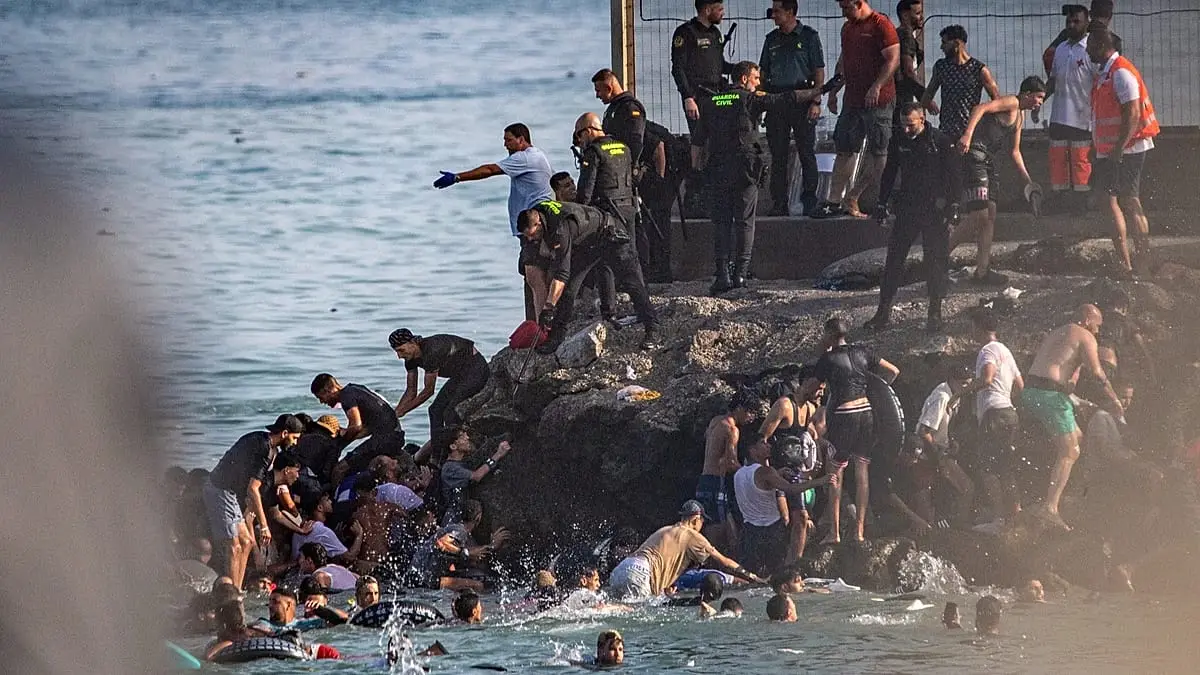
On Monday, 28 September 2026, Miguel Ángel Pérez Triano, the Spanish Government Delegate in Ceuta, resigned from his post. He did so, saying that he had received threats against himself, his family and his friends. This is related to the events that took place in Ceuta on 30th July 2026. That day, approximately 80,000 people crossed from Morocco into Ceuta, mainly by sea, a city with a population of 83,000. As of today, around 10,000 remain there. The aim of this article is not to provide a detailed account of what happened or to look for those responsible, but rather to gain a better understanding of how this humanitarian crisis has been used politically and how it has become yet another tool for political manoeuvring.
From the moment the crisis erupted, citizens, the media, and politicians alike have asked the same question: ‘How could something like this have happened without anyone doing anything to stop it?’ It is a legitimate question to which we still have no answer and for which judicial proceedings have been opened. However, 60 days after what happened, the question being asked most frequently in the Spanish Parliament is not that one, but rather: ‘Whose fault is it, and why isn’t it mine?’ That is the way it is. At times of crisis, when the public most needs a coherent response, politicians become more divided.
The Criminal Gangs Involved
Indeed, each Spanish political party has rushed to identify who it believes is behind the mobilisation of 80,000 people. The suspects include Morocco, criminal gangs, the ruling of the Spanish Supreme Court, migrant regulations and Pedro Sánchez himself. What is truly revealing is that it is not the facts that lead each actor to choose one explanation over another, but their political interests.
The Government, led by the PSOE (Spanish Socialist Workers’ Party), described what happened as a ‘violation of Spain’s territorial integrity’, blaming criminal gangs and leaving the Moroccan government out of the equation. Indeed, Spain–Morocco relations make it difficult to formally accuse Morocco of anything, mainly because of its role in controlling the migratory flows arriving in Spain. The People’s Party, the main opposition party, accused the Prime Minister of having ‘left Spain unprotected’ and demanded that elections be called. Its main argument was that what had motivated so many people to come was the government’s lax migration policy, while it refrained from explicitly mentioning Morocco. This is understandable if we consider that opinion polls give it a winning position in the next elections, and it could not afford to enter them with poor relations with its southern neighbour. Finally, VOX, the far-right party, described what happened as an ‘invasion’ and accused Sánchez of allowing it to happen. It claims that Spain is subject to Morocco and that relations must be severed in order for the country to conduct its foreign policy as it should.
What happened in Ceuta?
What happened in Ceuta has become an internal political dispute with international externalities. Consequently, when the aim is to project a domestic image, foreign-policy actions lose their rigour and relevance. By naming criminal gangs as responsible, the Government protected its relationship with Morocco, but at the same time appeared lenient towards the perpetrators of a violation against its country. Although discreet diplomacy may be understandable, it produces rhetoric without clear consequences and leaves opposition parties to fill the vacuum by meeting the public’s expectation of action.
What is truly interesting about all this is how political interests have taken centre stage in the debate, while the reality of the people in Ceuta – both migrants and Ceutans – has been relegated to the background. Shouldn’t humanitarian crises affecting our country bring us together? Unfortunately, this is not the first time we have seen such events in Spain quickly become political arguments, used in debates that exclude citizens. In 2004, when Madrid fell victim to a jihadist attack just three days before the general election, the People’s Party government focused on proving a connection to the domestic terrorist organisation ETA, despite there being no evidence of one. Many argued that acknowledging Al-Qaeda’s responsibility would have meant admitting that Spain’s presence in Iraq had had deadly consequences for Spanish civilians, as demonstrated by the unprecedented scale of the 11 March Madrid attacks, and would have meant, as it did, losing the election.
In 2004, in 2026, in Spain and in many other countries, humanitarian crises quickly lose their humanitarian character in politicians’ eyes. How often have Ceuta’s fatalities been discussed? It is estimated that around 90 people lost their lives as a result of the mass arrival of migrants in July. In addition, around 2,493 minors are still waiting to find out what will become of them. Ceuta’s social and healthcare services have been stretched to their limits for far too long and do not have the resources to deal with this situation. This is the reality in Ceuta today.
Although determining responsibility for events such as these is highly important for any country, we are losing sight of the fact that the victims are not the Government or the parties, but citizens and immigrants. We have become accustomed to this type of crisis turning into political debates about who is to blame and who would have handled it better. These debates arrive at the worst possible moment, when the public most needs a rapid, coherent and, above all, humanitarian response. There will always be time to trade blame, but the objective of any politician, whether in government or not, should be the well-being of the people. So tell me: in what way have politicians helped Ceuta?