
1. Introduction
Since 2019, European Union law has required national capacity mechanisms to admit power plants located in other Member States, yet foreign capacity still wins only a modest share of what these mechanisms buy. The obligation sits in Article 26 of Regulation (EU) 2019/943 on the internal market for electricity, part of the Clean Energy Package, and was meant to stop each Member State from securing its supply as if its borders were closed. For several years, however, the rule existed mostly on paper. 2024 was the first year in which regional coordination centres recommended how much foreign capacity each national mechanism should admit (European Union Agency for the Cooperation of Energy Regulators [ACER], 2024), and in October 2024 Belgium contracted foreign capacity for the first time (Elia, 2024). The system has now run long enough to produce auction results, so what the literature could previously only model can finally be tested against evidence.
This article asks the following research question: what factors continue to limit cross-border participation in EU capacity mechanisms despite the existence of common European regulations? Cross-border participation here means direct participation under Article 26, in which a resource located in one Member State holds a capacity contract in another. Great Britain is excluded, because since leaving the EU its mechanism lies outside Article 26 and cannot test the rule. Strategic reserves are excluded as well, since Article 26(1) makes their opening conditional on technical feasibility. The article leaves aside the separate debate on whether capacity mechanisms are justified at all.
The question matters because the sums involved are considerable. Member States spent almost €11 billion in 2024 on nearly 40 security-of-supply measures (ACER, 2025), and every megawatt procured at home that could be sourced more cheaply abroad adds to that bill. Regulators and transmission system operators (TSOs), which write the rules for foreign entry, and investors deciding whether a neighbouring mechanism is worth entering are the most direct beneficiaries of a clear answer. Scientifically, the literature predates the evidence: Roques (2019) mapped the practical obstacles before the rules applied, and Menegatti and Meeus (2024) showed in a model that foreign participants earn almost nothing. This article adds the empirical layer by confronting these arguments with the first auctions held under the full Article 26 framework.
The answer, in one sentence, is that foreign capacity is paid little for a commitment that guarantees the buying country no electricity in a shared shortage, so staying at home is the rational choice. The analysis combines a legal review of Article 26 and its implementing acts, a secondary analysis of auction results published by TSOs and regulators in Belgium, Poland, Italy and France, and a review of the academic and policy literature. Sections 2 and 3 explain what capacity mechanisms are and what Article 26 promised, and Section 4 presents what the auctions delivered. Section 5 explains why participation stays limited, Section 6 weighs whether this reflects slow implementation or the design itself, and Section 7 concludes.
2. Capacity mechanisms and the adequacy problem
A capacity mechanism pays power plants, storage operators and flexible consumers for being available, not only for the electricity they sell. These energy sector participants are being paid to be ready to decrese, increase or temporarily stop electricity usage. Article 2(22) of Regulation (EU) 2019/943 defines it as a measure to ensure resource adequacy by remunerating resources for their availability, where resource adequacy means having enough resources to meet demand when the system is tightest (Florence School of Regulation, 2024). Governments introduce such mechanisms because a plant needed for only a few hours of scarcity each year struggles to recover its fixed costs when prices are capped or when policymakers intervene as soon as prices spike (Florence School of Regulation, 2024; Holmberg et al., 2025). A capacity payment therefore works like a retainer paid to a fire brigade: its value lies in being on call, not in the hours spent putting out fires.
The mechanisms in use fall into two main categories. A strategic reserve keeps a small number of plants outside the market and activates them only in a shortage, as in Germany, Sweden and Finland. A capacity market procures firm capacity through regular auctions held up to four years ahead of delivery, and operates in France, Belgium, Italy, Ireland and Poland; it is centralised where the TSO buys on behalf of consumers and decentralised in France, where suppliers must buy capacity certificates (Florence School of Regulation, 2024). Belgium, Ireland and Italy use reliability options, contracts under which providers pay back revenue when wholesale prices exceed a set strike price. Capacity markets already cover about 40% of EU electricity demand, and no two Member States have designed them alike (Florence School of Regulation, 2024; Holmberg et al., 2025).
The price tag explains why the question deserves attention. Capacity mechanisms cost €7.4 billion in 2023 (ACER, 2024) and €6.5 billion in 2024, more than double the 2020 level, while auction prices varied more than tenfold across the EU (ACER, 2025). The 2024 market design reform, Regulation (EU) 2024/1747, removed the words “temporary” and “last resort” from the legal framework, and the Clean Industrial Deal State Aid Framework of June 2025 added a fast-track approval route (Holmberg et al., 2025). With an integrated market estimated to need 19% less back-up capacity by 2030 than isolated national markets (Zachmann et al., 2024, as cited in Holmberg et al., 2025), much depends on whether capacity can cross borders.
3. What Article 26 actually requires
Article 26 promises open access, but only up to a ceiling set by grid operators. Article 26(1) provides that capacity mechanisms other than strategic reserves shall be open to direct cross-border participation of capacity providers located in another Member State. Under Article 26(7), TSOs set a maximum entry capacity (MEC) for each border every year, on the recommendation of the regional coordination centre, taking into account the expected availability of interconnection and the likelihood that both systems face stress at the same time. Entry capacity is then allocated to eligible providers, the resulting revenues are shared between TSOs, and the TSO where the foreign resource is located runs availability checks and applies non-availability payments (Article 26(8) to 26(10)). The rule therefore guarantees access to no particular volume, it grants access up to a number that the operators themselves calculate.
Turning this promise into a working procedure took five years. Article 26(11) required the European Network of Transmission System Operators for Electricity (ENTSO-E) to submit, by 5 of July 2020, methodologies for calculating MEC, sharing revenues, checking availability, determining non-availability payments, operating a registry and identifying eligible capacity. ACER adopted the resulting technical specifications in Decision No 36/2020 of 22. December 2020, but the provisions on MEC could only apply once the regional coordination centres were established and results of the European Resource Adequacy Assessment (ERAA) were available (ACER, 2020). ACER approved an ERAA for the first time only for the 2023 edition, and 2024 was the first year in which regional coordination centres recommended entry capacities (ACER, 2024). The machinery that Article 26 describes has therefore operated in full for barely two auction cycles.
State aid control adds a second layer. Every capacity mechanism requires Commission approval under the Guidelines on State aid for climate, environmental protection and energy, whose non-discrimination principle requires cross-border resources capable of providing the same service to be eligible (European Commission, 2022; Florence School of Regulation, 2024). The Commission approved the Belgian mechanism only after an in-depth investigation (European Commission, 2021), and in March 2025 it reported on how the approval procedure could be streamlined (European Commission, 2025). Holmberg et al. (2025) conclude that EU action has concentrated on preventing harm to the internal market, while limited efforts to encourage cross-border coordination have produced no substantive progress. The framework is complete, but it is built to permit foreign participation rather than to make it attractive.
4.What the auctions show
Belgium provides the clearest example of the rule working as intended. In the Y-1 auction for delivery year 2025/2026, published on 31. October 2024, it selected 1,260 MW of foreign capacity, 976 MW from the Netherlands and 284 MW from Germany, the first foreign capacity in the mechanism’s history (Elia, 2024). The contribution from France was assessed at zero, so the border with Belgium’s largest neighbour stayed closed by calculation (ACER, 2024). Belgium thus shows that foreign participation can function, and equally how decisively the entry calculation shapes the result.
Poland shows the more common pattern of real participation well below the permitted volume. In the main auction for delivery in 2028, held on 14. December 2023, foreign units from Czechia, Slovakia and Sweden won slightly over 1 GW of more than 7 GW contracted (Energy Regulatory Office, 2024). Ministerial parameters had capped foreign volumes at 1,820 MW for the synchronous profile zone, 424 MW for Lithuania and 600 MW for Sweden (Minister of Climate, 2023), so foreign providers filled little more than a third of the 2,844 MW available, and ACER (2024) confirms that entry capacities were reached on no border. Later auctions stayed at the same order of magnitude: just over 1.5 GW of more than 8 GW for 2029, and almost 1 GW of nearly 6.9 GW for 2030 (Energy Regulatory Office, 2025, 2026).
Prices tell a sharper story than volumes. For delivery in 2030, Polish units cleared at 465.02 PLN/kW/year, while foreign units in the synchronous profile zone cleared at 78.00 PLN/kW/year, about one sixth of the domestic price (Energy Regulatory Office, 2026). In Italy’s auction for 2027, 4,200 MW of foreign capacity at the northern border received €7,199 per MW per year, against a premium of €47,000 per MW per year for domestic capacity (ESS News, 2025). In France, the remuneration of interconnectors for delivery in 2024 was ten times lower than for 2023 (ACER, 2024). Table 1 summarises the four cases.
| Country | Route for foreign capacity | Foreign capacity non-tracted | Foreign price to domestic |
|---|---|---|---|
| Belgium | Direct participation of Dutch and German resources; entry from France assessed at zero | 1,260 MW, delivery 2025/2026 | Not reported in the sources used |
| Poland | Direct participation in three foreign zones with ministerial volu-me caps | Almost 1 GW of nearly 6.9 GW, delivery 2030 | Synchronous zone: 78.00 against 465.02 PLN/kW/year |
| Italy | Separate foreign ca-pacity product at each border | 4,365 MW, delivery 2027 | Northern border: €7,199 against €47,000 per MW/year |
| France | Remuneration of in-terconnection capacity | Not quantified in the sources used | 2024 remuneration one tenth of the 2023 level |
Figure 1 compares contracted foreign capacity with the entry capacity available in Belgium and Poland.
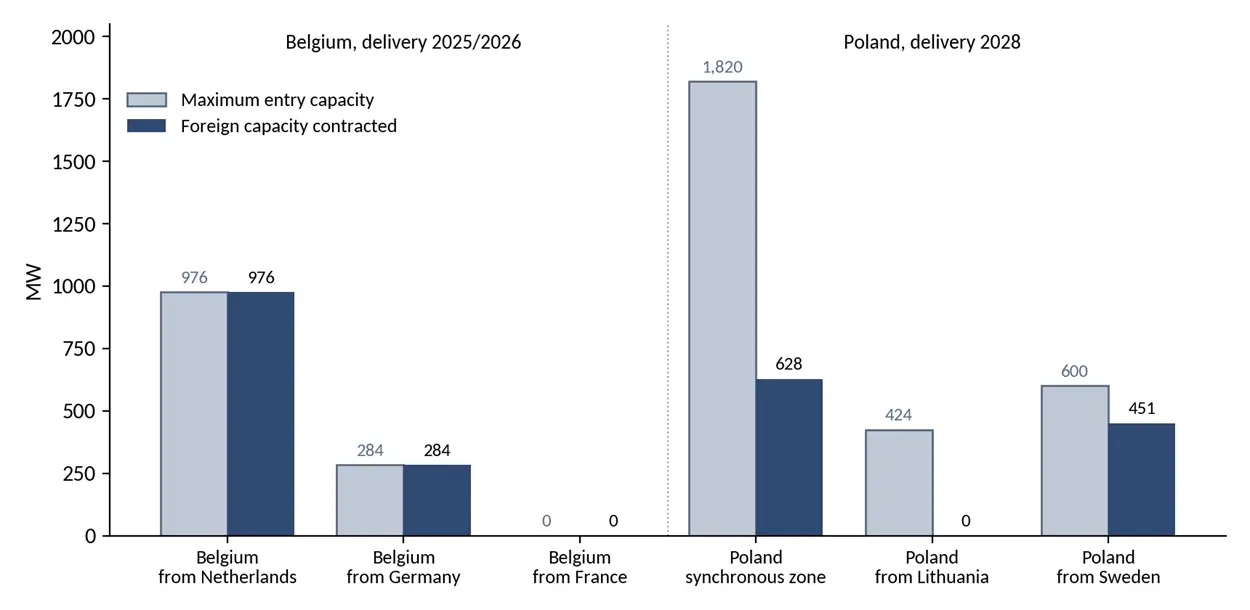
The figure shows two outcomes under one rule. Belgium filled its entry capacity on both open borders, while Poland left most of the synchronous zone’s ceiling and all of Lithuania’s unused. Across the four mechanisms, foreign capacity is present but modest, and where prices are published it earns a fraction of the domestic price. The door is open, but few find it worth walking through.
5. Why participation stays limited
The weakest link is revenue. A foreign provider earns the capacity price of the zone it bids into, but the entry capacity it needs is itself a scarce right, and the revenue it generates is shared between TSOs under Article 26(9). Modelling by Menegatti and Meeus (2024) shows that revenues received by foreign generators in a neighbour’s capacity market are close to zero, and Holmberg et al. (2025) add that participation becomes unattractive, even when economically efficient, where booking transmission capacity is expensive. The auction data are consistent with this, since foreign capacity received roughly one sixth of the domestic price in Poland’s 2030 auction and about 15% of the domestic premium in Italy’s 2027 auction. At such levels, the foreign payment is a marginal addition to revenue and is unlikely to change an investment decision.
The buying country cannot count on foreign capacity at the moment it needs it most. Under EU rules, electricity flows across borders according to market coupling rather than capacity contracts, and cutting cross-border flows in a shortage would breach internal market law. Holmberg et al. (2025) nevertheless identify distrust of the market during scarcity as a major driver: Member States fear that interconnection capacity will be reduced or flows limited, and therefore regard foreign capacity as riskier than domestic procurement (Roques & Verhaeghe, 2022, as cited in Holmberg et al., 2025). Article 26(7) writes this suspicion into the rule itself by instructing operators to discount entry capacity for the likelihood of simultaneous stress.
The same logic invites free-riding. Because internal market rules prevent restrictions on foreign access to domestically procured capacity, one country’s mechanism also helps secure supply next door (Holmberg et al., 2025). A neighbour that benefits anyway has little reason to contribute, and a buyer has little reason to pay abroad for what spills over regardless. Both sides therefore value cross-border capacity weakly.
Even a willing bidder meets a physical ceiling. The MEC reflects expected interconnection availability, and although Article 16(8) of Regulation (EU) 2019/943 requires TSOs to offer at least 70% of cross-zonal capacity for trade, Holmberg et al. (2025) note that TSOs keep margins to manage operational issues. The effect is visible at the French-Belgian border, assessed at zero, and in Poland, where foreign entry for 2028 was capped at 2,844 MW (ACER, 2024; Minister of Climate, 2023). The ceilings sit far below the potential, since interconnectors could in theory cover about 40% of German peak load (Stiewe et al., 2025, as cited in Holmberg et al., 2025).
Procedure raises the cost of entry further. Each mechanism defines its product, lead time, derating factors and penalties differently, and national reliability standards range from one hour of expected loss of load per year in Sweden to 6.7 hours in Czechia (Holmberg et al., 2025). Certification is cumbersome and relatively costly, especially for smaller providers, and must be completed separately for every mechanism. Most importantly, costly new-build capacity is procured years ahead in auctions that are, in practice, not open to cross-border competition (Holmberg et al., 2025), so foreign capacity enters mainly where volumes are smallest and commitments shortest.
6. Implementation failure or design consequence?
Most of the evidence supports the answer given in the introduction. Foreign capacity earns a fraction of domestic prices in Poland, Italy and France, Polish auctions left most entry capacity unused, and the French border with Belgium stayed closed by calculation. These observations match the modelled prediction of near-zero revenues and the literature’s emphasis on distrust during scarcity. Article 26 transfers a payment across the border, not a firm claim on electricity.
Some of the evidence, however, cuts against that answer and must be stated openly. Belgium filled its entry capacity on both open borders at the first attempt, and foreign contracts in Poland rose from slightly over 1 GW for 2028 to just over 1.5 GW for 2029, which is not how an inert mechanism behaves. The low foreign price in Poland’s 2030 auction also admits two readings, either a low value placed on foreign capacity or intense competition among foreign bidders for a limited entry volume, and the aggregate data used here cannot separate them. The most plausible reconciliation is that participation appears where commitments are short and entry volumes modest, and stays marginal where it would matter most, in the long-term auctions that finance new capacity.
The two readings in the title are therefore not mutually exclusive. The five-year delay before Article 26 applied in full was an implementation failure, and it is fading as regional coordination centres and the ERAA mature. Weak revenues, the absence of firm delivery and free-riding, by contrast, follow from the design and will not disappear with time. This supports Menegatti and Meeus (2024), who call explicit cross-border participation a false hope and argue for evolving towards a Europeanised adequacy mechanism, and Holmberg et al. (2025), who propose making approval of national mechanisms conditional on regional coordination. This article adds the first post-implementation auction evidence to these largely model-based arguments.
The evidence has clear limits. It covers four mechanisms and few delivery years, so it cannot establish a trend, and the Belgian case rests on a single auction. Per-border volumes rely partly on ACER summaries rather than full auction datasets, and no data were available on rejected bids or on the costs foreign providers incur to participate. Finally, entry capacities depend on the ERAA, whose methodology remains disputed (Holmberg et al., 2025), so the benchmark against which participation is measured is itself contestable.
7. Conclusion
This article asked why cross-border participation in EU capacity mechanisms remains limited despite common European rules. The first auctions held under the full Article 26 framework show foreign capacity to be present but modest, and usually paid a fraction of the domestic price. The main reason is structural: the buying country pays for availability abroad without gaining a firm claim on electricity in a shared shortage, while grid ceilings, divergent national designs and the exclusion of foreign capacity from long-term auctions reinforce this weakness. Slow implementation explains the delay until 2024, but not the limited participation since then.
For the current reform debate, the implication is that streamlining national approvals will not by itself integrate capacity mechanisms across borders. Two questions follow for future research. The first is whether target models under the new State aid framework will open the long-term auctions, in which new capacity is financed, to foreign providers. The second is whether regional mechanisms with joint rules for scarcity and cost-sharing would deliver the integration that the present model has not achieved.
References
ACER. (2020). Decision No 36/2020 of 22 December 2020 on the technical specifications for cross-border participation in capacity mechanisms. European Union Agency for the Cooperation of Energy Regulators.
ACER. (2024). Security of EU electricity supply: 2024 monitoring report. European Union Agency for the Cooperation of Energy Regulators.
ACER. (2025, 20. November). €11 billion spent EU-wide on fragmented electricity security-of-supply support in 2024 [Press release]. European Union Agency for the Cooperation of Energy Regulators. https://www.acer.europa.eu/news/eu11-billion-spent-eu-wide-fragmented-electricity-security-supply-support-2024
Elia. (2024, 31. October). Elia publishes CRM auction results: Guaranteed security of supply for 2025-2026 and major progress made regarding 2028-2029 [Press release].
Energy Regulatory Office. (2024). Electricity market: President of URE announces the results of the main auction on the capacity market for deliveries in 2028. https://www.ure.gov.pl/en/communication/news/368,Electricity-market-President-of-URE-announces-the-results-of-the-main-auction-on.html
Energy Regulatory Office. (2025). Electricity market: The President of URE announces final results of the 2029 main power supply market auction. https://www.ure.gov.pl/en/communication/news/413,Electricity-Market-The-President-of-URE-Announces-Final-Results-of-The-2029-Main.html
Energy Regulatory Office. (2026). The President of URE announces the final results of the main capacity market auction for 2030 deliveries. https://www.ure.gov.pl/en/communication/news/504,The-President-of-URE-announces-the-final-results-of-the-main-capacity-market-auc.html
ESS News. (2025, 28. February). Terna allocates 43 GW in Italian capacity market auction for 2027. https://www.ess-news.com/2025/02/28/terna-energy-storage-capacity-auction-2027-delivery-results/
European Commission. (2021). State aid SA.54915: Belgium, capacity remuneration mechanism.
European Commission. (2022). Guidelines on State aid for climate, environmental protection and energy 2022 (2022/C 80/01). Official Journal of the European Union, C 80, 1–89.
European Commission. (2025). Report on the assessment of possibilities of streamlining and simplifying the process of applying a capacity mechanism under Chapter IV of Regulation (EU) 2019/943 (COM(2025) 65 final).
Florence School of Regulation. (2024, 30. July). Capacity mechanisms. European University Institute. https://fsr.eui.eu/capacity-remuneration-mechanisms/
Holmberg, P., Maurer, C., Morawiecka, M., Roques, F., & Zachmann, G. (2025). Europe’s electricity capacity mechanisms need to be better coordinated (Policy Brief 30/2025). Bruegel.
Menegatti, E., & Meeus, L. (2024). Cross-border participation: A false hope for fixing capacity market externalities? (Working Paper RSC 2024/53). Robert Schuman Centre for Advanced Studies. https://doi.org/10.2139/ssrn.5029186
Minister of Climate. (2023). Regulation of 4 August 2023 on parameters for the main auction for delivery year 2028 and the parameters for the additional auctions for delivery year 2025 (Journal of Laws 2023, item 1561).
Regulation (EU) 2019/943 of the European Parliament and of the Council of 5 June 2019 on the internal market for electricity (recast). (2019). Official Journal of the European Union, L 158, 54–124.
Regulation (EU) 2024/1747 of the European Parliament and of the Council of 13 June 2024 amending Regulations (EU) 2019/942 and (EU) 2019/943 as regards improving the Union’s electricity market design. (2024). Official Journal of the European Union, L series.
Roques, F. (2019). Counting on the neighbours: Challenges and practical approaches for cross-border participation in capacity mechanisms. Oxford Review of Economic Policy, 35(2), 332–349. https://doi.org/10.1093/oxrep/grz008