
Diversification, Not Retreat: How Saudi Arabia and the UAE Are Reshaping Their Economies.
Introduction
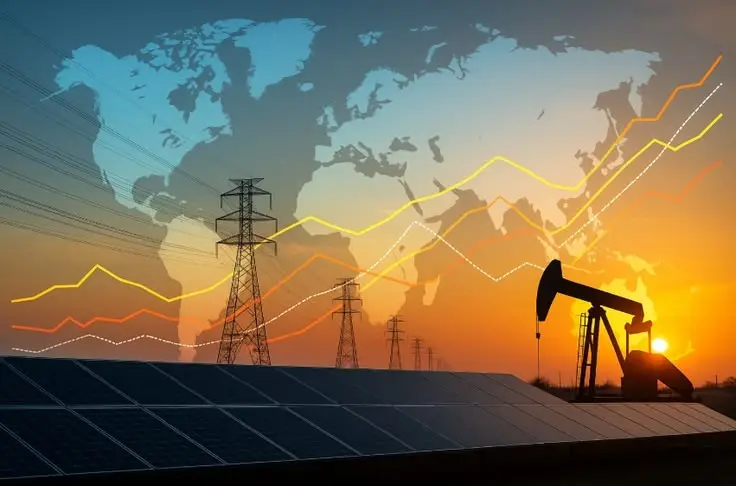
The global climate landscape, marked by rising temperatures, natural disasters, and environmental degradation, highlights the need for more environmentally friendly practices. In terms of energy, this does not mean a complete halt to fossil fuel use, but it is a start toward moving away from them and opting for renewable energy sources such as solar or wind power. This shift is highly significant for countries that rely on their oil markets, which are one of the most important components of their economy and an important tool of geopolitical power; this is the case of the Arab Gulf states. Stringent climate policies and technological advancements are forcing more sustainable governance, and in oil-dependent countries, this pushes them to consider alternatives that could maintain their economic and diplomatic advantages (Alli & Abdalla, 2025, p. 1). Today, demand is shifting from gas and coal to lithium and cobalt, vital to producing green energy. As a result, those investing in new and greener technologies are gaining relevance in the political landscape, as is the case with China. Hence, new alliances emerge, and power conflicts are more likely to occur (p. 2). While this shift is relevant across the entire Gulf region, this report will focus on two main cases, which represent some of the most developed transition strategies: Saudi Arabia and the United Arab Emirates (UAE). These nations have created national agendas and increased green investment to become more sustainable and follow global environmental trends (pp. 2-3).
Overall, the global and regional context raises the research question: how are Gulf states adapting to the global energy transition, and what are the economic and geopolitical implications of their strategies? This question will be answered first by introducing the background of global and regional trends, followed by an explanation and analysis of two case studies, and finally the implications and policy recommendations to gain a better understanding of the future geopolitical and environmental dynamics within the region.
Background
Oil dependency
Member nations of the Gulf Cooperation Council (GCC)* have historically been some of the most oil-producing nations in the world; this includes Bahrain, Kuwait, Oman, Qatar, Saudi Arabia, and the UAE (Salem et al., 2023, p. 2). They have had a strong comparative advantage in hydrocarbons and an abundance of oil and natural gas, all of which have shaped their finances, economy, and social contracts. Nevertheless, the global shift towards more environmentally friendly energies is pressuring the region to reconsider its economic model reliant on fossil fuels (Qanas & Sawyer, 2025, p. 1). As a point of comparison, renewable energy sources made up 49.9% of the total electricity consumption in the EU in 2025, driven especially by wind and solar power (Eurostat, 2026).
Until recently, the region functioned through what is called a “rentier model” characterized by a dominant public sector and the dependency of revenue coming from the ownership or control of scarce assets, in this case hydrocarbons (Qanas & Sawyer, 2025, p. 2). In countries that used this model, oil revenues were used for public spending and social welfare programs. This means that the state does not get its money mainly from taxing citizens but from external rents and then distributes its money downwards. This creates a social welfare contract of economic welfare in exchange for limited political participation, inverting the Western liberal logic of taxation for representation. For this reason, oil and gas sales are incredibly important for GCC states, being crucial to maintaining their culture of dependency and a passive private sector (p. 2).
Although rents are still the core of the Gulf states’ political economy, they are losing efficiency for long-term prosperity; as a consequence, the model used is now shifting to an “entrepreneurial model”. This term is drawn from Mazzucato’s conceptualization of state entrepreneurship, and it is characterized by strategic risk-taking, shaping of markets, and co-creating value with the private sector to drive an energy transition. In this framework, the state acts as the leader of innovation, funding technological advancements before the private sector and external markets can benefit from them. In other words, the government pays for the early stages of science that private companies usually avoid because of the high risk of failure (p. 3). Hence, this highlights the role of the state in supporting entrepreneurship not only through policymaking but also through investment in research or infrastructure (p. 6).
*The Gulf Cooperation Council, formed in 1981, is a regional alliance focused on the economy, politics, and security of the region.
The energy transition
Figure 1
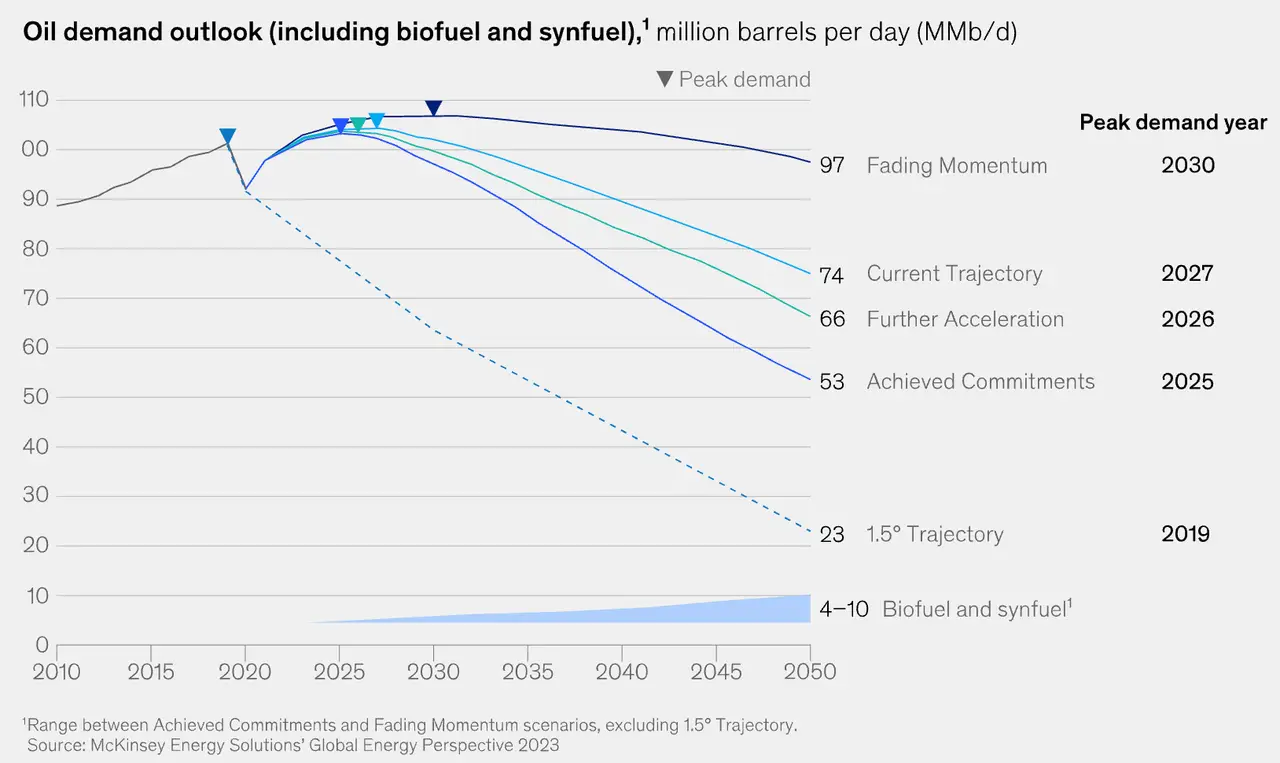
Oil demand outlook (Million barrels per day, MMB/ d)
Note. Figure obtained from Di Fiori et al. (2024)
Projections of oil demand raise questions about long-term stability of hydrocarbon revenue. As shown in Figure 1, demand is only expected to decline, with a brief peak in 2030 followed by a sharp decline in subsequent years (Di Fiori et al., 2024). This forecast is made on the basis of energy efficiency, government spending on green energy, and continued electrification of transport, all of which have increased in recent years and, as a result, negatively influenced oil demand. Alongside the pressure on demand, this region holds some of the world’s lowest-cost solar potential and substantial wealth that could be directed towards clean energy investment, which studies suggest can enhance cost efficiency, social advantages, and subsidy savings (Alli & Abdalla, 2025, p. 7). Despite this trend, recent conflicts in Iran and disruptions in the Strait of Hormuz have destabilized global oil supply chains and increased energy security concerns. In the short term, these disruptions reinforce the economic and geopolitical importance of oil-producing countries in the Gulf but complicate their long-term transition into more sustainable energy systems.
Building on this, the next section examines how Saudi Arabia and the UAE are each adapting to the entrepreneurial model differently, shaped by distinct resource endowments and priorities.
Case studies
Case 1: Saudi Arabia: Vision 2030 and Economic Diversification
In April 2016, the Kingdom of Saudi Arabia announced its initiative known as Vision 2030. This plan entailed a transformation of its socio-economic priorities and governance structures, acting as a roadmap to improve social welfare and establish new revenue streams that would ensure a sustainable foundation for economic growth. Within the economic umbrella, the country expressed its efforts to diversify its economy and hence undergo an energy transition that would reduce the vulnerabilities of an oil-dependent economy (Sheline & Ulrichsen, 2025, p. 2). This includes raising the share of non-oil exports in non-oil GDP from 16% to 50% in 2030 and increasing non-oil government revenue from 163 billion to 1 trillion (SAR) (Fattouh & Sen, 2016, p. 2).
One of the pillars to achieve these aims is the National Renewable Energy program under Vision 2030, which seeks to shift the focus away from oil by expanding renewable energy capacity. The key objective of the program is to generate 50% of the country’s electricity from renewable sources, particularly wind, solar, and hydropower. While this supports sustainability goals, it also attracts investment into a country with the resources and capabilities to become a key player in the renewable energy sector (National Renewable Energy Programme, 2023). This strategy is a strong economic scheme to improve energy efficiency and redirect oil resources exclusively for export markets, thus replacing oil at home to sell abroad.
Figure 2
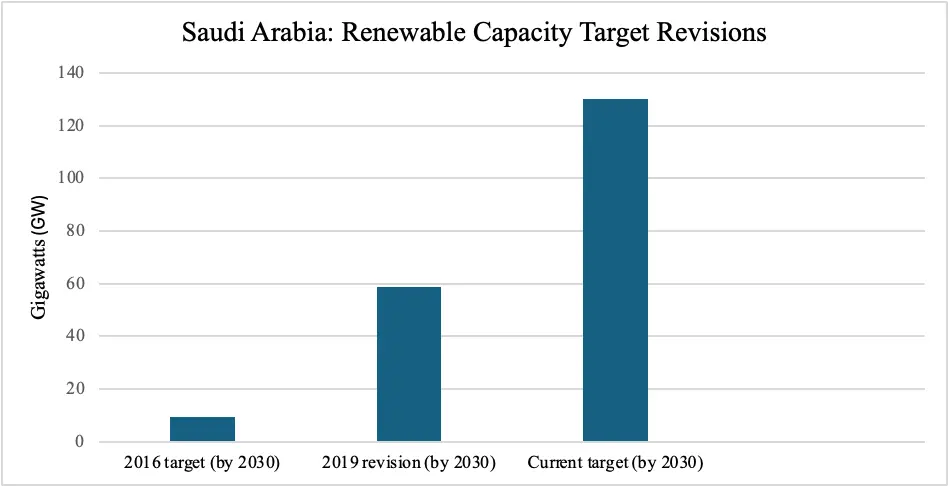
Saudi Arabia: Renewable Capacity Target Revisions.
Note. Created by the author based on data from Schulkes (2024)
Figure 3
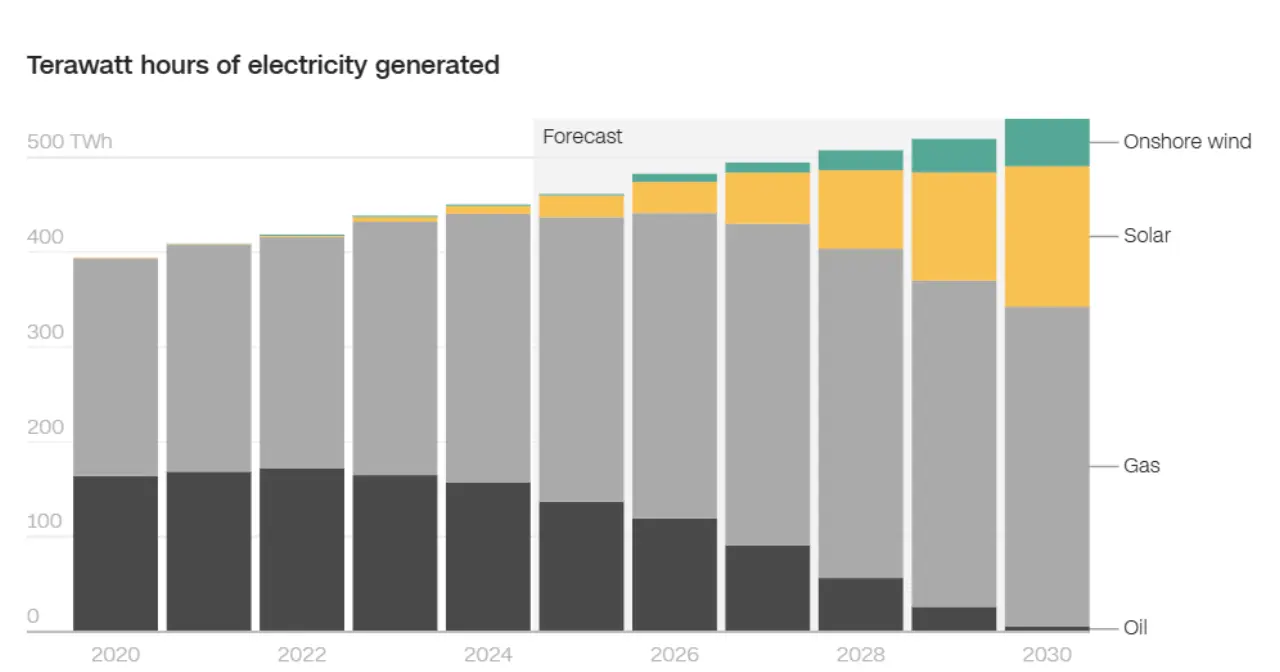
Terawatt hours of electricity generated
Note. Figure obtained from Saudi Arabia Energy Consulting (2025)
As of 2025, Saudi Arabia has installed 12 gigawatts (GW) of solar capacity, contributing to its broader aim of 130 GW of renewable energy capacity by 2030 (Saudi Arabia Energy Consulting, 2025). This progress represents a substantial increase from the initial target of 9.5GW, now revised to 130GW. On the whole, this achievement increases its importance in the sector and the possibilities of having a leadership role, while also being a preparation for the potential shifts in the patterns of energy demand in upcoming years. However, Figure 3 indicates that it is not a halt to the use of fossil fuels, and the production of oil and natural gas still plays a crucial role. Taken together, these developments suggest that Saudi Arabia is diversifying its energy mix while protecting it against potential changes in demand.
This approach to energy diversification reflects a broader strategy in which the state uses state-led investment and long-term planning to reshape the country’s economic structure. By adopting an entrepreneurial model of governance, the Saudi government seeks to improve economic opportunities through public investment, the development of new industries, and strategic planning. Therefore, this demonstrates that Saudi Arabia has opted for diversification through methods of state-led economic and social transformation.
Case 2: United Arab Emirates
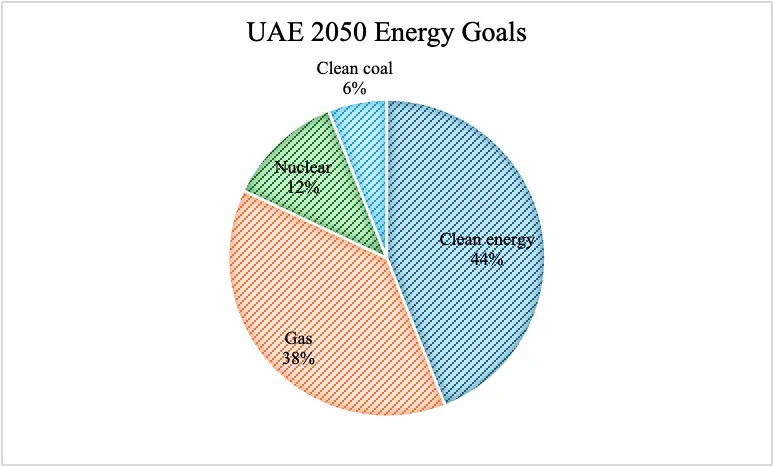
Similarly to Saudi Arabia, the United Arab Emirates (UAE) is following a strategy of increased investment in renewable energies and economic diversification. The goal is for energy to be distributed as shown in Figure 4 by 2050, with the majority of its energy capacity to be generated from renewable energies. Nonetheless, today the oil dependency in the nation is significantly high. According to the International Trade Administration (2025), the UAE holds the 6th largest reserve of oil and accounts for 30% of its GDP. This influence is also evident in political developments, with its recent exit from OPEC in May 2026, which allows them to pursue more independent policies in the production and export of oil. Hence, despite recognizing the need to invest in other resources for the future, oil continues to be the priority.
Figure 4
UAE 2050 Energy Goals
Note. Created by author based on data from
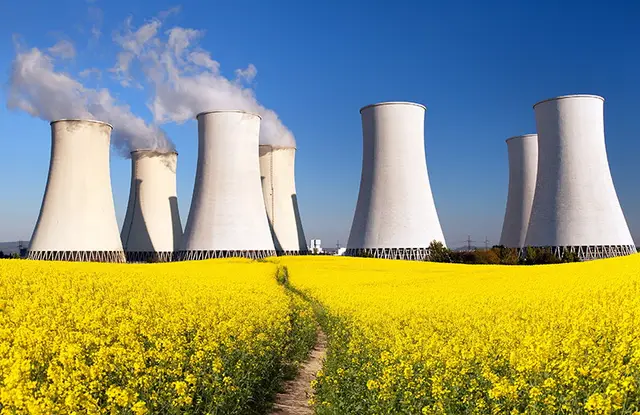
Contrasting with Saudi Arabia, the UAE is not limited to energy sources such as solar, wind, or hydropower. The UAE’s strategy places a lot of importance on Nuclear power. The country currently operates the first and one of the biggest nuclear plants in the Gulf region, the Barakah Nuclear Power Plant, which has four reactors and produces 40TWh of energy annually. Thanks to this plant, nuclear energy accounts for 25% of the country’s total electricity needs (Embassy of the United Arab Emirates, Washington, DC, n.d.). This investment helps the country not only diversify from the oil and gas markets but also enter new ones. An increase in nuclear power opens the door to high-tech investors and job opportunities (ENEC, 2024). Hence, the increased presence of nuclear energy comes with benefits beyond sustainability and economic diversification; it also contributes to job creation and helps ensure that the country will have the electricity-generating capacity to sustain the growth it has experienced in recent decades.
In addition to renewables and nuclear power, the country has invested in two key sectors: tourism and technology. Dubai has become a hub for tourists visiting the Middle East, attracting over 19.59 million people in 2025, up from 18 million in 2024. Meanwhile, the technology sector is also growing in the country. The government has launched multiple programs to boost tech investment and drive rapid development. They have not only created innovation hubs but also supported start-ups through subsidies and public-private partnerships. In addition, the country is placing special emphasis on two areas within the technological sector: artificial intelligence and digital transformation. To strengthen its investment in the sector, the UAE has made efforts to attract high-skilled workers (Chokani, n.d.). This is seen with policies like the 10-year Golden Visa, which was launched specifically to target specialized talent like doctors or scientists, allowing them to live and work independently, while also providing 10-year residency to anyone who graduated from a top100 university in the fields of artificial intelligence, software engineering, or biotechnology (The United Arab Emirates Government Portal, n.d.).
Implications
Economically, both cases, Saudi Arabia and the United Arab Emirates, are proof that the energy transition does not imply the complete halt of fossil fuels. In both cases presented, there is not a strategy of replacement but rather one of diversification. On the one hand, Saudi Arabia has focused on the expansion of renewable energy capacity, designed to redirect oil consumption domestically to sell it abroad. Thus, the country has not stopped the production of oil, and fossil fuels are still a key component of the country’s economy. The UAE shows a more pronounced pattern of this; oil represents 30% of its GDP, and its move away from OPEC gives it more freedom in production and export decision-making. Hence, these policies do not signal a retreat from the oil market but rather a pursuit of autonomy and competitiveness. Due to this, diversification is not a means to replace oil revenue but one to add pillars to its economy.
From a geopolitical standpoint, these strategies reposition Gulf states within the global energy order. The countries’ ambition to rise in new sectors like technology or renewables while still emphasizing oil exports gives them leverage in international climate diplomacy while preserving their influence in global oil markets. Furthermore, the UAE’s exit from OPEC has major geopolitical implications in terms of the GCC alliances and in the prioritization of national bargaining power. Additionally, the investment in nuclear energy with the Barakah power plant and the policies induced to attract high-skilled workers like the Golden Visa indicate a strategy focused on competing globally for capital, technology, and human expertise.
Moreover, the two cases are proof that there is not a single way to achieve economic diversification. While both countries have a similar strategy on paper, their national priorities and available resources differ. Hence, this suggests that the broader energy transition will result in different outcomes among the Gulf region.
Finally, it is also important to acknowledge that these strategies come with a great degree of risk. Both countries have invested billions in attempting to diversify their economies. However, the standards set, for instance, 130 GW of renewable energy capacity in the case of Saudi Arabia, are not easy standards to meet. This means that profiting from the investment will not be easy and will take a long amount of time. In addition, the introduction of new markets such as tourism comes with its own risks, and regional instability might affect it. There are also questions about the long-term sustainability of this model of governance and the policies applied. To what extent will hydrocarbon revenues decline faster than the diversification measures have to mature?
Policy recommendations
- Milestone-based renewable targets
Breaking the broader goals into short-term milestones. This will allow states to revise their progress continuously and react more efficiently to potential problems that might arise. In addition, this is highly significant for investment as it allows the government to understand if the state-led investment is translating into delivered capacity.
- Rebalance the rentier social contract
Given that governments are shifting oil money away from direct public welfare spending and towards diversification projects, there is the threat that citizens feel the oil deal is disappearing. Hence, to avoid public frustration, governments should manage this shift gradually, for instance, setting job-creation targets in new industries. This way, citizens will see the benefits from new industries like renewables, tech, and nuclear energy.
- Export nuclear expertise regionally
In the case of the UAE, they have a first-mover advantage through the Barakah plant. This gives the country the possibility to export knowledge and training, partnering with other Gulf countries considering doing similar investments. Therefore, turning a tool of economic diversification into one that gives them additional diplomatic and economic power.
- Balance OPEC independence with regional coordination
The UAE’s exit from OPEC grants it autonomy over oil production; however, it also carries the risk of the country becoming more isolated. Due to this, policymakers should pursue mechanisms of bilateral or informal coordination with remaining OPEC members. These actions would strengthen regional price stability while retaining independent decision-making.
References
Ali, A. H., & Abdalla, M. (2025). Energy transitions era: geopolitical characteristics and connotations in the Arab Gulf States. Sustainable Futures, 10, Article 100808. https://doi.org/10.1016/j.sftr.2025.100808
Di Fiori, L., Ding, C., Furnari, E., Smith, M., & Wilczynski, P. (2024, January 24). Global energy perspective 2023: Oil outlook. McKinsey & Company. https://www.mckinsey.com/industries/oil-and-gas/our-insights/global-energy-perspective-2023-oil-outlook
Embassy of the United Arab Emirates. (n.d.). UAE energy diversification. https://www.uae-embassy.org/discover-uae/climate-and-energy/uae-energy-diversification
Emirates Nuclear Energy Corporation. (n.d.). Nuclear energy in the UAE. https://www.enec.ae/discover/nuclear-energy-in-the-uae/
Eurostat. (2026). Renewable energy statistics. European Commission.
https://ec.europa.eu/eurostat/statistics-explained/index.php?title=Renewable_energy_statistics
Fattouh, B., & Sen, A. (2016). Saudi Arabia’s Vision 2030, oil policy and the evolution of the energy sector. Oxford Institute for Energy Studies. /api/pdf/2016/07/Saudi-Arabias-Vision-2030-Oil-Policy-and-the-Evolution-of-the-Energy-Sector.pdf?__cf_chl_tk=dfAIXScWd5SCcZxSNj1LyyfLbT_4Zfb6GMerpi.6.6s-1789549690-1.0.1.1-KHfatSiQlSTdeJMO56uGXkUHGBdBQ0oesp_Co_kL.AQ
International Trade Administration. (2025). United Arab Emirates- country commercial guide. U.S. department of commerce. https://www.trade.gov/country-commercial-guides/united-arab-emirates-oil-and-gas
Kachalia, M. A., Audi, M., & Ali, A. (2026). Geopolitical Conflict and Financial Market Reactions: Evidence from the 2026 US–Israel–Iran Crisis. Policy Journal of Social Science Review, 4(5), 443-465.
National Renewable Energy Program. Saudipedia. Retrieved September 16, 2026, from https://saudipedia.com/en/national-renewable-energy-program
Qanas, J., & Sawyer, M. (2025). Navigating the Energy Transition in the Gulf Cooperation Council (GCC) States: The Role of Industrial Policies in Fostering Sustainable Economic Competitiveness. Review of Political Economy, 1–23. https://doi.org/10.1080/09538259.2025.2559686
Salem, H. S., Pudza, M. Y., & Yihdego, Y. (2023). Harnessing the energy transition from total dependence on fossil to renewable energy in the Arabian Gulf region, considering population, climate change impacts, ecological and carbon footprints, and United Nations’ Sustainable Development Goals. Sustainable Earth Reviews, 6(1), 10.
Saudi Arabia Energy Consulting. (2025). Saudi solar energy boom: 70GW by 2030. https://saudienergyconsulting.com/insights/articles/saudi-solar-energy-boom-70-gw-by-2030
Schulkes, P. (2024). Deep data: Saudi Arabia struggles to achieve renewables revolution. Amwaj.media. https://amwaj.media/en/article/deep-data-saudi-arabia-struggles-to-achieve-renewables-revolution
Sheline, A., & Ulrichsen, K.C. (2025). Saudi Arabia’s Vision 2030 and a nation in transition. Rice University’s Baker Institute for Public Policy. http://doi.org/10.25613/F7J4-6X14
The United Arab Emirates Government Portal. (n.d.). Golden visa. UAE. https://u.ae/en/information-and-services/visa-and-emirates-id/residence-visas/golden-visa