
Nuclear power is returning to energy policy as a source of firm, low-carbon electricity. It is not primarily an alternative to wind and solar. It is an alternative to some combination of gas-fired back-up, long-duration storage, imported electricity and grid reinforcement when variable renewables cannot meet demand. This distinction explains why governments are reconsidering a technology that remains expensive and slow to build. The revival is driven by energy security, rising electricity demand and the difficulty of financing fully decarbonised power systems with variable generation alone. However, renewed interest does not guarantee a broad nuclear expansion. Large projects still depend on public risk-sharing, while small modular reactors remain commercially unproven. Nuclear is therefore returning as a strategic option whose value depends on national institutions, financing costs and supply-chain control. Recent activity is substantial but concentrated. The IEA counted 63 reactors under construction in early 2025. Of the 52 reactors that began construction worldwide from 2017, 25 used Chinese designs and 23 Russian designs. The revival therefore changes the distribution of industrial influence as well as the electricity mix (IEA, 2025a, pp. 8-9).
Construction cost and system value
Nuclear’s main weakness is its upfront cost. The US Energy Information Administration estimates a total overnight cost of USD 8,255 per kilowatt for a new large light-water reactor and USD 9,831 for a small modular reactor. The comparable estimates are USD 1,086 for combined-cycle gas, USD 1,712 for onshore wind and USD 1,484 for utility-scale solar. All figures are in 2025 dollars. The assumed construction lead time is six years for both nuclear technologies, compared with three years for wind and gas and two for solar (EIA, 2026a, p. 6). Levelised cost estimates show a smaller difference because nuclear plants operate for long periods at high capacity factors. For US projects entering service in 2031, the EIA estimates an average levelised cost of USD 87.81 per megawatt-hour for advanced nuclear. These estimates are in 2025 dollars and include available tax credits. Nuclear remains above onshore wind at USD 56.75, solar at USD 58.33 and combined-cycle gas at USD 77.46. It is below solar paired with battery storage at USD 94.20 and offshore wind at USD 118.79 (EIA, 2026b, p. 8).
These figures do not establish that nuclear is cheaper than renewables. They show why the comparison changes at system level. Wind and solar have low generation costs but require networks, balancing services, storage or dispatchable back-up as their share rises. Nuclear provides output that is largely independent of weather. Its economic case is strongest where governments value firm low-carbon capacity and can lower financing costs. It is weakest where construction risk is high or cheaper sources of flexibility are available. Financing is therefore as important as engineering. Interest accumulates during long construction periods, while revenue begins only after completion. A project that appears viable with sovereign borrowing can become uneconomic with a high commercial cost of capital. This helps explain why the IEA expects state-owned enterprises and public equity to remain central to new nuclear investment (IEA, 2025a, pp. 75-80). Figure 1 shows how strongly investment in new reactors continues to depend on state-owned enterprises and public finance.
Financing also affects comparisons with other technologies. Wind and solar can be built in stages and earn revenue sooner. Nuclear concentrates capital in a single asset whose value depends on completion. Guarantees and regulated returns can make that risk investable, but they decide whether taxpayers, consumers or developers absorb the cost of failure. Financing models can produce different electricity costs with the same reactor design. A government borrowing at sovereign rates can spread repayment across decades, while a private developer prices construction delays and political uncertainty into its required return. Public guarantees make projects investable by transferring contingent liabilities to the state. The relevant question is which party can best manage each risk. Institutional credibility therefore becomes an economic input into nuclear construction alongside engineering capability (IEA, 2025a, pp. 75-80).
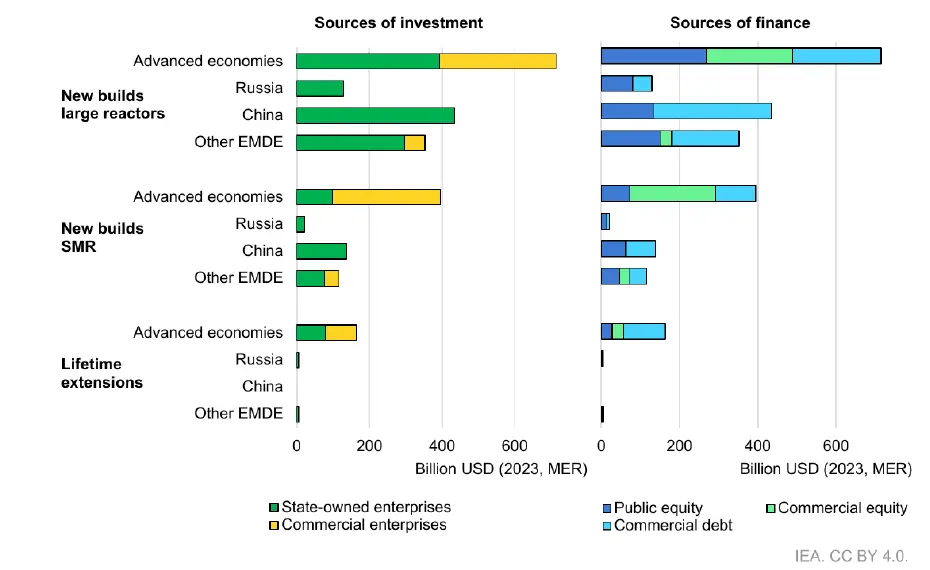
Figure 1 Cumulative nuclear investment by source and type of finance in selected regions under the IEA Announced Pledges Scenario, 2024-2050. Unit: billion USD in 2023 prices at market exchange rates. Source: IEA (2025a), CC BY 4.0.
Sizewell C and the transfer of risk
Sizewell C illustrates the attempt to make a large project financeable by transferring some construction risk to consumers. Under the regulated asset base model, households begin contributing through electricity bills during construction. This reduces the amount that must be borrowed and allows investors to earn a regulated return before the plant generates electricity. The arrangement may lower financing costs, but it exposes consumers to delays and overruns. The National Audit Office gives a project baseline of GBP 38.2 billion in 2024-25 prices, associated with full operation by July 2039. The lower regulatory threshold is GBP 40.5 billion and October 2039. The higher threshold reaches GBP 47.7 billion and August 2043. Typical household bills are expected to rise by GBP 4 in 2025-26 and by around GBP 19-21 a year during the first decade of operation (NAO, 2026, pp. 7-9, 27-28). Sizewell has not yet accumulated a construction delay comparable with Hinkley Point C because its final investment decision was taken only in 2025. The risk is nevertheless substantial. The NAO reports that Hinkley’s latest scenarios involve a delay of five to seven years and a cost overrun of around 100 per cent. Sizewell’s use of the same design and supply chain may create savings through repetition, but it also links the project to a technology with a weak European delivery record. Its success will depend on whether public risk-sharing lowers finance costs without weakening pressure to control construction costs (NAO, 2026, pp. 7-8, 24-28). The regulated asset base model changes who bears a cost overrun. Consumers pay before receiving electricity and the state supplies most debt, even though investors retain performance incentives. A lower financing rate can reduce the plant’s lifetime cost while leaving households exposed during construction. Sizewell therefore tests risk allocation as well as engineering.
France and strategic planning
France provides the clearest historical example of nuclear power as an instrument of energy sovereignty. After the 1973 oil shock, the 1974 Messmer plan accelerated a standardised programme of pressurised-water reactors to reduce dependence on imported fossil fuels. EDF built 56 reactors between 1974 and 1989, supported by a centralised utility and coordinated industrial policy. Nuclear supplied about 65 per cent of French electricity in 2023 (EDF, 2026; RTE, 2024). The proposed EPR2 programme seeks to recover part of that model. EDF plans six reactors at Penly, Gravelines and Bugey at an estimated cost of EUR 72.8 billion in 2020 prices. The financing plan includes a subsidised state loan covering at least half of construction and a 40-year contract for difference. Building a series could allow designs, workers and suppliers to be reused, although the benefit depends on avoiding the redesign and project-management failures experienced by recent European EPR projects (EDF, 2025). France’s experience shows that standardisation is not permanent. The earlier programme benefited from repeated construction, a stable order book and central coordination. Once building slowed, skills and supplier capacity became harder to retain. EPR2 must rebuild this industrial system while adding capacity. Its economics depend on maintaining a project sequence long enough for learning to reduce costs. Interruptions caused by approvals, financing changes or redesign would weaken these gains. State planning can create continuity, but it cannot substitute for effective project management (EDF, 2025; IEA, 2025a, pp. 75-80). The European Commission opened an in-depth State aid investigation on 31 March 2026. This examines whether the planned public support is proportionate and whether it could distort competition or reinforce EDF’s market power. It does not mean that the programme will be rejected. The Commission may approve the package, impose conditions or issue a negative decision. Conditions on the subsidised loan, pricing mechanism or protection against overcompensation could force France to renegotiate the financing package and delay its final investment decision. France can use sovereign credit to support nuclear construction, but it cannot treat the proposed terms as settled until the investigation is complete (European Commission, 2026a; 2026b).
Small reactors and private demand
Small modular reactors, or SMRs, are reactors of up to roughly 300 megawatts per module whose main components can be manufactured in factories and assembled on site. Their smaller project size could reduce financing requirements and allow capacity to be added gradually. These advantages have not yet been demonstrated at commercial scale in Western markets, and smaller reactors sacrifice some economies of scale. The IEA estimates that their levelised costs in 2040 will remain about 20 per cent above those of large reactors in several major markets (IAEA, 2021; IEA, 2025a, p. 52). SMRs change the scale of the financing problem rather than removing it. A smaller unit requires less capital before construction, allowing utilities to add capacity in stages. Yet factory production lowers unit costs only if developers receive enough orders to keep manufacturing lines active and standardise components. Early designs may therefore face a coordination problem. Buyers wait for evidence of lower costs, while suppliers need a larger order book to produce it. Licensing differences can also limit repetition if the same design requires modifications in each market. Their strategic value will depend on whether governments coordinate regulation and procurement without shielding weak designs from commercial discipline (IEA, 2025a, p. 52).
Technology companies have nevertheless created a new source of demand. Google has agreed to purchase power from Kairos reactors, with the first targeted for 2030, while Amazon has invested in X-energy and supports plans for an initial 320-megawatt project. This private capital is important, but it does not remove the public role in licensing, first-of-a-kind construction and fuel supply (Amazon, 2024; Google, 2024). Corporate demand also extends beyond SMRs. Microsoft’s 20-year power-purchase agreement supports the planned restart of Three Mile Island Unit 1, renamed the Crane Clean Energy Center, with about 835 megawatts expected to return to the grid. Meta’s 20-year agreement supports the continued operation of Constellation’s 1,121-megawatt Clinton plant and a 30-megawatt uprate (Constellation, 2024; 2025). These agreements show that large buyers can provide revenue certainty for existing plants, restarts and uprates. They do not yet prove that private buyers can finance new large reactors without government guarantees. Figure 2 places this demand in the wider growth of data-centre electricity consumption. Supporting an operating plant or restart involves less construction risk than financing an unproven design. Technology companies can strengthen a project’s credit quality through long-term purchases, while public authorities retain licensing and may support first-of-a-kind costs. Private demand is expanding nuclear finance rather than replacing the state.
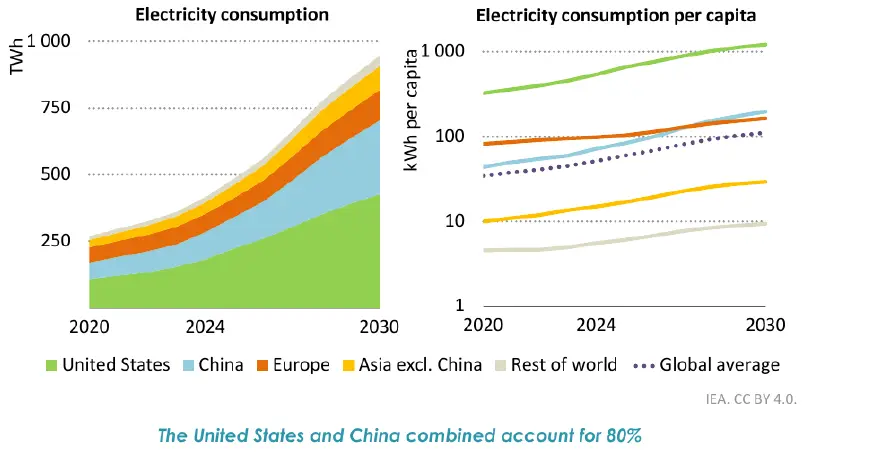
Figure 2 Data-centre electricity consumption and consumption per capita by region in the IEA Base Case, 2020-2030. Units: terawatt-hours and kilowatt-hours per capita. Source: IEA (2025b), CC BY 4.0.
Nuclear geoeconomics
The strategic dimension also concerns who supplies reactors and fuel. Rosatom markets an integrated export package covering uranium, construction, assistance with financing, training and long-term services. Such arrangements can create relationships that continue for the operating life of a plant. Russia also accounts for about 40 per cent of global uranium-enrichment capacity, making fuel-cycle dependence a separate security issue from reactor ownership (IEA, 2025a, p. 10; Rosatom, 2023, pp. 213-219).
For importing states, vendor choice creates a trade-off between easier entry and bargaining freedom. A bundled offer can help a country finance and operate its reactor where expertise is limited. Yet reliance on one supplier for fuel, maintenance and specialist services can make diversification costly. Governments should assess bids against the lifetime structure of dependence rather than the construction price alone. Requiring compatible fuel options, training and access to technical documentation may raise initial costs, but it can reduce exposure after commissioning. Nuclear strengthens sovereignty only when the supplier relationship develops national capability instead of preserving dependence on the original vendor (IEA, 2025a, pp. 10, 62-66; Rosatom, 2023, pp. 213-219).
This model competes on more than reactor price. A newcomer may need help establishing regulation, training operators and securing fuel. Bundling these functions lowers immediate barriers where domestic expertise is limited, but can deepen dependence on the supplier for maintenance, components and fuel after construction ends. The fuel cycle gives supplier relationships a different character from infrastructure contracts. Reactors operate for decades, while fuel assemblies, enrichment and specialist maintenance must remain available throughout. Switching suppliers may require regulatory approval and technical adaptation, so dependence cannot be removed as quickly as replacing a commodity contract. This creates bargaining power after construction. It also explains why diversification requires investment in conversion and enrichment capacity, not only restrictions on Russian imports. Sanctions that move faster than alternative supply may initially raise costs or threaten fuel availability. Accepting some of those costs may nevertheless be necessary if governments treat fuel autonomy as part of energy security (IEA, 2025a, p. 10).
The United States prohibited imports of Russian low-enriched uranium from August 2024, although waivers may continue until January 2028 where no viable alternative exists or imports are judged to be in the national interest. The European Union has followed a slower route. Its 2025 roadmap proposed restricting new Russian nuclear-supply contracts and requiring national diversification plans rather than imposing a comprehensive nuclear sanctions ban. The contrast shows the difficulty of reducing dependence quickly when utilities need compatible fuel and enrichment services (US Department of Energy, 2024; European Commission, 2025). Reactor tenders have also become contests over industrial influence. In 2024, the Czech government selected South Korea’s KHNP over France’s EDF as the preferred supplier for two reactors at Dukovany. The decision concerned price and delivery, but also domestic industrial participation and a relationship expected to last for decades (Government of the Czech Republic, 2024). Nuclear exports therefore combine commercial contracts with standards, training, fuel services and diplomatic ties.
China India and the global balance
The geographical centre of nuclear construction is moving east. Half of the capacity under construction at the end of 2025 was in China. Serial construction, state-owned utilities and policy-bank finance have provided continuity that recent Western projects have lacked. China is expected to approach 100 gigawatts of capacity around 2030, although rapid growth in solar means nuclear may expand without gaining a dominant share of generation (IEA, 2026a; 2026b). India begins from a smaller base, with about 5 gigawatts under construction at the end of 2025. Nuclear generation is forecast to rise quickly through 2030, but coal is expected to remain dominant. In both countries, nuclear is tied to industrial development and long-term demand growth rather than replacing renewables (IEA, 2026a; 2026b).
The contrast with recent Western projects is institutional as well as financial. Regular construction retains skilled workers and carries lessons across sites. Stop-start programmes lose that capability and make each project resemble a first-of-a-kind build. China’s advantage comes partly from continuity, while India’s expansion depends on creating a comparable project sequence. China’s construction advantage does not mean that its model can be copied directly. State-owned utilities, policy-bank finance and a large domestic market allow projects to be planned as a programme rather than isolated investments. Western governments can reproduce parts through standard designs and long-term procurement, but they operate under different regulatory and fiscal constraints. India faces a test. Rapid demand growth creates space for nuclear capacity, yet expansion depends on whether domestic manufacturing and project delivery improve quickly enough to compete with coal and renewables. In both countries, capacity growth should not be confused with market dominance. Nuclear output can rise substantially while its share of generation changes slowly if electricity demand and renewable deployment grow faster (IEA, 2026a; 2026b). The revival is uneven. Nuclear may gain output globally while losing or holding its share as renewables grow faster. Expansion will be strongest where states can organise finance, repeat standardised designs and secure fuel-cycle services.
Conclusion
Nuclear power is returning because energy policy now values security and firm low-carbon capacity alongside the cost of individual generators. The shift is strategic because reactor procurement determines industrial partnerships and long-term fuel dependencies. Private power-purchase agreements are widening the market, particularly for existing plants and experimental SMRs, but public institutions still carry much of the risk of new construction. Nuclear will gain ground where governments can control financing and delivery. Where they cannot, high capital costs and delays will continue to outweigh its system value.
References
Amazon (2024) ‘Amazon enlists nuclear small modular reactors in push for net carbon-zero’, 16 October. Available at: https://www.aboutamazon.com/news/sustainability/amazon-nuclear-small-modular-reactor-net-carbon-zero
Constellation (2024) ‘Constellation to Launch Crane Clean Energy Center, Restoring Jobs and Carbon-Free Power to the Grid’, 20 September. Available at: https://www.constellationenergy.com/news/2024/Constellation-to-Launch-Crane-Clean-Energy-Center-Restoring-Jobs-and-Carbon-Free-Power-to-The-Grid.html
Constellation (2025) ‘Constellation, Meta Sign 20-Year Deal for Clean, Reliable Nuclear Energy in Illinois’, 3 June. Available at: https://investors.constellationenergy.com/news-releases/news-release-details/constellation-meta-sign-20-year-deal-clean-reliable-nuclear
EDF (2025) ‘EDF shares its forecasted cost estimate of the EPR2 programme for EUR 72.8bn’, 18 December. Available at: https://www.edf.fr/en/the-edf-group/dedicated-sections/journalists/all-press-releases/edf-shares-its-forecasted-cost-estimate-of-the-epr2-programme-for-eu728bn
EDF (2026) ‘History’. Available at: https://www.edf.fr/en/the-edf-group/the-edf-group/history
European Commission (2025) ‘Roadmap to fully end EU dependency on Russian energy’, 6 May. Available at: https://commission.europa.eu/news-and-media/news/roadmap-fully-end-eu-dependency-russian-energy-2025-05-06_en
European Commission (2026a) ‘State aid SA.119469 (2025/N): support for the construction and operation of six new nuclear reactors in France’, decision of 31 March, OJ C/2026/2619. Available at: https://eur-lex.europa.eu/legal-content/EN/TXT/?uri=CELEX:52026AS119469
European Commission (2026b) ‘State aid procedures’. Available at: https://competition-policy.ec.europa.eu/state-aid/procedures_en
Government of the Czech Republic (2024) ‘The Government Has Decided on a Preferred Supplier for the New Nuclear Power Source at Dukovany’, 17 July. Available at: https://vlada.gov.cz/vanoce/en/media-centrum/aktualne/the-government-has-decided-on-a-preferred-supplier-for-the-new-nuclear-power-source–negotiations-on-the-construction-of-two-units-at-dukovany-will-be-214609/
Google (2024) ‘Google signs advanced nuclear clean energy agreement with Kairos Power’, 14 October. Available at: https://blog.google/company-news/outreach-and-initiatives/sustainability/google-kairos-power-nuclear-energy-agreement/
International Atomic Energy Agency (IAEA) (2021) ‘What are Small Modular Reactors (SMRs)?’, 4 November. Available at: https://www.iaea.org/newscenter/news/what-are-small-modular-reactors-smrs
International Energy Agency (IEA) (2025a) The Path to a New Era for Nuclear Energy. Paris: IEA. Available at: https://www.iea.org/reports/the-path-to-a-new-era-for-nuclear-energy
International Energy Agency (IEA) (2025b) Energy and AI. Paris: IEA. Available at: https://www.iea.org/reports/energy-and-ai
International Energy Agency (IEA) (2026a) ‘Nuclear’, Global Energy Review 2026. Paris: IEA. Available at: https://www.iea.org/reports/global-energy-review-2026/technology-nuclear
International Energy Agency (IEA) (2026b) Electricity 2026. Paris: IEA. Available at: https://www.iea.org/reports/electricity-2026
National Audit Office (NAO) (2026) Sizewell C. London: NAO. Available at: https://www.nao.org.uk/reports/sizewell-c/
Rosatom (2023) State Atomic Energy Corporation Rosatom Public Report 2023. Available at: https://www.report.rosatom.ru/go_eng/go_rosatom_eng_2023/rosatom_2023_eng.pdf
RTE (2024) ‘French Annual Electricity Review 2023: Key findings’. Available at: https://analysesetdonnees.rte-france.com/en/annual-review-2023/keyfindings
US Department of Energy (2024) ‘Biden-Harris Administration Enacts Law Banning Importation of Russian Uranium’, 14 May. Available at: https://www.energy.gov/articles/biden-harris-administration-enacts-law-banning-importation-russian-uranium
US Energy Information Administration (EIA) (2026a) Assumptions to the Annual Energy Outlook 2026: Electricity Market Module. Washington, DC: EIA. Available at: https://www.eia.gov/outlooks/aeo/assumptions/pdf/EMM_Assumptions.pdf
US Energy Information Administration (EIA) (2026b) Levelized Costs of New Generation Resources in the Annual Energy Outlook 2026. Washington, DC: EIA. Available at: https://www.eia.gov/outlooks/aeo/electricity_generation/pdf/LCOE_report.pdf