
Introduction
“This is not only a war unleashed by Russia against Ukraine. This is a war on our energy” declared European Commission President Ursula von der Leyen in 2022 as she called for Europe to “get rid of this dependency all over Europe” (European Commission, 2022). Three years later, in her 2025 State of the Union address, von der Leyen struck a markedly more confident tone, arguing that Europe had “made it” and placing the emphasis on “more homegrown renewables – with nuclear as a baseload” (European Commission, 2025).
This energy transformation is remarkable. For decades, Russian fossil fuels have occupied a central position in the EU’s energy system, a dependency of choice that subsequently became an instrument for achieving geopolitical goals. By 2021, Russia supplied approximately 155 billion cubic metres (bcm) of gas to the EU, accounting for around 40% of total imports (Umbach, 2023). The hope that peace in Europe could be achieved through interdependence ultimately shattered on the 24th of February 2022, the start of Russia’s full-scale invasion of Ukraine. It is a perfect example of how energy dependencies can be weaponised in times of war.
In response, the EU launched the REPowerEU plan, centred on diversification of supply, increased energy efficiency, and accelerated deployment of renewable energy (European Commission, n.d.-b). Within this strategy, the Southern Gas Corridor (SGC), a pipeline network transporting gas from Azerbaijan to Europe, has emerged as a key alternative. Yet, its relatively limited capacity compared to former Russian supply levels raises fundamental questions on how such projects can meaningfully reduce the structural dependency.
This essay therefore asks: to what extent has the Southern Gas Corridor (SGC) contributed to the EU’s efforts to reduce dependence on Russian gas since 2022, and what structural and geopolitical limitations constrain its effectiveness? It argues that while the SGC enhances short-term diversification and resilience, it does not eliminate dependency but rather redistributes it, highlighting the limits of diversification as a pathway to genuine energy autonomy.
1. EU Dependency on Russia Gas: Structural Roots and Strategic Shock
The EU’s dependency on Russian gas can be traced back to as far as the middle of the cold war. Following the devastating oil crisis in 1973, Western Europe sought to diversify away from the Middle East and thus started contemplating Soviet gas (Bösch, 2014). For the Soviet Union this was also seen as attractive as it desperately needed hard currency (Deutsche Mark/USD), innovative western technology (pipes compressors) and stable export revenues (Gustafson, 1985). Basically, western companies would provide infrastructure while the USSR would supply gas. The result is the creation of the Urengoy–Pomary–Uzhgorod pipeline that supplies gas primarily to West Germany to which this realignment is largely due with the “Wandel durch Handel” (=change through trade) doctrine and the “Ostpolitik” (Bösch, 2014). While the United States feared that its allies would become too dependent on its geopolitical rival, Western Europeans argued that this would create a “detente” in the relationship between East and West (Rogov, 2022).
Whether oil or gas, this created long-term infrastructure dependence as pipelines are expensive, geographically fixed and have long-term contracts, exemplified by the later constructions of the Brotherhood pipeline, Yamal-Europe, and Nord Stream. By the early 2020s, this system had evolved into a highly integrated energy network, with Russia as the dominant supplier. While Russian gas exports reached approximately 155 bcm, representing around 40% of EU imports, several member states, particularly Central and Eastern European countries were even higher at times exceeding 80% (Interfax, 2025; Slavov, 2025).
Importantly to note, this dependency was not entirely unforeseen. Previous disruptions such as gas disputes between Russia and Ukraine in 2007–2008 or the Crimean annexation in 2014, had already demonstrated the risks associated with supply chain dependency, foreshadowing the more severe disruptions that would follow in 2022 (Kirby, 2014). This asymmetrical dependency, when exploited, is what Farrell and Newman (2019) call “weaponised interdependence”. This is when “some states are able to leverage interdependent relations to coerce others” (p.45). In the case of EU-Russia energy relations, Russia’s control over gas supplies allowed it to influence European markets and political decision-making. The Ukraine war forced Europe to rethink and progressively reduced gas deliveries from Russia, contributing to a stark rise in prices and significant market instability. This marked the start of a fundamental shift in EU energy policy, transforming energy security from a largely technocratic issue into a central element of geopolitical strategy.
2. The Southern Gas Corridor and Azerbaijan’s Strategic Energy Diplomacy
The corridor is a gas‑transport “value chain” that links Azerbaijan’s offshore Shah Deniz gas field with markets in Turkey and the EU through a series of interconnected pipelines (Trans Anatolian Natural Gas Pipeline, n.d.). It is often described as one of the largest and most complex gas‑infrastructure projects ever built, spanning roughly 3,500 km across seven countries (State Oil Company of the Azerbaijan Republic, n.d.). Its main projects includes the South Caucasus Pipeline (SCP), the Trans-Anatolian Pipeline (TANAP), and the Trans Adriatic Pipeline (TAP), which delivers gas to Southern Europe via Greece, Albania, and Italy (Trans Adriatic Pipeline AG, n.d.).
The seeds were already planted prior to the full-scale Russo-Ukraine war and became operational in December 2020, with an initial 10 bcm per year, expandable to approximately 20 bcm. This is by far not enough to reduce the gap of Russia which was supplying roughly 140–146 billion cubic meters (bcm) per year of pipeline gas (International Energy Agency, 2022; European Commission, n.d. -a). When introduced, it was by design not meant to cover such a vast quantity of gas, although it remains a significant project for diversification (International Energy Agency, 2022). In addition, the dependency within the EU of where the gas is sent, is asymmetrical. South-eastern and central Europe especially depend on these pipelines supplying a total of 8 EU countries (Bulgaria, Romania, Slovakia, Slovenia, Croatia, Greece, Hungary, Italy) (European Commission, n.d-a). Non-EU countries dependent affected by this pipeline are Georgia, Serbia, North Macedonia, Ukraine and Turkey. The significance of the gas supplies can be seen with the increase of more than 40% between 2021 and 2024 between Azerbaijan and the EU (European Commission, n.d.-a).
Azerbaijan is an attractive actor for several reasons. Similarly to the EU it aims for strategic autonomy emphasising sovereignty, territorial integrity and non-interference. It is a perfect example of “hedging”, i.e., “a strategy that places utmost importance on realizing the economic, territorial and political interests of small states (…), while at the same time avoiding confrontation with large states” (Hamzaoglu, 2025, p.1456). In practice this non-alignment means it firmly avoids joining either a Western or Russian camp and instead tries to preserve room for manoeuvre between the EU, Russia, Türkiye, Iran, and increasingly Asian partners (Ministry of Foreign Affairs of the Republic of Azerbaijan, 2016; Longuève, 2026). In addition, it is a country that functions as a rent economy of which the hydrocarbon sector constitutes “roughly one-third of GDP and makes up over 90% of total exports” (International Energy Agency, n.d.).
Following the geopolitical shocks of the Russo-Ukraine war, Azerbaijan has used “energy diplomacy” using its oil and gas not just as economic assets but foreign policy tools. Although there is no singular academic definition for energy diplomacy, Griffiths (2019) defines it as “government-related foreign activities that aim to ensure a country’s energy security while also promoting business opportunities related to the energy sector”. By exporting hydrocarbons to Europe through routes that bypass Russia, Azerbaijan increases its strategic value to the EU and turns its energy into diplomatic influence while presenting itself as a reliable, non-Russian supplier (Ministry of Foreign Affairs of the Republic of Azerbaijan, 2016).
Another reason for Azerbaijan to engage with the EU is the military outcome in Nagorno-Karabakh which led to more than 100,000 ethnic Armenians fleeing to Armenia in 2023, effectively ethnically cleansing the region of most of its Armenian population (International Crisis Group, 2023). This has made Azerbaijani foreign more assertive in its immediate neighbourhood. One of the priorities following the “success” over this region, is to use energy diplomacy to convert its military gains in Nagorno-Karabakh into a favourable peace-settlement with Armenia, including border delimitation, transport connectivity, and full recognition of Azerbaijan’s new territorial integrity. By supplying the EU with fossil fuels, Azerbaijan may implicitly signal that the EU is willing to prioritise energy security over taking a firm stance on the Nagorno-Karabakh conflict.
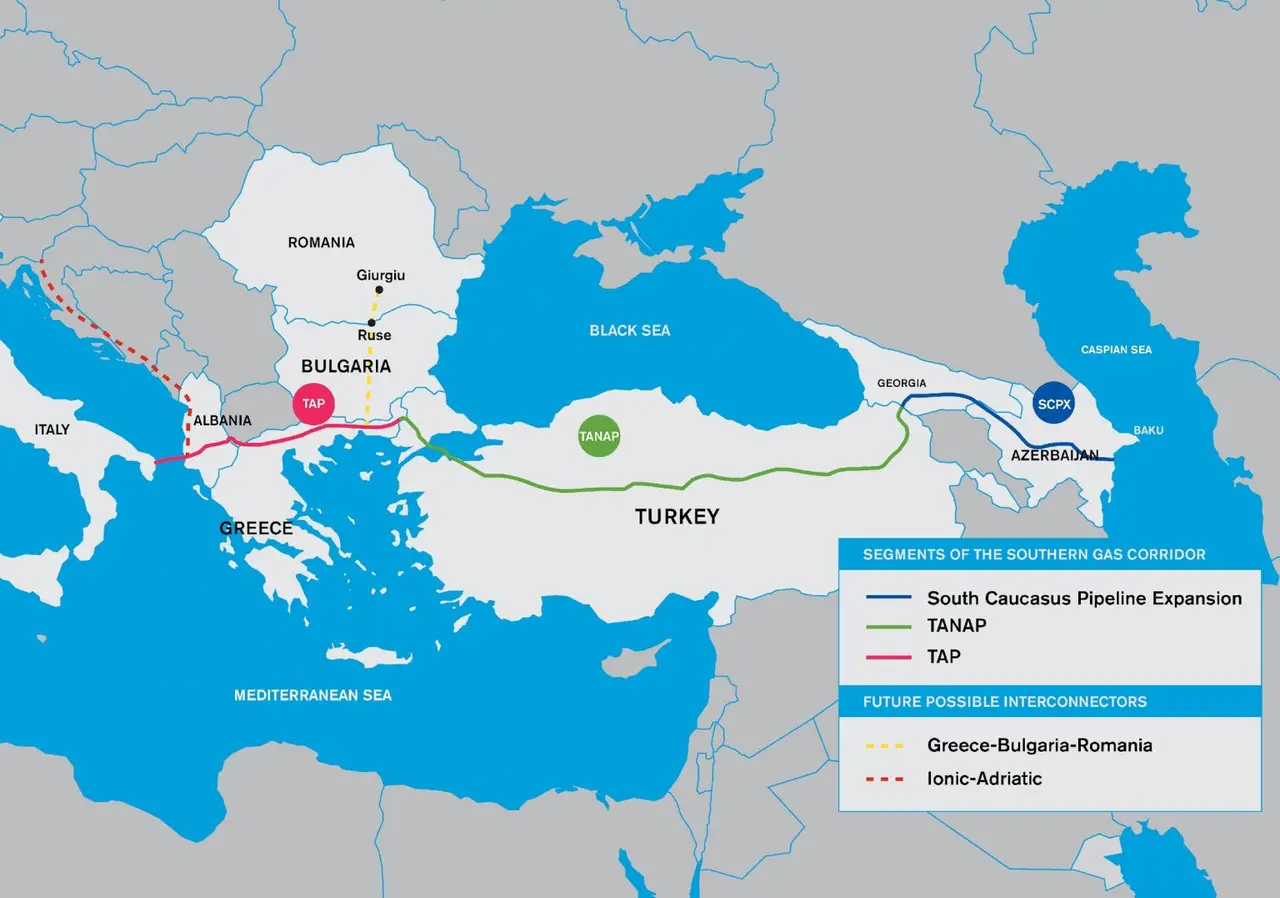
Illustration: Map of the Southern gas Corridor
3. The role of Transit States in the SGC
While the SGC is often framed as a diversification success, most recently called “fruitful” by European Energy Commissioner Dan Jørgensen on a visit to Azerbaijan following the Iran war and the effects it has on EU energy policy, its functioning ultimately depends on a chain of transit countries, adding a further geopolitical complexity (Pacheco, 2026). Rather than constituting a simple bilateral relationship between the EU and Azerbaijan, the corridor stretches across Georgia, Turkey, Greece, Albania and Italy (European Commission, n.d.-a).
Among these, Turkey occupies a particularly pivotal position. As the host of the Trans-Anatolian Pipeline (TANAP), which forms the central segment of the corridor, Türkiye effectively acts as the geographical and strategic bridge between the Caspian region and European markets (Siddi, 2017). This position provides Ankara with significant geopolitical leverage, as it practically becomes an indispensable transit hub through which Azerbaijani gas must pass before reaching the EU (Siddi, 2017). In this sense, the goal of eliminating geopolitical exposure as seen with Gazprom is a myth. Instead, the SGC, shifts part of the EU’s dependency from a dominant supplier (Russia) to a more complex network that includes an array of transit actors.
Türkiye’s role is further amplified by its broader ambition to establish itself as a regional energy hub. Due to its strategic position, Turkey refuses to apply western sanctions on Russia. Concretely this creates a vicious loophole for the EU, where Russian sourced gas still enters the EU market via Turkey’s pipelines and LNG terminals (Tavelishvili, 2025; Tovima, 2025). This is particularly concerning for Brussels, especially at a time when EU–Türkiye relations are already strained amongst others due to the ongoing democratic backsliding and the unresolved Northern Cyprus conflict. This redirection is also felt in energy diplomacy where beyond Russian and Caspian gas, it is also an important actor for Middle Eastern gas, becoming not only a transit country but a central node in regional energy governance.
Other than Turkey, most transit countries are considered geopolitically stable. The real tension remains with Azerbaijan’s fragile geographical situation and the persisting hostile conflict with Armenia. Additionally, the risk always increases with more transit countries as is the case with the SGC with a total of six transit countries. At the same time, transit countries are not merely sources of risk, but also beneficiaries of the corridor. Bulgaria illustrates an extreme case where before over 90% of its gas needs was covered with Russian imports. Today, between 50-60% comes from the SGC and the rest comes from LNG through Greece and Turkey (Interfax, 2025; Slavov, 2025). Greece is similar, although less extreme, in 2021 Russia accounted for 41% of Greece’s natural gas imports, alongside 21% of crude oil imports and 96% of hard coal imports (International Energy Agency, 2023). The fact that it has multiple import options meant that it was already less vulnerable than Bulgaria when the energy crisis hit (European Commission, n.d.-a). The result in both countries though is clear, there is a certain degree of alignment between EU diversification goals and the regional partners, reinforcing the corridor’s political viability.
4. Diversification or Dependency? The Limits of the Southern Gas Corridor
Although SGC contributes to reducing reliance on Russian gas, it does not fundamentally resolve the EU’s structural vulnerability in its high external energy dependence being a resource-scarce continent. For this reason, the strategy to diversify its suppliers is the most useful. In this, Azerbaijan is part of the broader REPowerEU plan but is not a significant dependency like other partners. For instance, Eurostat notes that in 2026, gas imports came mainly from Norway (30%), the United States (17%), Algeria (14%), and Russia (14%), Azerbaijan not even included as a separate entity at around 3-4% EU gas imports, so not even in the top four suppliers (Abnett, 2026). This is not to say that Azerbaijan is irrelevant, it most certainly is, most notably for Southern and Central European countries but overall it represents a small amount.
The partnership with Azerbaijan is not without diplomatic tensions. In April 2025, Illham Aliyev criticized the EU’s climate regulations calling out its “ban on fossil fuel financing” and the EU’s unwillingness to engage in “long-term gas purchase contracts”. In his remarks he indicated that Azerbaijan “should not look only to the west” and that they “can look to the east, to the south” showing deteriorating signs in their relationship (Bagirova, 2025). When the Iran crisis hit at the end of February 2026, the EU backed down in its gas import authorisation rules adopting a more flexible and pragmatic approach to avoid further supply chain disruptions (Abnett, 2026).
In the quest for strategic autonomy, many call out the EU for having sacrificed its values and norms and being too “soft” on Azerbaijan. In October 2024, the European Parliament passed a resolution condemning Azerbaijan’s human‑rights record and even called for the EU to end its gas dependency on Baku and suspend the EU–Azerbaijan energy‑partnership MoU (Switzerland–Armenia Association, 2024). This, among others, came after Azerbaijan’s 2023 military offensive in Nagorno‑Karabakh and the mass displacement of Armenians, which has been accused of violating international law (Switzerland–Armenia Association, 2024). Civil society actors and watchdogs have also warned that the EU’s push for new infrastructure loans and the Southern Gas Corridor expansion risks enriching an oligarchic elite linked to corruption schemes such as the “Azerbaijani Laundromat,” while making Europe more dependent on an illiberal regime (CEE Bankwatch Network, 2017; Van den Bossche, 2024).
In sum, although it is a smaller and less systematically dominant actor than Russia, it remains a strategic supplier whose interests do not necessarily align with those of the EU. As discussed, Azerbaijan’s status as a hydrocarbon-dependent rentier state incentivises the use of energy exports as instruments of foreign policy, enhancing its geopolitical leverage. The EU’s sacrifice on normative commitments and Von der Leyen’s ambition of becoming the first “geopolitical commission” shows the EU’s more pragmatic approach driven by immediate security concerns (European Commission, 2019). Such pragmatism risks creating the perception that normative considerations can be subordinated to strategic interests, thereby potentially undermining its credibility as a value-based international actor (Manners, 2002).
Conclusion
Russia’s “war on energy” was a “watershed moment” for the Union (European Commission, 2022). The subsequent energy shock has resulted in a profound transformation of both policy and discourse. As this essay has shown, the SGC has played a significant role in this shift by contributing to short-term diversification, particularly enhancing resilience in vulnerable regions such as Southeast and Central Europe. The goal of bypassing Russian infrastructure has therefore materialized and reduced the EU’s immediate exposure to a single dominant supplier.
However, this has not come without downsides. For one, its overall impact remains structurally constrained which explains why Azerbaijan is not in the EU’s top suppliers. Its limited capacity, geographical concentration and continued reliance on transit countries (most notably Turkey) highlights that diversification does not automatically equate independence. This reflects a broader reality: As a resource-scarce region, the EU cannot fully escape external reliance but can only seek to manage and balance it. While Baku presents itself as a reliable partner, its hedging foreign policy, regional assertiveness, and domestic governance raise questions about the long-term sustainability and ethical consistency of the EU’s normative approach. The growing willingness of the EU to prioritise energy security over normative commitments signals a shift toward a more pragmatic, interest-driven external policy.
At the same time, this analysis has important limitations. This essay has largely prioritized infrastructure and supply diversification which does not fully capture the broader transformation of the EU’s energy system, particularly the accelerating role of renewables. Additionally, with the new highly pertinent developments in the Middle East, energy dynamics are rapidly changing once again, making this analysis constrained by the early-stage nature of post-2022. Future studies could assess comparative analyses with other suppliers such as LNG imports from the US or pipeline gas from Norway and Algeria, which would enable a more comprehensive understanding of EU energy policy. To this end, it would be interesting to analyse whether the EU’s pursuit of energy security will ultimately reinforce or undermine its identity as a normative power in international affairs.
References
Abnett, K. (2026, March 12). EU to soften gas authorisation rules to help secure LNG supplies, diplomats say. Reuters.
https://www.reuters.com/business/energy/eu-soften-gas-authorisation-rules-help-secure-lng-supplies-diplomats-say-2026-03-12/
Bagirova, N. (2025, April 9). Azerbaijan urges EU to reassess finance restrictions on gas corridor expansion. Reuters.
https://www.reuters.com/business/energy/azerbaijan-urges-eu-reassess-finance-restrictions-gas-corridor-expansion-2025-04-09/
Bösch, F. (2014). Energy diplomacy: West Germany, the Soviet Union and the oil crises of the 1970s. Historical Social Research, 39(4), 165–185. https://doi.org/10.12759/hsr.39.2014.4.165-185
CEE Bankwatch Network. (2017, September 6). Azerbaijan’s Laundromat scandal raises concerns over the EU’s growing business ties with the authoritarian regime. https://bankwatch.org/press_release/azerbaijan-s-laundromat-scandal-raises-concerns-over-the-eu-s-growing-business-ties-with-the-authoritarian-regime
European Commission. (2019, November 27). Speech by President-elect von der Leyen in the European Parliament plenary on the occasion of the presentation of her College of Commissioners and their programme (SPEECH/19/6408). https://ec.europa.eu/commission/presscorner/detail/es/speech_19_6408
European Commission. (2022, September 14). State of the Union 2022.
https://commission.europa.eu/strategy-and-policy/state-union/state-union-2022_en
European Commission. (2025, September 10). State of the Union 2025. https://commission.europa.eu/strategy-and-policy/state-union/state-union-2025_en
European Commission. (n.d.-a). Diversification of gas supply sources and routes.
https://energy.ec.europa.eu/topics/energy-security/diversification-gas-supply-sources-and-routes_en
European Commission. (n.d.-b). REPowerEU.
https://commission.europa.eu/topics/energy/repowereu_fr
Farrell, H., & Newman, A. L. (2019). Weaponized interdependence: How global economic networks shape state coercion. International Security, 44(1), 42–79. https://doi.org/10.1162/isec_a_00351
Griffiths, S. (2019). Energy diplomacy in a time of energy transition. Energy Strategy Reviews, 26, Article 100386. https://doi.org/10.1016/j.esr.2019.100386
Gustafson, T. (1985). Soviet negotiating strategy: The East-West gas pipeline deal, 1980–1984. RAND Corporation. https://www.rand.org/content/dam/rand/pubs/reports/2007/R3220.pdf
International Crisis Group. (2023, October 5). Responding to a humanitarian catastrophe in Nagorno-Karabakh.
https://www.crisisgroup.org/stm/europe-central-asia/caucasus/nagorno-karabakh-conflict/responding-humanitarian-catastrophe-nagorno
International Energy Agency. (2022, March 3). A 10-point plan to reduce the European Union’s reliance on Russian natural gas. https://www.iea.org/reports/a-10-point-plan-to-reduce-the-european-unions-reliance-on-russian-natural-gas?
International Energy Agency. (2023). Greece 2023. IEA.
https://www.iea.org/reports/greece-2023
International Energy Agency. (n.d.). Azerbaijan energy profile. IEA.
https://www.iea.org/reports/azerbaijan-energy-profile/overview
Interfax. (2025). Azerbaijan suspends gas supplies to Bulgaria for technical reasons – Bulgargaz.
https://interfax.com/newsroom/top-stories/109005/
Longuève, E (2026, February 12). From military victory to diplomatic expansion: Azerbaijan’s foreign policy strategic evolution. Sciences Po CERI.
https://www.sciencespo.fr/ceri/en/news/from-military-victory-to-diplomatic-expansion-azerbaijan-s-foreign-policy-strategic-evolution/
Manners, I. (2002). Normative power Europe: a contradiction in terms?. JCMS: Journal of common market studies, 40(2), 235-258.
Ministry of Foreign Affairs of the Republic of Azerbaijan. (2016, October 20). A look at the 25-year period of independence and modern foreign policy priorities. https://mfa.gov.az/en/news/a-look-at-the-25-year-period-of-independence-and-modern-foreign-policy-priorities
Pacheco, M. (2026, March 3). EU praises Azerbaijani gas partnership amid energy disruption triggered by Middle East crisis. Euronews.
https://www.euronews.com/my-europe/2026/03/03/eu-praises-azerbaijani-gas-partnership-amid-energy-disruption-triggered-by-middle-east-cri
Reuters. (2026, March 17). Ukraine accepts EU offer to help restore Druzhba pipeline. https://www.reuters.com/business/energy/ukraine-accepts-eu-offer-help-restore-druzhba-pipeline-2026-03-17/
Rogov, K. (2022, June 30). Putin’s war against Ukraine: A step toward moving Russia east. Wilson Center.
https://www.wilsoncenter.org/blog-post/putins-war-against-ukraine-step-toward-moving-russia-east
Siddi, M. (2017). The EU’s botched geopolitical approach to external energy policy: The case of the Southern Gas Corridor. Geopolitics. https://doi.org/10.1080/14650045.2017.1416606
Slavov, G. (2025, September 25). Bulgaria to suspend Russian gas transit for short-term contracts in 2026, prime minister says. Reuters.
https://www.reuters.com/business/energy/bulgaria-suspend-russian-gas-transit-short-term-contracts-2026-prime-minister-2025-09-25
State Oil Company of the Azerbaijan Republic (SOCAR). (n.d.). Southern Gas Corridor.
https://socar.de/en/socar-2/southern-gas-corridor/
Switzerland–Armenia Association (GSA). (2024, October 24). European Parliament denounces Azerbaijan.
https://gsa.swiss/european-parliament-denounces-azerbaijan/
Trans Anatolian Natural Gas Pipeline (TANAP). (n.d.). Southern Gas Corridor.
https://www.tanap.com/en/southern-gas-corridor
Trans Adriatic Pipeline AG. (n.d.). The Southern Gas Corridor.
https://www.tap-ag.com/about-tap/the-big-picture/the-southern-gas-corridor
Tavelishvili, S. (2025). Turkey’s strategic role in European energy security: Implications of the energy sector for political cooperation. The Near East and Georgia, 17, 405–414. https://doi.org/10.32859/neg/17/405-414
Tovima (2025, August 9). Turkey’s stance risks undermining EU plan to ban Russian gas. https://www.tovima.com/world/turkeys-stance-risks-undermining-eu-plan-to-ban-russian-gas/
Umbach, F. (2023, March 30). The European Union’s LNG supply security. GIS Reports.
https://www.gisreportsonline.com/r/eu-lng
Van den Bossche, T. (2024, November 21). Human rights violations in Azerbaijan: the European Union and the Council of Europe must act! European Centre for Law and Justice.
https://eclj.org/geopolitics/eu/violations-des-droits-de-lhomme-en-azerbaidjan-lunion-europeenne-et-le-conseil-de-leurope-doivent-agir-
Illustrations/Figures:
SOCAR Germany. (n.d.). Southern Gas Corridor [Map]. /api/wp-media/2021/05/Southern-Gas-Corridor-SOCAR.jpg