
If this trajectory continues, hostage diplomacy will not remain an aberration. It will become part of the operating logic of a more transactional and more coercive international order.
1. Introduction
1.1 People as Leverage
In recent years, the detention of foreign nationals has re-emerged as a salient feature of contemporary international relations dynamics. Commonly referred to as ‘hostage diplomacy’, this practice operates at the State level and involves the arrest, detention, or sentencing of individuals to extract political concessions (Declaration Against Arbitrary Detention in State-to-State Relations, 2026). These range from sanctions relief to prisoner exchanges for financial gains, diplomatic recognition or broader strategic leverage. In the current international environment, coercion increasingly extends into the physical vulnerability of individuals, whose liberty and security become instruments within geopolitical disputes.
Foreign nationals, dual citizens, political detainees and civilian captives have consequently become both targets and tools of leverage in disputes that range from bilateral negotiations to open armed conflict. This pattern reflects deeper shifts in the structure of the international system: as great-power rivalry intensifies, sanctions regimes expand and large-scale warfare re-enters the geopolitical landscape, incentives for asymmetric forms of pressure growth. Thus, hostage diplomacy represents a coercive strategy that is relatively low-cost yet potentially high impact, particularly in contexts where conventional military or economic escalation carries significant risks.
The recent escalation involving Iran makes this trend even more visible. What had often been treated as a contained pattern of ‘judicialized’ coercion, such as arrests, politicised trials, and selective releases, now sits within a wider landscape of interstate military confrontation (Global Affairs Canada, 2025; Landay, 2026). The result is the intensification of this phenomena: as conflict deepens, detainees and dual nationals may acquire even greater strategic value.
1.2 From Wrongful Detention to Hostage Logic
At the formal level, hostage diplomacy is usually distinguished from classic hostage-taking. The latter is more openly associated with armed groups or wartime abductions, and it is explicitly prohibited under international humanitarian law. Article 34 of the Fourth Geneva Convention is unequivocal:
“The taking of hostages is prohibited.” (International Committee of the Red Cross [ICRC], 1949/2025, Art. 34)
State hostage diplomacy, by contrast, operates through legal form: the individual is attested, prosecuted, sentenced or held under the language of national security, espionage, or public order, rather than openly ‘kidnapped’ in the conventional sense. Yet in practice, the moral and strategic distinction is narrower than the legal one. The Initiative Against Arbitrary Detention in State-to-State Relations explicitly identifies the arbitrary arrest or sentencing of foreign nationals for diplomatic leverage as a growing abuse, particularly where dual citizens are used as pawns to extract international concessions (Global Affairs Canada, 2025). When detention is intended to compel another government to change behaviour, it operates according to the same coercive logic, even if presented through judicial procedure: the cell replaces the tunnel, the courtroom replaces the armed raid, and the rhetoric of sovereignty replaces the open threat, but the coercive mechanism remains recognisably similar.
This grey zone is precisely what makes the practice so durable. States that engage in hostage diplomacy benefit from plausible deniability. They can claim that their judiciary is independent, that the detainee violated domestic law, or that foreign criticism amounts to interference in internal affairs. That ambiguity slows collective responses and weakens deterrence. It also creates a policy trap for democratic governments: if they refuse to negotiate, their citizens may remain imprisoned for years; if they do negotiate, they may unintentionally confirm that the tactic works. The result is a perverse incentive structure in which humanitarian urgency is weaponised and the cost of repetition is often lower than the cost of restraint.
1.3 Why is coercion working again
The central question, then, is not simply why some regimes detain foreign nationals, but why this tactic has become strategically attractive again in the current international environment. The answer lies in a convergence of structural weaknesses.
- First, enforcement is fragmented. International law condemns both hostage-taking and arbitrary detention, but the mechanisms available to punish violators are slow, politically dependent, and unevenly applied.
- Second, democracies are vulnerable to domestic pressure in ways that more authoritarian systems are not. Public campaigns, press coverage, and the visible suffering of detainees’ families generate intense demands for action, making political leaders more likely to seek negotiated solutions even when they know such solutions may produce long-term costs.
- Third, every successful swap creates a ‘market signal’: it suggests that detaining individuals can yield sanctions relief, financial transfers, prisoner exchanges, or political recognition.
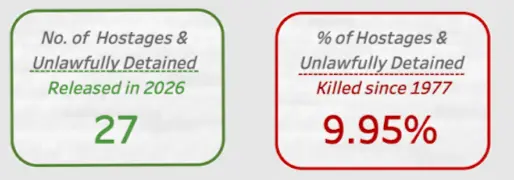
Figure 2: Numerical data of recent hostage-taking cases, source: https://hostageaid.org/hostage-metrics-engine/
Note to the graphic team related to figure 2: is it possible to create a better graphic?
“Hostage diplomacy is now a low-risk form of asymmetric warfare” (Briggs, 2021).
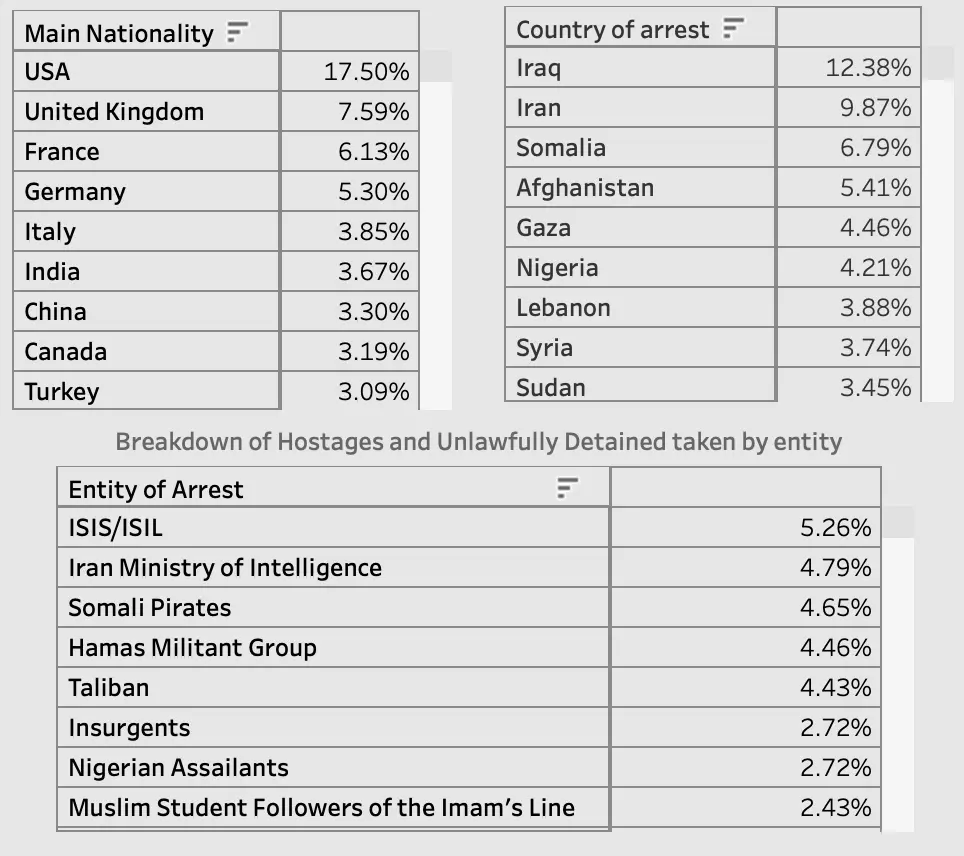
Figure 3: Map overview of the main nationality of hostages and unlawfully detained (shown as colours and shades) and the Country where they are held (shown through dots), source: https://hostageaid.org/hostage-metrics-engine/
2. The Case of Iran: current escalation and detainees’ risks
2.1 Iran Before Open War: Judicialized Coercion
Among contemporary cases, Iran remains one of the clearest and most consequential examples of state hostage diplomacy. For years, the Islamic Republic has detained foreign nationals and dual citizens (especially those with Western ties) under charges such as espionage, collaboration with hostile governments, or threats to national security (Global Affairs Canada, 2025; Reuters, 2025). The major example related to Iran’s use of human beings as leverage and its deep historical roots in U.S.-Iran relations is the 1979-1981 Iran hostage crisis, when Iranian students seized the U.S. Embassy in Tehran and held American diplomats hostage for 444 days (U.S. Department of State, Office of the Historian, n.d.). The pattern is well established: arrest, opaque legal proceedings, restricted consular access, prolonged detention, and eventual release only when wider diplomatic incentives align. Iran’s refusal to recognise dual nationality further deepens the vulnerability of detainees, because it allows Tehran to deny outside governments a fuller protective role while preserving maximum leverage over the individual case. Reuters reported on March 3, 2026, that at least six American citizens or legal permanent residents were being held in Iran, while advocacy groups warned that thousands of dual U.S.-Iranian nationals in the country could be exposed to heightened danger in the context of the widening conflict.
Iran’s significance lies in the way detention is framed and institutionalised. Through formal legal procedure and security-based prosecutions, the State embeds coercion within a judicial framework that allows it to deny political intent while still deriving diplomatic leverage from those held in custody. The result is a system in which the judiciary does not merely punish alleged wrongdoing but becomes part of a broader coercive architecture. This is why Iran has become a paradigmatic case: it shows how hostage logic can be embedded within legal procedure rather than outside it.
The September 2023 U.S.-Iran detainee deal captured this logic with unusual clarity. Five Americans were released from Iranian detention as part of an arrangement that also involved the transfer of roughly $6 billion in Iranian funds from South Korea to Qatar and the release of Iranians held in the United States (The Iran Primer, 2023). the political lesson was difficult to miss: detention had bargaining value. From a humanitarian standpoint, the deal secured the release of prisoners. From a strategic standpoint, however, it also reinforced the perception that holding foreign nationals can produce meaningful concessions. That is the central dilemma of hostage diplomacy: the immediate moral imperative to bring people home can coexist with the longer-term risk of making future detentions more likely.
2.2 Iran after Escalation: when war deepens the incentive
If the pre-2025 pattern showed how Iran used detention as calibrated leverage in a tense but still open negotiating environment, the events of 2025 and 2026 suggest something even more troubling: military escalation does not necessarily weaken hostage diplomacy; it may strengthen it. On June 21, 2025, U.S. forces struck Iran’s three main nuclear sites, directly joining Israel’s campaign against Iranian targets. As the confrontation widened in 2025-2026, detention did not recede into the background. On the contrary, as diplomatic channels narrowed and the conflict expanded regionally, the strategic value of detainees increased. Advocates warned that foreign and dual nationals in Iran faced heightened risk, underscoring a crucial dynamic: escalation does not displace hostage diplomacy. It can amplify it. Once coercive diplomacy shifts into open confrontation, individuals in custody may become even more politically significant within an increasingly volatile bargaining environment.
For this reason, Iran should not be treated merely as one case among several. It is indeed the pivot as it illustrates the full continuum of contemporary coercion: legal ambiguity, diplomatic bargaining, sanctions pressure, military escalation, and the persistent political utility of human captives. It shows that hostage diplomacy persists across phases of conflict, adjusting to changing levels of confrontation and serving as a durable instrument of coercive adaptation.
2.3 Why the Iran case matters beyond Iran
The Iranian case matters beyond its immediate regional context because it illustrates how leverage is being reimagined in contemporary geopolitics. In a truly rules-based system, detaining foreign nationals for political gain would carry prohibitive diplomatic costs. Today, such costs exist but are often manageable, as deterrence remains limited when releases are still tied to concessions. Iran’s experience is not unique in kind, but it is unusually clear, making visible the coercive logic that appears in various forms in Russia, Venezuela and conflict settings, such as Gaza.
The broader lesson is stark: hostage diplomacy is increasingly embedded within a harsher political normality, where weak enforcement and fragmented multilateralism converge to reward coercive behaviour.
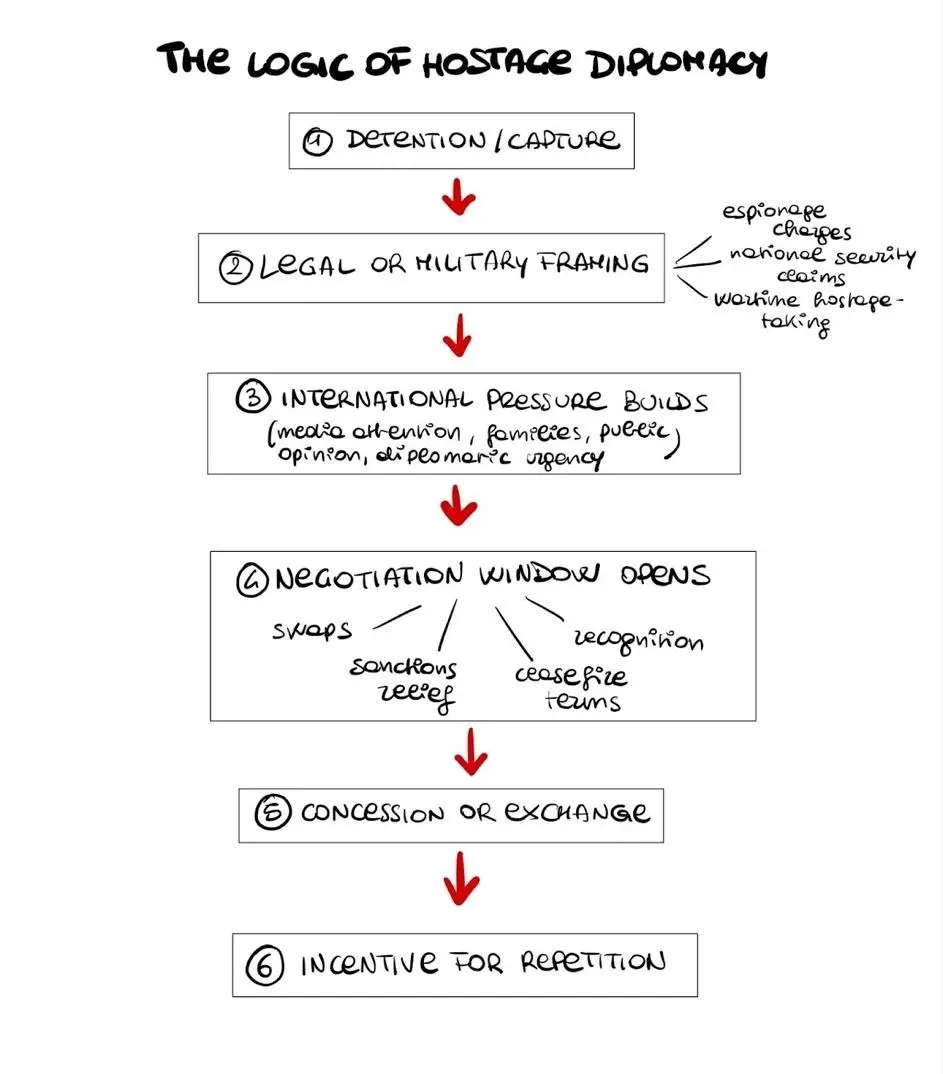
Figure 4: The phases of the logic of hostage diplomacy
Note to the graphic team related to figure 4: next to the boxes “3. International pressure builds” and “4. Negotiation window opens” it needs to be added a vertical box with the sentence “Each successful resolution may also reinforce the tactic” + better visualization graphic
3. Other international recurrences and correlated evidence
Taken together, these cases show that hostage diplomacy has become a recurring instrument of coercive bargaining across diverse political and conflict settings. UN human rights experts describe hostage-taking and politically motivated detention as practices “on the rise,” involving both state and non-state actors and including situations such as Russia, Venezuela, and the mass abductions linked to the October 7, 2023 attacks (Office of the United Nations High Commissioner for Human Rights [OHCHR], 2025).
What changes across contexts is the form, spacing between opaque judicial proceedings and wartime captivity. On the other side, the function remains constant: captivity becomes the leverage. In policy terms, the United States’ ‘Wrongful Detention’ risk indicator captures this logic in a functional language (U.S. Department of State, n.d.): linking different contexts without collapsing their political distinctions.
Figure 5: Data overview of the main nationality of hostages and unlawfully detained, the Country where they are held, and the entity that detained them, source: https://hostageaid.org/hostage-metrics-engine/
Note to the graphic team related to figure 5: is it possible to create a better graphic of these still reporting the main data?
3.1 Russia’s case: Wrongful Detention as Strategic Pressure
As previously stated, in the Russian case wrongful detention functions as a low-visibility but high-impact tool of strategic pressure, turning individual prisoners into assets within a wider confrontation with the West. As evidence of this, The March 2023 arrest of journalist Evan Gershkovich on espionage charges immediately securitised the case and elevated its political value (Reuters, 2023). His closed-door trial in 2024 reinforced the perception that detention could generate leverage under conditions of legal opacity (Reuters, 2024a).
U.S. officials framed the case as overtly political, describing it as “the Kremlin using American citizens to achieve its political objectives” (Reuters, 2024a). Within great-power rivalry, detention thus operates below the threshold of open military escalation while still producing strategic pressure that governments must address.
3.2 Venezuela’s Case and Peculiarities: Coercion, Sanctions, and Regime Survival
Venezuela illustrates a more transactional form of coercion in which detained foreigners are interwoven into negotiated exchanges between states. In December 2023, the United States granted clemency to Alex Saab, a close ally of President Nicolás Maduro, and released him to Caracas in return for the freedom of ten Americans held in Venezuelan detention, including several whom the U.S. considered wrongfully detained (Reuters, 2023), highlighting how detention can be traded for political concessions. U.S. officials continued to describe multiple Americans as wrongfully detained in 2025 and called for their release, underscoring that individuals remain negotiable assets beyond a single swap (Reuters, 2025a). This pattern shows how hostage logic persists as a pragmatic instrument in negotiations shaped by sanctions, legitimacy, and diplomatic engagement.
3.3 Gaza’s Case: Hamas, Hostages, and Wartime Bargaining
The Gaza case makes the coercive logic unmistakable: human beings are embedded directly in war diplomacy. After October 7, 2023, when 251 hostages were seized, captivity became central to ceasefire negotiations and exchange arrangements (Reuters, 2025b). Truces were extended in connection with phased releases, placing hostages at the core of both negotiation terms and timing (Reuters, 2023c).
Despite the clear prohibition under international law, later ceasefire phases continued to link releases to large-scale exchanges, confirming the enduring bargaining value of captives (Salem et al., 2025). The case reinforces this article’s central argument: coercion through individuals remains politically effective, and negotiated releases, while lifesaving, can sustain the incentive structure that enables it (OHCHR, 2025).
4. International Responses: Recognition Without Deterrence?
If hostage diplomacy has become a recurring instrument of coercion, international responses over the past five years suggest that governments increasingly recognise it as a distinct and growing policy problem. What is less clear is whether recognition has translated into effective deterrence.
At the multilateral level, Canada’s 2021 Declaration Against Arbitrary Detention in State-to-State Relations marked a significant normative step (Global Affairs Canada, 2021). By explicitly condemning the use of detention for diplomatic leverage and framing it as a structural problem rather than a series of isolated consular disputes, the initiative sought to move the issue from bilateral crisis management toward coordinated resistance. Over time, dozens of states have endorsed the declaration, signalling broad normative alignment. Yet the declaration is politically binding rather than legally enforceable, and its deterrent capacity ultimately depends on sustained collective action.
Parallel discussions within the G7 and the European Union have reinforced the idea that wrongful detention is embedded in wider geopolitical competition. The language has hardened, and awareness has grown. Governments no longer treat such cases as unfortunate anomalies; they increasingly recognise them as deliberate coercive tactics.
At the national level, the United States has developed one of the most institutionalised responses. The formal designation of a case as “wrongful detention” activates a specialised interagency process coordinated by the Office of the Special Presidential Envoy for Hostage Affairs. In 2025, an executive order introduced additional tools to sanction and restrict foreign actors involved in politically motivated detentions. As the White House declared, “No American should fear being taken as a political pawn” (The White House, 2025). In February 2026, the United States formally designated Iran a state sponsor of wrongful detention, reinforcing the intention to attach reputational and material costs to systematic coercive practices. Targeted sanctions have also been imposed on specific Russian and Iranian officials linked to wrongful detention (U.S. Department of State, 2024).
Collectively, these initiatives reflect a shift from reactive crisis management toward institutionalised deterrence. Governments now explicitly name the practice and attempt to price it. Yet hostage diplomacy persists, and in some contexts appears to be expanding.
The reasons lie less in rhetorical weakness than in structural constraints. Enforcement mechanisms operate slowly and remain politically mediated, while detention produces immediate bargaining leverage. Coordination across states is uneven, as strategic interests diverge and collective signalling lacks consistency. Humanitarian urgency further complicates deterrence: democratic governments face intense domestic pressure to secure releases, often under public scrutiny and compressed timelines. Each successful exchange, though lifesaving, can also reinforce the perception that detention yields tangible results.
This asymmetry limits deterrence effectiveness. Sanctions, designations and joint statements impose reputational and economic costs, but they function indirectly and incrementally. The leverage created by holding an individual in custody is immediate, personal and politically visible. Where those gains are perceived as manageable relative to imposed costs, the incentive structure endures.
International responses today are more developed than a decade ago. Norms have been clarified, frameworks established and targeted tools expanded. Yet these mechanisms primarily manage consequences and mitigate harm. They do not consistently alter the calculus that makes detention usable as leverage in a fragmented international system.
Recognition has advanced. Structural deterrence remains incomplete. And hostage diplomacy thrives in this precise space between legal clarity and political fragmentation.
5. Conclusion
What is emerging from the cases previously examined is not merely a breakdown of international order, but it is something more unsettling – the consolidation of a harsher one: an environment in which coercion works often enough to be repeated, and in which human beings themselves are increasingly turned into instruments of negotiation.
Hostage diplomacy is often described as a symptom of disorder; moreover, like an erosion of norms, a failure of enforcement, a regression to coercive politics. Yet the persistence of this practice suggests a different reading. It is not chaos that sustains it, but calculation. Detentions are repeated because they produce results often enough to justify repetition. The logic survives because it remains politically usable.
Across such diverse actors and contexts – regimes, conflicts and ideological divides – the mechanism is strikingly similar. Whether cloaked in judicial procedure or executed through armed capture, the deprivation of liberty still becomes leverage. In this logic, courts, prisons and conflict zones serve the same strategic function, which is transforming human vulnerability into bargaining power.
The real danger is therefore not only that hostage diplomacy violates established rules. It is that it works often enough to begin reshaping expectations. In this view, when coercive detention yields concessions (even sporadically), it risks normalising itself as an accepted bargaining tool within geopolitical competition.
What we are witnessing is not simply disorder, but adaptation: a system in which coercion, calibrated below the threshold of open war, becomes embedded in diplomatic practice. And more, a system in which legal condemnation coexists with strategic repetition. If this trajectory continues, hostage diplomacy will not remain an aberration. It will become part of the operating logic of a more transactional and more coercive international order. One in which human beings themselves are increasingly treated not as protected subjects of law, but as instruments of negotiation.
Reference List
Alterman, J. B., & Rezaian, J. (2025, June 4). Combating state hostage taking and wrongful detention. Center for Strategic and International Studies. https://www.csis.org/analysis/combating-state-hostage-taking-and-wrongful-detention
Briggs, R. (2021, December 3). Five steps to tackle state hostage-taking. Chatham House. https://www.chathamhouse.org/publications/the-world-today/2021-12/five-steps-tackle-state-hostage-taking
Brookings Institution. (2024, January 17). Postponed: The threat of hostage-taking: A conversation with U.S. Special Presidential Envoy for Hostage Affairs Roger Carstens. https://www.brookings.edu/events/the-threat-of-hostage-taking-a-conversation-with-u-s-special-presidential-envoy-for-hostage-affairs-roger-carstens-and-other-experts/
Global Affairs Canada. (2021, February 15). Launch of Declaration Against Arbitrary Detention in State-to-State Relations. Government of Canada. https://www.canada.ca/en/global-affairs/news/2021/02/launch-of-declaration-against-arbitrary-detention-in-state-to-state-relations.html
Global Affairs Canada. (2025, February 10). Arbitrary detention in state-to-state relations: Report. Government of Canada. https://www.international.gc.ca/world-monde/issues_development-enjeux_developpement/human_rights-droits_homme/arbitrary-detention-arbitrare-report-rapport.aspx?lang=eng
International Committee of the Red Cross. Geneva Convention (IV) relative to the protection of civilian persons in time of war. https://ihl-databases.icrc.org/assets/treaties/380-GC-IV-EN.pdf
International Committee of the Red Cross. (2025). Geneva Convention (IV) relative to the protection of civilian persons in time of war: Commentary on Article 34. https://ihl-databases.icrc.org/en/ihl-treaties/gciv-1949/article-34/commentary/2025
International Committee of the Red Cross. (2025, 8th October). FAQ: About the ICRC and the hostages held in Gaza. https://www.icrc.org/en/document/FAQ-icrc-work-hostages-gaza
International Committee of the Red Cross. (n.d.). Rule 96. Hostage-taking. https://ihl-databases.icrc.org/en/customary-ihl/v1/rule96
Landay, J. (2026, March 3). Americans in Iran face possible peril as U.S.-Israeli strikes grow, detainee advocates warn. Reuters. https://www.reuters.com/world/middle-east/americans-iran-face-possible-peril-us-israeli-strikes-grow-detainee-advocates-2026-03-03/
Office of the United Nations High Commissioner for Human Rights. (2025, March 4). Hostage-taking is a cruel game, Special Rapporteur on torture calls for immediate release of hostages worldwide. https://www.ohchr.org/en/press-releases/2025/03/hostage-taking-cruel-game-special-rapporteur-torture-calls-immediate-release
Osborn, A., Lebedev, F., Papachristou, L., Hunnicutt, T., & Shalal, A. (2024, August 2). Evan Gershkovich and Paul Whelan released in Russia–West prisoner swap. Reuters. https://www.reuters.com/world/lawyer-ex-us-marine-whelan-jailed-russia-says-she-cannot-confirm-his-whereabouts-2024-07-31/
Parraga, M., Armas, M., & Hunnicutt, T. (2023, December 21). Americans freed by Venezuela in U.S. prisoner swap land at Texas base. Reuters.
us-has-freed-close-ally-venezuela-president-swap-jailed-americans-ap-2023-12-20
Psaledakis, D., Landay, J., & Symmes Cobb, J. (2025, March 7). U.S. determined there are 9 wrongfully detained Americans in Venezuela. Reuters.
rubio-monday-determined-there-are-9-wrongfully-detained-americans-venezuela-2025-03-07
Reuters. (2023, November 27). Israel–Hamas war: The hostage deal and ceasefire explained. israelhamas-war-hostage-deal-ceasefire-gaza-2023-11-22
Reuters. (2023, March 30). Who is Evan Gershkovich, the American reporter arrested in Russia? Who-is-evan-gershkovich-american-reporter-arrested-russia-2023-03-30
Reuters. (2024, June 26). Russia starts secret trial for U.S. reporter Gershkovich on spy charges. https://www.reuters.com/world/europe/gershkovich-appears-with-shaved-head-before-start-closed-trial-russia-2024-06-26/
Reuters. (2025, October 8). Israeli hostages held by Hamas in Gaza: A timeline of the crisis. https://www.reuters.com/world/middle-east/israeli-hostages-rescues-releases-ceasefire-talks-2025-10-08/
Salem, M., Al-Mughrabi, N., & Mackenzie, J. (2025, January 20). Hamas frees hostages, Israel releases Palestinian prisoners on day one of ceasefire. Reuters. https://www.reuters.com/world/middle-east/gaza-ceasefire-hostage-release-set-begin-2025-01-19/
The Iran Primer. (2023, September 20). Iran-US prisoner swap: Detailed fact sheet. https://iranprimer.usip.org/index.php/blog/2023/sep/20/iran-us-prisoner-swap-fact-sheet-details
The White House. (2025, September 5). Strengthening efforts to protect U.S. nationals from wrongful detention abroad. https://www.whitehouse.gov/presidential-actions/2025/09/strengthening-efforts-to-protect-u-s-nationals-from-wrongful-detention-abroad/
United Nations. (1979, December 17). International Convention against the Taking of Hostages. https://treaties.un.org/doc/db/terrorism/english-18-5.pdf
U.S. Department of State. (n.d.). About us: Special Presidential Envoy for Hostage Affairs. https://2021-2025.state.gov/about-us-special-presidential-envoy-for-hostage-affairs/
U.S. Department of State. (2023, April 27). Sanctioning Russian Federation and Iranian state actors responsible for the wrongful detention of U.S. nationals. https://2021-2025.state.gov/sanctioning-russian-federation-and-iranian-state-actors-responsible-for-the-wrongful-detention-of-u-s-nationals/
U.S. Department of State (n.d.). Travel advisories. https://travel.state.gov/en/international-travel/travel-advisories.html
U.S. Department of State. (2024). U.S. government response to wrongful detention. https://2021-2025.state.gov/u-s-government-response-to-wrongful-detention/