
Italian centri sociali (social centres) are self-managed spaces that emerged from the grassroots, typically in abandoned public or private buildings, which are reclaimed and opened to the community. They host political and cultural activities (concerts, film screenings, rehearsal rooms, libraries) and, in many cases, neighbourhood services, such as after-school programmes, canteens and legal advice desks. An important legal distinction is between the CSOA (centri sociali occupati autogestiti, occupied self-managed social centres), where occupation is also a political strategy and the CSA (centri sociali autogestiti, self-managed social centres in spaces made available by a public body), which use spaces formally granted by a public body (Mudu, 2004).
In recent years, several social centres have been evicted: Leoncavallo in Milan (21 August 2025), Askatasuna in Turin (18 December 2025) and Spin Time in Rome (29 July 2026). The authorities invoked the restoration of legality, the protection of property owners and public order, yet these spaces also provide welfare from below, such as affordable housing and food.
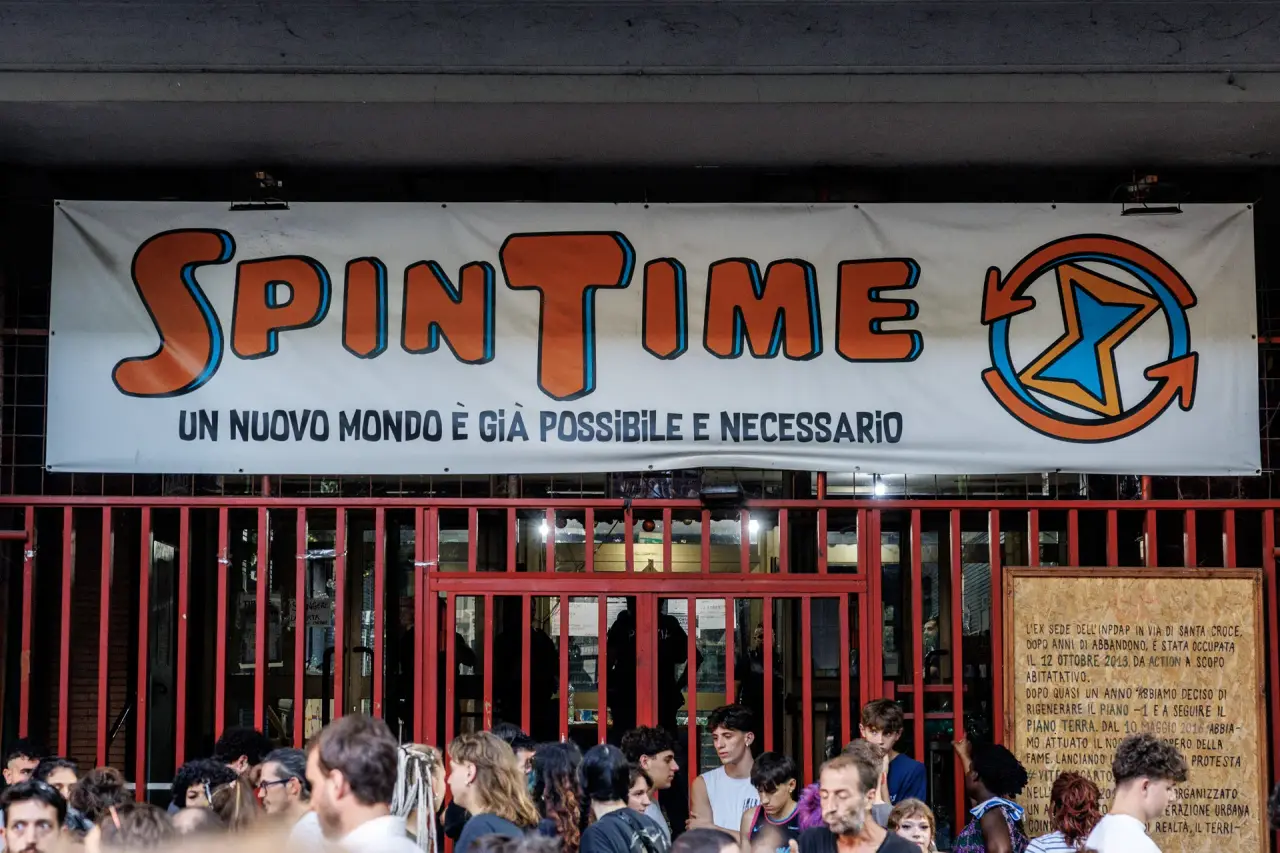
Spin Time Labs is the former Inpdap headquarters, owned by a public real-estate fund managed by InvestiRE SGR and occupied since October 2013 by the housing movement Action. It housed over 400 people and, on the lower floors, had spaces open to the public: a tavern, an auditorium, a recording studio, a carpentry workshop, a coworking space, and an after-school programme. On 29 July 2026, a fire led to the evacuation of the building, which was declared unfit for use and then seized by the Digos (the State Police unit responsible for public order investigations) both because of the occupation and to investigate the fire. Residents were left without housing and set up a permanent sit-in in front of the building. At dawn, the Civil Protection service put up emergency tents and cots and distributed water and meals, while the most vulnerable families were moved to nearby facilities. On 10 August, about 150 people were still camping outside, and on 21 August activists announced that all 356 former residents had found temporary accommodation.
The International and European Legal Framework
The International Legal Framework
Article 11(1) of the International Covenant on Economic, Social and Cultural Rights (ICESCR), which binds Italy, recognises everyone’s right to an adequate standard of living, including housing (UN General Assembly, 1966). States may choose how to implement it and may do so progressively, within available resources. The UN Committee on Economic, Social and Cultural Rights (CESCR) has clarified that legal security of tenure is a core element of this right and that it extends to “informal settlements, including occupation of land or property”. Eviction is therefore not prohibited, but it must be lawful, reasonable and proportionate, respect procedural safeguards such as genuine consultation, adequate notice and access to legal remedies, and must not leave people homeless. Where those affected cannot provide for themselves, the State must take all appropriate measures, to the maximum of its available resources, to ensure alternative housing.
The European Legal Framework
At the European level, the Council of Europe offers two systems of protection. The first is the European Convention on Human Rights (ECHR), which protects both the occupants, under Article 8, and the owner, under Article 1 of Protocol No. 1 (Council of Europe, 1950). The Convention gives no right to a home, but Article 8 protects the home a person already has, whether rented, owned or simply lived in. Anyone at risk of eviction should be able to ask an independent court to assess proportionality, including the risk of homelessness. The State may still evict unlawful occupants, since Article 8 does not oblige it to tolerate an unlawful occupation indefinitely, but it must consider their situation, especially if they are vulnerable. The protection is weaker, however, when the person seeking possession is a private owner, since legislation may already have struck the balance between owner and occupier.
The second system is the revised European Social Charter, which Italy ratified in 1999 and which includes the right to housing (Article 31) (Council of Europe, 1996). It requires States to prevent homelessness and to carry out evictions with adequate notice, alternative accommodation and legal remedies. However, the Charter is monitored by a committee of experts whose conclusions are nonbinding, and individual residents cannot lodge a complaint, so it serves mainly as a benchmark.
Spin Time in the Italian Legal Framework
Articles 17 and 18 of the Italian Constitution may protect the cultural and recreational activities provided by social centres, as they guarantee the rights to peaceful assembly and freedom of association, respectively.
Article 17 protects peaceful, unarmed gatherings, while Article 18 allows citizens to associate freely for purposes not prohibited by criminal law. The activities carried out within social centres are not inherently illegal. Social centres are born as places of political and cultural association and as spaces separate from institutions.
In certain scenarios, the nature of social centres might lead to occupying a space, and, from there, its legality is determined by the decision of the owner of said space. If a public space is occupied, it can be decided that the social centre is authorised to utilise it if it’s considered to be more useful to the community that way. Without this legalisation process, the social centre automatically becomes illegal, and authorities will demand a judicial seizure. Another important activity that is carried out within social centres is the political kind. It is in these spaces that protests and dissident expressions find a place to ignite themselves.
Attempts to regularise Spin Time began in 2023, when the Gualtieri administration inserted the building into its “Casa Comunale” (communal house) plan, a move blocked by the owners, who wish for the property to become a luxury hotel.
Organisations such as Save the Children emphasised the importance of Spin Time as an “experience of civil participation”. It appealed to the right of every kid to live in adequate psychological and material conditions, following the seizure that resulted in about 400 homeless people, of whom at least 90 are minors. It criticised the measures taken as not sufficient to ensure those rights. According to a study from the University of Milan-Bicocca, thanks to Spin Time’s social model, every euro invested in its regulation would generate around two euros in social value.
On August 7, Mayor Gualtieri signed an ordinance to provide extraordinary housing assistance for 60 days. The ordinance provided for the replacement of the accommodations available until then and provided those left homeless on the streets with priority given to families with children and vulnerable individuals. The ordinance stipulates that the registered residents will be transferred to accommodation facilities identified within the municipality or, if insufficient, throughout the metropolitan area. To assist the families, a temporary reception desk was also set up near Spin Time. The ordinance also stipulated the continuity of schooling for the affected minors.
Four days later, the municipality announced that housing had been found for 160 people. However, many of these people were relocated to housing far from the neighbourhood, and therefore from their workplaces and loved ones. For this reason, some residents rejected alternative housing.
After the seizure of the building, the Spin Time community continued to gather in a permanent presence on the streets, resuming its cultural and civic initiatives. The community wishes Rome’s administration to reach an agreement with the property owners; Gualtieri confirmed his intention to purchase the building to regularise the space following the process explained at the beginning of the paragraph, even though he admitted that the negotiations will take a long time.
Spin Time and Politics
The case of Spin Time is part of a broader political debate, started already in 2023 as Prime Minister Giorgia Meloni announced a campaign against occupations, and Spin Time appeared to be on the Interior Ministry’s list of 126 buildings to be cleared (Bonato, 2026), and as one has read earlier, it corresponds to the same year in which Gualtieri started his attempts to regularise the building. Following the fire in July 2026, more right-leaning parties such as Fratelli d’Italia and Lega opposed the residents’ return to the building. By contrast, the Movimento 5 Stelle (M5S) criticised the use of the fire to justify the eviction, while the Partito Democratico (PD) and Alleanza Verdi e Sinistra (AVS) called for a prompt solution for the affected families (ANSA; 2026).
Support for Spin Time has also come from organisations working in social welfare and civil society, which have emphasised the consequences of the eviction for the residents. The CGIL trade union, which has supported the initiative since its beginning, provided accommodation for residents evacuated from the building at its office (ANSA, 2026; RaiNews, 2026). Save the Children Italia also highlighted the precarious housing conditions faced by more than 90 children and called for a stable solution that would safeguard their rights while preserving the centre’s social and cultural activities (Save the Children Italia, 2026). These interventions brought attention to the social consequences of the eviction, particularly for children and families whose housing, education and community relationships had been disrupted.
The debate has further expanded through the involvement of political representatives and prominent cultural figures. Councillor Massimiliano Smeriglio and Member of the European Parliament Ilaria Salis attended the September demonstration. Their interventions have increased the visibility of the case, extending the discussion beyond the legality of the occupation itself to include the future of the centre’s social and cultural activities and the responsibility of public institutions towards its former residents.
Conclusion
This brief did not intend to settle whether Spin Time was lawfully evicted, but to use it as a case study to observe Italian social centres through a legal lens. International and European standards do not prohibit eviction. They require it to be proportionate, procedurally fair, and not to leave anyone homeless, while protecting the owner’s peaceful enjoyment of their property. Italian law protects the activities of social centres but not the occupation that houses them. Thus, the seizure may well be lawful, and the open question is whether the State did enough for those affected. Further, the political divide over Spin Time shows that regularisation depends as much on will as on law. What is missing is therefore neither a legal basis nor a duty of care, but a lasting solution for the former residents, which the municipality’s plan to buy the building may yet provide.
References
ANSA. (2026, July 30). Incendio allo Spin Time, sequestro giudiziario dello stabile [Fire at Spin Time, judicial seizure of the building]. https://www.ansa.it/sito/notizie/cronaca/2026/07/30/incendio-allo-spin-time-sequestro-giudiziario-dello-stabile-_718f6af2-0c97-4b22-8419-29fc1a9c298d.html
Bonato, N. (2026, August 13). Perché il futuro di Spin Time è diventato un caso politico [Why the future of Spin Time has become a political case]. Pagella Politica. https://pagellapolitica.it/articoli/futuro-spin-time-caso-politico
Brnovic, T. (2024). Resilience in resistance: The Meloni government’s influence on Roman social centers. Trinity College Digital Repository.
Council of Europe. (1950). European Convention on Human Rights. 4 November 1950.
Council of Europe. (1996). European Social Charter (revised). 3 May 1996.
Italian Republic. (1948). Costituzione della Repubblica italiana [Constitution of the Italian Republic]. Senato della Repubblica. https://www.senato.it/sites/default/files/repository/Costituzione_ITALIANO.pdf
Mudu, P. (2004). Resisting and challenging neoliberalism: The development of Italian social centers. Antipode, 36(5), 917–941.
Pecorelli, V. (2015). Spazi liberati in città: i centri sociali. Una storia di resistenza costruttiva tra autonomia e solidarietà. Loughborough University / Università degli Studi di Milano-Bicocca.
RaiNews. (2026, September 19). Corteo a Roma per Spin Time, in 50mila in corteo: restituire il palazzo al pubblico[March in Rome for Spin Time, 50,000 marchers: give the building back to the public]. https://www.rainews.it/articoli/2026/09/corteo-a-roma-per-spin-time-in-50mila-in-corteo-restituire-il-palazzo-al-pubblico-6a37b29f-4ba7-4bf7-9661-11da14aaa607.html
Save the Children Italia. (2026, July 31). Spin Time: necessario garantire subito una soluzione stabile per gli oltre 90 minori coinvolti [Spin Time: a stable solution must be guaranteed immediately for the more than 90 minors involved]. https://www.savethechildren.it/press/spin-time-necessario-garantire-subito-una-soluzione-stabile-gli-oltre-90-minori-coinvolti
United Nations General Assembly. (1966). International Covenant on Economic, Social and Cultural Rights. 16 December 1966.